Procure to pay covers everything from a requisition being raised to a supplier being paid, and in 2026 most organizations face three viable paths: buy a source-to-pay suite, extend the procurement modules already sitting inside the ERP, or build an agent layer that orchestrates both. The right answer depends far less on feature checklists than on integration cost, which routinely equals or exceeds first-year license fees. Suites win on breadth and supplier networks. ERP extension wins when your master data and approval policy already live there. An agent layer wins when the gap is judgment work, not missing screens.
Every procure to pay evaluation I have sat in on this year has followed the same shape. Somebody opens with a feature grid, the incumbent ERP vendor gets a defensive slide, and roughly ninety minutes in a finance lead asks the only question that matters: what does this cost us once it is actually connected to everything? Nobody in the room has a number.
This guide is about that number, and about the decision it should drive.
If you want the mechanics of how agent-driven procurement works in practice, quote parsing, three-way matching, exception triage and human approval thresholds, that ground is already covered in our companion guide on AI procurement automation and cycle time. This piece assumes you accept that automation in procurement works. The open question is what you should own, what you should rent, and what should never leave your system of record.
Where procure to pay actually begins
Ask five procurement leaders where the process starts and you will get two camps. One says the requisition. The other says sourcing, on the grounds that price is decided long before anyone raises a PR.
Both are right about their own scope, and the distinction is not academic, because it determines which product category you should even be looking at. Procure to pay, strictly read, runs from requisition through purchase order, receipt, invoice and payment. Source to pay wraps that with spend analysis, category strategy, sourcing events, supplier qualification and contract award. If your leakage is in price negotiation and category coverage, buying purchase order software will not fix it, and no amount of purchase order automation will recover a badly negotiated rate card.
The practical test we use with clients: pull twelve months of spend and ask how much of it was competitively sourced. If most spend is on contracts negotiated years ago and never revisited, your problem is upstream and you need strategic sourcing software or a serious spend analysis software capability before you touch the transactional layer. If spend is well sourced but invoices still take two weeks to clear, your problem is downstream and accounts payable automation software is the higher-return investment.
Sourcing and procurement software is sold as one thing and used as two, which is why so many suites end up with a heavily used transactional half and a sourcing half that opens twice a year.
Most mid-market organizations we work with have the second problem. They have decent contracts and a transactional process held together by spreadsheets, email approvals and one very patient person in finance. Ask how many people it takes to process invoices in your busiest month; the answer usually locates the bottleneck faster than any maturity assessment.
The 2026 forcing function: you no longer control the timing
For years the procure to pay decision could be deferred indefinitely. That option closed.
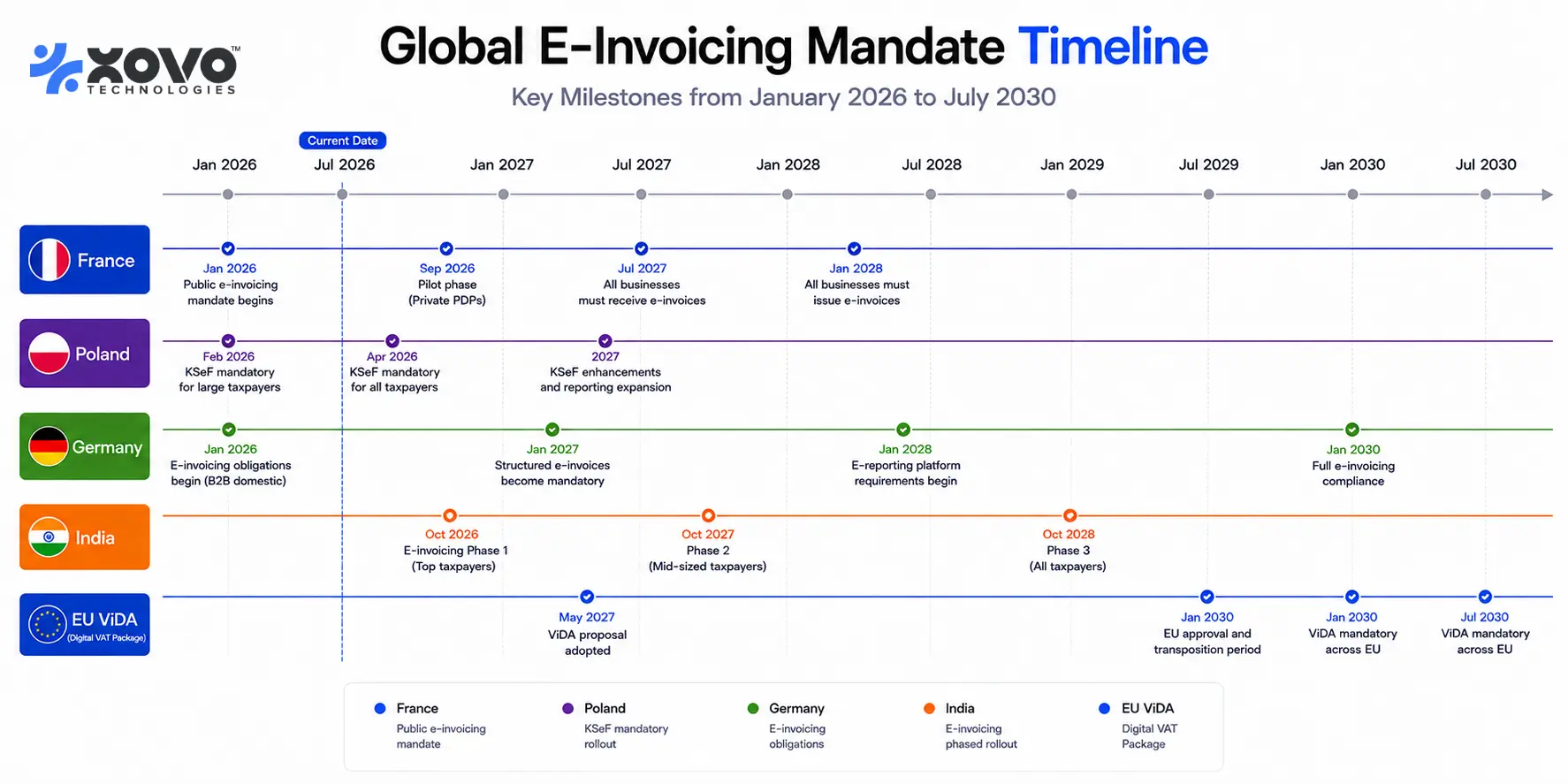
Structured e-invoicing mandates are now arriving on fixed statutory dates across the jurisdictions most mid-market and enterprise buyers trade in, and they apply to the invoice format itself, not to your internal workflow. You cannot negotiate the date with a tax authority.
| Jurisdiction | What changes | Date | Who is hit first |
|---|---|---|---|
| France | All VAT-registered businesses must be able to receive structured e-invoices; large and mid-cap companies must issue via an approved platform | 1 September 2026 | Every French-established VAT-registered entity for reception; large and mid-cap for issuance |
| France | Issuance obligation extends to SMEs and micro-enterprises | 1 September 2027 | Smaller entities |
| Poland | KSeF clearance becomes mandatory for large taxpayers (turnover above PLN 200 million) | 1 February 2026 | Largest taxpayers, already live |
| Poland | KSeF mandatory for most remaining VAT-registered businesses | 1 April 2026 | Everyone else, already live |
| Germany | Obligation to issue e-invoices for businesses above EUR 800,000 turnover (receipt has been mandatory since January 2025) | 1 January 2027 | Larger German entities |
| Germany | Issuance obligation extends to all businesses | 1 January 2028 | Remaining entities |
| India | E-invoices must reach the Invoice Registration Portal within 30 days for taxpayers with AATO of INR 10 crore or more | In force since 1 April 2025 | Mid-size and larger Indian entities |
| EU (ViDA) | Structured e-invoicing to EN 16931 becomes mandatory for intra-EU B2B transactions under Council Directive (EU) 2025/516 | 1 July 2030 | Cross-border EU trade |
Two things follow from that table. First, France on 1 September 2026 is four weeks away as I write this, and the reception obligation is universal, which means even a UK or US parent with a small French subsidiary is in scope for that entity. Second, the direction is consistent enough that building a procure to pay stack in 2026 with no structured invoice ingestion path is a decision you will pay to reverse.
The pressure has also eased in places, which vendors rarely mention. Malaysia canceled its Phase 5 rollout and raised the exemption threshold from RM 500,000 to RM 1 million effective 1 January 2026, following the Prime Minister's 7 December 2025 announcement. Mandates slip. Plan for the dates that are already law, not the ones on a vendor roadmap slide.
The vendor market, sorted the way buyers actually experience it
Analyst quadrants group procurement software vendors by suite completeness. Buyers experience the market as five distinct commercial models with five different failure modes.
Full source-to-pay suites. Gartner evaluated 13 providers in its 2026 Magic Quadrant for Source-to-Pay Suites, published in January 2026, naming SAP, Coupa, Oracle, Ivalua, GEP and Zycus among the Leaders, with Coupa positioned highest on the Ability to Execute axis for a third consecutive year. SAP's pitch rests on SAP Business Network, which it describes as the largest supplier network in the source-to-pay market, spanning more than 190 countries. These are the source to pay procurement vendors with genuine end-to-end coverage, and they are also the ones whose implementations run longest.
AP and e-invoicing specialists. Basware, Medius, Tungsten and similar players sell depth in one place: getting invoices in, compliant, and matched. Basware was accredited as a Certified Platform by France's DGFiP, announced 13 January 2026, and acquired Australian AP automation provider Redmap on 17 December 2025. These are accounts payable software products first and procurement products second. If your problem is the invoice tail and the mandate calendar, these accounts payable automation solutions solve more of it per dollar than a suite will.
Orchestration and intake layers. Zip was named a Visionary in the same 2026 Magic Quadrant, described in its own announcement as the only agentic procurement orchestration platform on the list, with USD 371 million raised at a USD 2.2 billion valuation and around 7 million suppliers across its customer base. This category is procurement orchestration software in the literal sense: it does not replace your ERP or your suite, it sits in front of both and routes intake. It is the fastest-growing shape in the market and the one most likely to be mistaken for a suite in a demo.
Spend-management fintech. Ramp raised USD 750 million at a USD 44 billion valuation announced 4 June 2026, reporting more than USD 1.5 billion in annualized revenue across 70,000-plus businesses and roughly USD 200 billion in annualized purchase volume. Tipalti, Pleo and Payhawk occupy adjacent ground. These tools are excellent at card-led and tail spend and weak at direct materials, complex receipting and multi-entity tax logic.
ERP-native modules. SAP S/4HANA, Oracle Fusion Cloud Procurement, NetSuite, Dynamics 365 and Workday all ship procurement functionality you may already be licensed for. Oracle announced four new Fusion Agentic Applications inside Fusion Cloud SCM on 29 June 2026, including a Supplier Qualification Workspace. SAP has been rolling Joule agents into SAP Ariba Intake Management, Ariba Contracts and Fieldglass through the first half of 2026. This is the category most often dismissed in the first meeting and most often correct on the third. For plenty of groups the enterprise procurement software they need is already installed and paid for.
Below that tier sits a long tail of purchase order management software and saas procurement software aimed at smaller teams. Precoro publishes its list pricing, which is rare and useful as an anchor: Core from USD 499 per month billed annually, Automation from USD 999 per month, a standalone AP module from USD 499 per month, and custom Enterprise pricing. If someone in your organization is searching for the best procurement software and lands on a USD 6,000-per-year plan, that is what they found, and for a 40-person company it may genuinely be the right answer. There is no best procurement software in the abstract, only the one that matches your ERP topology and your exception profile.
The category names are a mess, and that costs you money
Half the bad shortlists I see started in a search box. Somebody types what they think they need, lands on a review site, and comes back with five products from three different categories, none of which solve the same problem. This is the translation table we hand clients before they build a longlist.
| What buyers search for | What the market actually sells | Where it belongs |
|---|---|---|
| purchase order software, purchase order system, purchase order management software | Transactional PO issuing, numbering and approval | Inside or directly beside the ERP |
| purchase order approval software, procurement approval software | Workflow routing, rarely a standalone product | ERP configuration or an intake layer |
| purchase order tracking software, procurement tracking software | Status visibility and reporting | Reporting layer, not usually a purchase |
| accounts payable software, accounts payable automation solutions | Invoice capture, matching, payment file generation | AP specialist or ERP module |
| invoice processing platforms, invoice management tools | Document capture plus workflow, increasingly sold with e-invoicing compliance | AP specialist or certified platform |
| strategic sourcing software, sourcing and procurement software | RFx, auctions, award scenario modeling | Source to pay suite |
| spend analysis software | Classification and category reporting on historical spend | Suite module or standalone analytics |
| procurement contract management software | Clause library, obligations, renewal alerts | Suite module or dedicated CLM; contract management in procurement is usually bought last |
| supplier onboarding software | Registration, qualification, banking and sanctions validation | Suite, ERP or specialist |
| procurement orchestration software | Intake routing across systems you already own | In front of everything else |
| procurement automation, procurement automation software | Umbrella term covering all of the above | Ask which stage of the cycle |
| enterprise procurement software, saas procurement software, procurement software tools | Marketing labels rather than categories | Ignore the label, ask what it writes to |
| AI procurement tools, AI sourcing tools, procurement AI agent | Anything from a smarter search box to a workflow that posts to the ledger | Ask what it writes to, and with whose approval |
Two conclusions follow. Purchase order approval software and procurement approval software are almost never things you buy; they are configuration inside something you already own, and a vendor line-iteming them is charging you for a workflow engine you have. Purchase order tracking software and procurement tracking software are reporting problems wearing a product costume: if visibility is being sold to you as a license, ask what data it needs and where that data sits today.
The distinction that does carry commercial weight is between invoice processing platforms and full suites, because they price on different units. Invoice management tools price on document volume. Suites price on named users, spend under management, or both, which is why the same organization gets wildly different quotes from the two. Phrases like procurement software tools tell you nothing about scope, and procurement automation software is not one market; it is at least four.
Procurement contract management software is the row where duplication is worst, because legal has frequently already bought a CLM that nobody in procurement was told about.
Option one: buy a suite
The case for buying is straightforward. You get requisition, PO, receipting, invoice, contract repository, supplier portal and reporting in one data model, with one vendor accountable for it working. For a business running four ERPs after three acquisitions, that single data model is worth real money, because the alternative is building it yourself.
The case against is cost and rigidity, and both are usually understated at the point of signature.
Vendr, which publishes negotiated pricing data from its own transactions, reported in February 2026 an average Coupa contract value of USD 95,000 across 123 purchases, with segment bands running USD 50,000 to USD 200,000 annually for small and mid-market, USD 200,000 to USD 800,000 for mid-market and enterprise, and USD 800,000 to USD 2,000,000 or more for large enterprise. The implementation figures in the same dataset are the ones people miss: USD 25,000 to USD 100,000 at the small end, USD 100,000 to USD 400,000 in the middle, and USD 400,000 to USD 1,500,000 or more at the top. Vendr also reported average savings of 22.75 percent against initial quotes, with 15 to 25 percent lower annual pricing on multi-year commitments.
Read those two rows together. At mid-market scale, implementation is roughly half of first-year subscription. At enterprise scale it approaches parity. That is before you have paid anyone internally.
Suites are also moving fast on the AI question, which changes the buy calculus. Coupa launched Coupa Compose and Coupa Catalyst at Inspire 2026 on 12 May 2026, including Navi Agent Studio, a no-code environment for building agents, and it attached an outcome-based pricing model and forward deployed engineers to the offering. That matters if you were planning to build a procurement AI agent yourself, because part of what you were going to build is now in the box.
Option two: extend the ERP you already run
Here is the question I get asked most often, usually with some embarrassment: our ERP already has a procurement module and nobody uses it, why is that?
In our experience it is almost never a capability gap. It is four other things, in roughly this order of frequency. The module was never configured past the default approval hierarchy, so it does not reflect how the business actually signs things off. Nobody licensed the requester seats, so casual buyers were never given access and went back to email. The supplier master was too dirty to trust, so buyers avoided the catalog. And the interface was designed for a full-time buyer, not for an engineer who orders test equipment twice a quarter.
None of those are fixed by buying different procurement software. They are fixed by configuration, licensing, data cleanup and a usable front door. I have watched an organization spend six figures replacing a purchase order system that would have worked fine with three weeks of workflow configuration and a supplier master deduplication run.
Extension is the cheapest option when three conditions hold: your ERP is a current release rather than an end-of-life one, your spend is concentrated in a small number of entities, and your approval policy is stable enough to encode once. Oracle and SAP are both shipping agentic capability directly into that layer now, which narrows the functional gap that historically justified a suite purchase.
The honest counter-case: if you are running SAP ECC or a heavily customized legacy Dynamics instance, extension is a trap. You will spend the same money and inherit a platform with a known end date. In that scenario the ERP upgrade is the project, and the procurement decision should wait behind it.
Option three: build an agent layer on top
The third option is the one this company builds, so treat what follows with appropriate skepticism and check the numbers yourself.
An agent layer does not replace the transactional system. It sits above whatever you already run, reads and writes through governed APIs, and takes on the judgment-heavy work that neither an ERP module nor a suite handles well: reading a supplier quote that arrived as a PDF in an email thread, triaging a price variance by pulling the contract and the receipt history, chasing a missing goods receipt, deciding which of four open POs an unreferenced invoice belongs to. Our AI Procurement Agent is built to run exactly in that position, with the ERP remaining authoritative.
Build makes sense in three situations. Your process is genuinely non-standard, so every suite requires customization that erodes the reason you bought a suite. Your volume is concentrated in exceptions rather than clean transactions, which is where license-per-seat pricing lines up badly with where the work actually is. Or you have already bought a suite, it works for the 70 percent, and you need to close the remaining 30 percent without a second platform. That last case is the most common reason clients call us.
The vocabulary here is badly inflated, so be specific with vendors. Agentic AI in procurement now covers everything from a smarter search box to a workflow that posts to the ledger without a human touching it. Agentic AI for accounts payable is the narrower and better-behaved version, because the inputs are documents and the outputs are postings you can reconcile. Ask any vendor selling either one what happens when the agent is wrong, and who finds out.
Build does not make sense if you lack a system of record. An AI agent for procurement with nowhere authoritative to write is a very expensive spreadsheet. The architectural pattern that works, and the guardrails it needs, is something we set out at length in our guide to agentic AI architecture and guardrails.
The decision matrix
Enterprise procurement software decisions get made on instinct far more often than anyone admits in the board paper, so this is the grid we actually walk clients through. Score each row honestly and the answer usually falls out of it.
| Decision factor | Buy a suite | Extend the ERP | Build an agent layer |
|---|---|---|---|
| Number of ERP instances | 2 or more, suite normalizes them | 1, extension is natural | Any, agent layer abstracts them |
| Process standardization | High, you can adopt vendor process | High, policy already encoded | Low, your process is the differentiator |
| Where the work sits | Volume of clean transactions | Volume of clean transactions | Exceptions, documents, chasing |
| Direct materials and receipting | Strong, especially Jaggaer and Ivalua | Strong, native to the ERP | Weak unless ERP handles receipting |
| E-invoicing compliance coverage | Bought, network included | Depends on ERP release and add-ons | Must be bought separately |
| Time to first measurable value | 7 to 14 months in our experience | 6 to 14 weeks if licenses exist | 8 to 16 weeks for a first workflow |
| Who owns it in year 3 | Vendor roadmap owns it | Your ERP team owns it | You own it, including the model layer |
| Exit cost | High, data and process both locked | Low, you already own the platform | Low to medium, agents are replaceable |
| Best fit | Multi-entity enterprise with fragmented spend | Single-ERP business with an underused module | Any org whose pain is judgment, not screens |
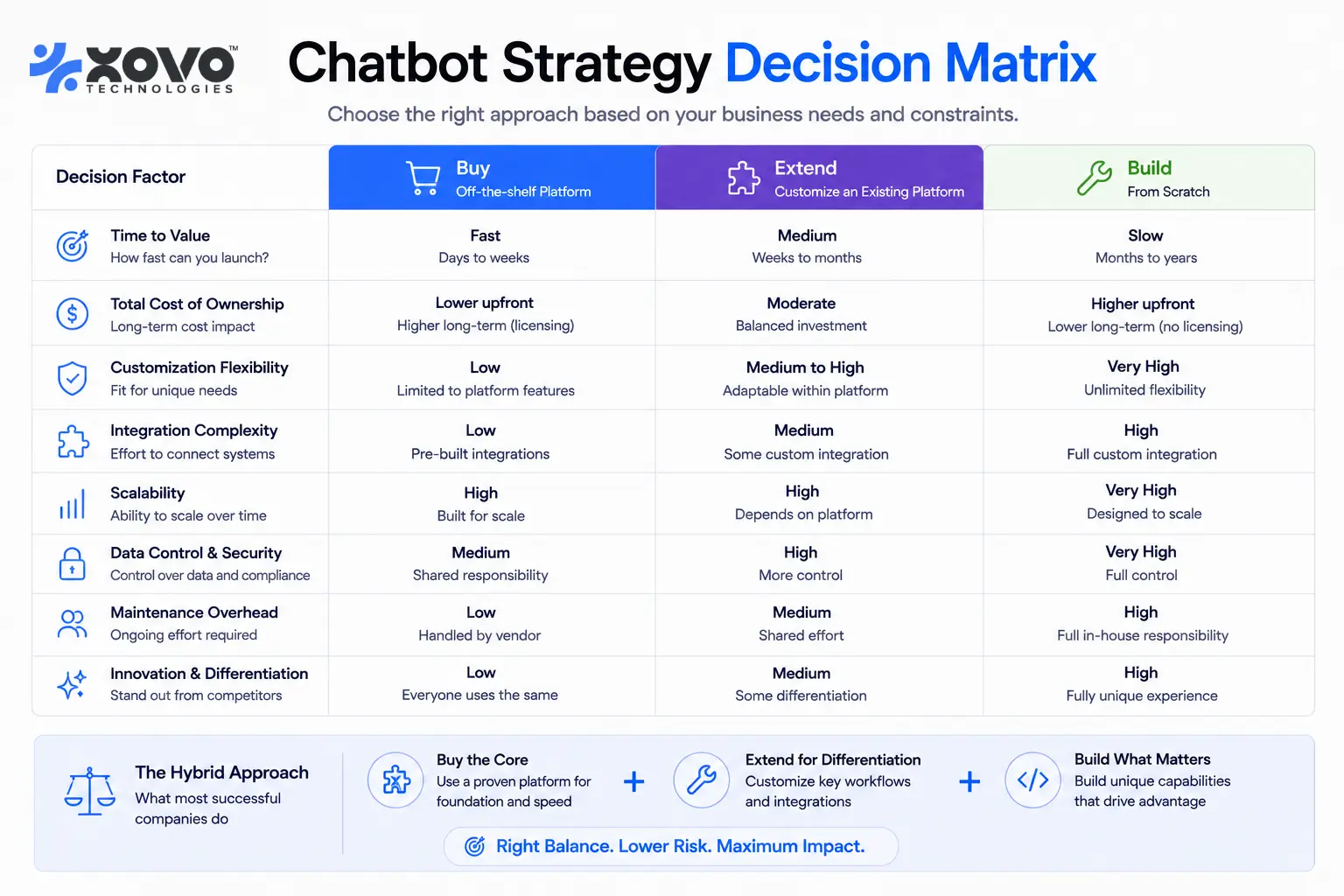
Nobody scores cleanly in one column. Most organizations that run this end up in a hybrid: extend the ERP for requisition and PO, buy a specialist for e-invoicing compliance, and put an agent layer across the exception queue. That combination is unfashionable because no vendor sells it, which is precisely why it tends to be cheaper.
What a procure to pay stack actually costs over three years
License price is the number in the proposal. It is rarely the largest number in the program.
The table below is a planning model for a mid-market business, roughly 400 to 800 employees, two ERP instances, around 30,000 invoices a year. Subscription and implementation bands for the suite column come from Vendr's February 2026 Coupa dataset. The small-vendor anchor comes from Precoro's published pricing. The internal effort and agent layer figures are XOVO's own engagement experience and are estimates, not published prices. Treat every cell as a range to be tested against your own quotes.
| Cost line, 3 years | Buy a suite | Extend the ERP | Build an agent layer |
|---|---|---|---|
| Subscription or license | USD 600k to USD 2.4m (USD 200k to USD 800k per year, mid-market to enterprise band) | USD 0 to USD 180k (incremental seats and modules) | USD 90k to USD 300k (model, infra, observability) |
| Implementation and system integrator | USD 100k to USD 400k, front-loaded in year 1 | USD 40k to USD 150k configuration | USD 150k to USD 450k build, phased |
| Integration work (both directions) | USD 80k to USD 250k, often outside the SI scope | Low, native | Included above, but rises with each ERP |
| Internal effort (backfill, testing, UAT) | 1.5 to 3 FTE-years | 0.5 to 1 FTE-year | 0.5 to 1.5 FTE-years |
| Data cleanup (supplier master, contracts) | USD 30k to USD 120k, unavoidable | Same, unavoidable | Same, unavoidable |
| E-invoicing compliance coverage | Usually bundled | Add-on or third-party PDP or PA | Third-party, USD 20k to USD 90k |
| Change fees and scope creep, years 2 to 3 | Material, vendor-rate-card driven | Low | Low, you hold the code |
| Realistic 3-year total | USD 900k to USD 3.2m | USD 150k to USD 500k | USD 300k to USD 900k |
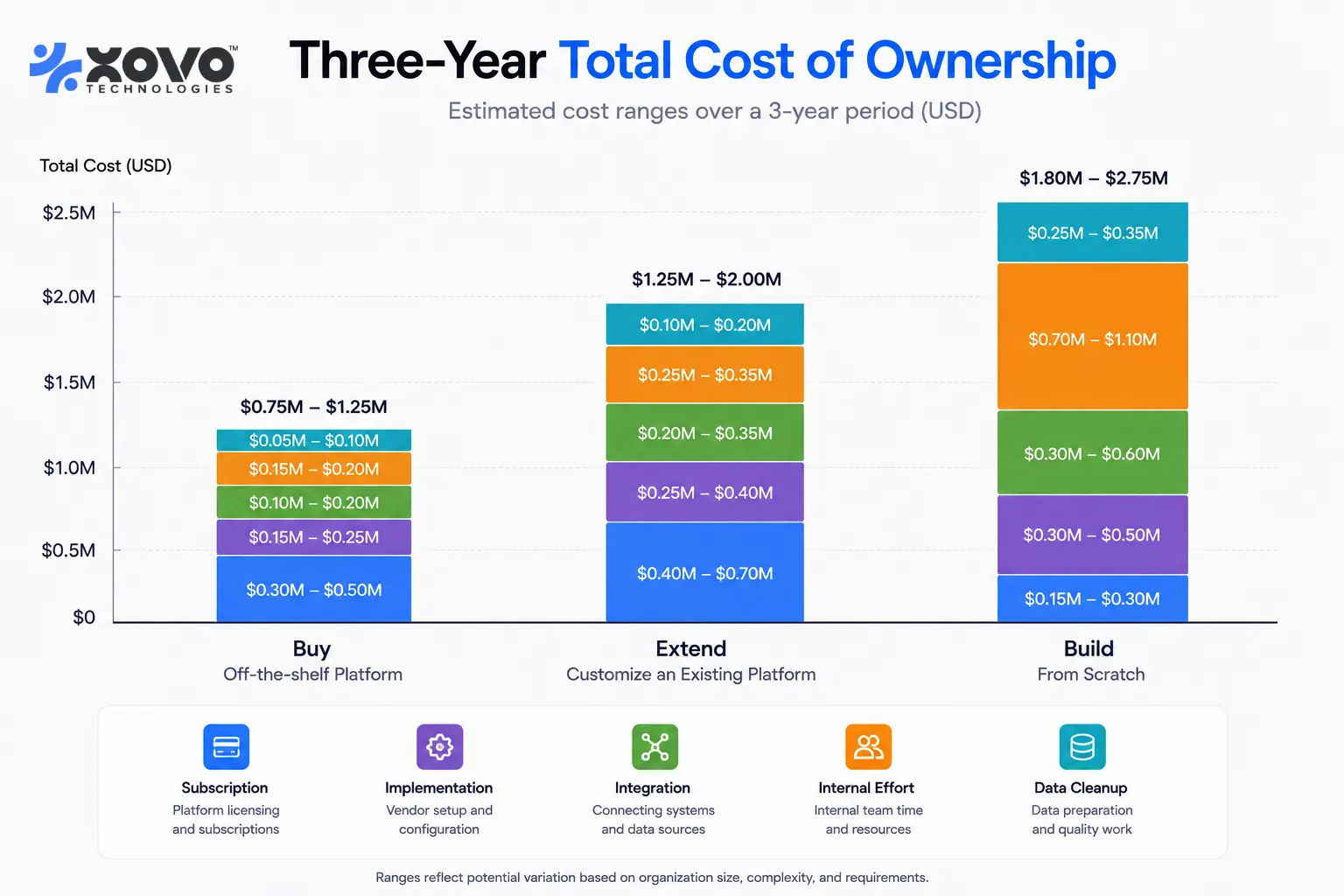
The row people argue with is integration, so let me defend it. Most procurement software vendors price the license precisely and the interface not at all, which is scope rather than dishonesty: their side of the boundary is genuinely all they can quote. In every suite rollout we have connected to, the statement of work covers the vendor's side of the interface and stops at the boundary. Everything on your side, the middleware, the identity mapping, the retry and idempotency logic, the reconciliation job that catches what the interface dropped overnight, is yours. That is where the USD 80,000 to USD 250,000 goes, and it is why first-year budgets get blown by teams who costed the license carefully and the plumbing not at all.
Accounts payable automation solutions are the cheapest row here to buy standalone and the easiest to remove later, which is why we usually recommend testing the market there first if you only have budget for one move.
The other line worth staring at is data cleanup. It appears in all three columns because it is not avoidable by any purchasing decision. Duplicate supplier records break matching regardless of which platform does the matching.
Who owns the integration layer after go-live?
You do. Almost always, and almost always by default rather than by decision.
The system integrator demobilizes 30 to 90 days after go-live. The vendor supports its own product up to its own API boundary. The middleware, the field mappings, the error queue and the nightly reconciliation between the procurement platform and the general ledger belong to whoever is left in the room, which is your team.
Make that explicit before signature. Three clauses are worth arguing for: a named support path for interface defects that is separate from application support, a commitment on API deprecation notice periods, and source access or full documentation for any custom integration code the SI writes, because you will be maintaining it. We have picked up too many engagements that began with a client unable to modify an interface built for them 18 months earlier because nobody had the mapping documentation.
If you are running an agent layer, the same rule applies with fewer illusions. You own it. The advantage is that you also own the code, so the fix is a pull request rather than a change request at a consulting day rate.
What must stay in the ERP, and what can move
This is the most useful table in this article, and the one that resolves most build-versus-buy arguments before they start. The principle is simple: anything that constitutes the financial record of truth stays. Anything that is judgment, document handling or chasing can move. Procurement and contract management data behave differently here, which is why they appear on separate rows.
| Capability | Where it belongs | Why |
|---|---|---|
| General ledger posting and period close | ERP, always | Auditability and statutory reporting live here |
| Supplier master record | ERP, always | One authoritative record; agents read and propose, never own it |
| Purchase order of record and commitment accounting | ERP | The PO is a financial commitment, not a workflow artifact |
| Goods receipt posting | ERP | Drives accruals and inventory valuation |
| Tax determination and e-invoicing submission | ERP or certified platform | Statutory liability; do not custom-build this |
| Payment execution and bank connectivity | ERP or treasury system | Segregation of duties and fraud controls |
| Approval policy definition | ERP or suite | Policy must be configurable by finance, not buried in code |
| Requisition intake and guided buying | Agent layer or intake tool | Usability problem, not an accounting one |
| Quote and invoice document extraction | Agent layer | Unstructured input is exactly what models handle well |
| Exception investigation and evidence assembly | Agent layer | The expensive human work; agent gathers, human decides |
| Supplier chasing and status follow-up | Agent layer | High volume, low judgment, no financial record created |
| Duplicate and anomaly detection | Agent layer, hard block into ERP | Fuzzy matching beats exact-match rules; the block stays in the ERP |
| Continuous supplier risk monitoring | Agent layer, feeding ERP flags | Signals change daily; the ERP is not a monitoring system |
Agentic AI for accounts payable lives entirely in the right-hand column of that table, which is the clearest way to explain the boundary to a finance director. Most accounts payable software assumes it owns the invoice; your ERP assumes it owns the liability. Settle which is true before you configure either, because that argument surfaced late has stalled more than one go-live we have been called into.
The line that gets crossed most often is the supplier master. A team builds an agent that creates supplier records to speed up onboarding, and eighteen months later there are two masters that disagree. Supplier onboarding software of any kind should propose records into the ERP with an approval step, never write them directly. On the risk monitoring row, the mechanics of continuous scoring against annual vetting are a topic in their own right, and we cover them separately in supplier risk management in 2026.
We have 400 suppliers on different payment terms. Does any of this survive that?
Yes, and the variety matters less than people fear, because payment terms are a data problem rather than a process problem.
What breaks automation is not 40 distinct terms. It is terms that exist only in a signed PDF and never made it into a structured field, so the system defaults everyone to net 30 and finance quietly overrides it. The fix is contract data extraction into structured fields, then term enforcement at invoice posting. That is unglamorous work, usually two to four weeks per few hundred contracts with an extraction pipeline and a human reviewing the output, and it pays for itself in early-payment discount capture alone. Whether those fields live in procurement contract management software or in six well-designed ERP fields matters far less than whether anyone maintains them after go-live.
Where the count genuinely bites is onboarding and the compliance calendar. Four hundred suppliers across several jurisdictions means several e-invoicing regimes, which is a strong argument for buying that specific capability from a certified platform rather than building it. Invoice processing platforms that already hold PDP or certified-platform status where you trade are worth more here than any feature comparison, and invoice management tools of that kind price on document volume, so their quotes move with your business in a way seat-based suites do not. It is also where a supplier network has real value: if a meaningful share of your suppliers are already transacting on SAP Business Network or a similar network, you inherit their connectivity instead of onboarding them one at a time.
Contract management in procurement is the piece that decides this. If your contracts are structured and your terms are enforced, 400 suppliers is a reporting problem. If they are not, 40 suppliers is already unmanageable.
How to avoid buying a suite that duplicates half your ERP
Run this before you shortlist, not after. It takes about a day and it has killed more bad purchases for our clients than any feature comparison.
List every capability in the RFP. Against each one, mark whether your ERP already does it, whether you are already licensed for it, and whether it is configured. Then price the suite against only the rows where the answer is no to all three. Most RFPs shrink by 40 to 60 percent under that treatment, and what remains is usually intake, e-invoicing compliance, supplier collaboration and analytics, none of which needs a full source to pay procurement platform.
Then ask the vendor a direct question and hold them to a written answer: which of these modules will require us to stop using the equivalent ERP function, and what happens to the data in it? A suite that runs alongside your ERP and a suite that displaces part of it are different projects with different costs, and the demo will not distinguish them.
Contract management in procurement is where this bites hardest, because legal, procurement and finance can each hold a partial version of the same agreement and none of them knows it.
The specific duplication to watch for is the requisition-to-PO path. Suites want to own it because it generates the transaction volume their pricing is based on. Your ERP already owns it because that is where commitment accounting lives. Running both means reconciling both, forever. If you already run purchase order management software or a native ERP module, purchase order automation belongs there; buying separate purchase order software on top is how organizations end up reconciling two numbering schemes and explaining it to an auditor.
Strategic sourcing software is the opposite case. It duplicates almost nothing in a typical ERP, which is why it is frequently the one module genuinely worth buying even when the rest of the suite is not.
Is a phased rollout genuinely cheaper, or just slower?
Genuinely cheaper, but not for the reason vendors give.
The saving from phasing automation in procurement is not in spreading spend across financial years. It is that phase one tells you what phases two and three should actually be, and that information is worth more than the sequencing. Every rollout we have run has changed shape after the first workflow went live, because the exception profile in production never matches the one described in the workshop.
The counter-case is real and I will state it. Phasing costs more when it forces you to build and then throw away temporary integrations, or when it stretches a program long enough that the sponsoring executive changes and priorities reset. If your phase one cannot deliver a measurable result inside a quarter, you are not phasing, you are stalling.
Our rule of thumb: phase one should be one workflow, one entity, one measurable metric, live within 90 days. For most clients that is invoice exception triage, because the baseline is easy to establish and the improvement is visible in the AP aging report within a few weeks. Our three-way matching case study walks through what that first phase looked like for one client.
What the vendor demo never shows you
Six things, consistently. I have sat through enough of these to make the list specific.
The demo runs on clean data. Most AI procurement tools look extraordinary on a curated dataset. Every supplier record is deduplicated, every catalog item is mapped, every PO has a receipt. Ask them to demo an invoice with a wrong PO number, a partial delivery and a currency mismatch, all at once, because that is your Tuesday.
The demo never shows the admin experience. You will see the buyer's screen, not the screen where someone maintains approval hierarchies across 60 cost centers. Ask to see a workflow being changed, timed.
The demo skips the ERP round trip. Data appears in the platform and everyone nods. Ask what happens when the ERP rejects the posting, where that error surfaces, and who is notified.
The demo has no volume. Approval queues look tidy with eight items. Ask for a reference customer with your invoice volume and talk to their AP team, not their CPO.
Pricing in the demo is per named user. Your actual cost driver may be transaction volume, supplier count, or spend under management, and the tiering on those is where the year-three surprise lives. Ask all shortlisted procurement software vendors to quote against your projected year-three volumes, not your current ones.
And on the agentic pitch, which now arrives badged variously as AI procurement tools, a procurement AI agent, or agentic AI in procurement: ask what the agent does when it is not confident. If the answer is a confidence score with no defined escalation path, the workflow design is missing, and you will be building it.
Comparing a suite and a custom build like for like
You cannot compare a license quote to a build estimate directly, because they cover different scopes over different time horizons. Normalize them on four axes and the comparison becomes honest.
Normalize the scope first. Define the exact workflows in play, not modules. "Invoice exception triage for non-PO invoices under EUR 10,000 across two entities" is comparable. "AP automation" is not.
Normalize the horizon to three years, including your own internal effort at a loaded rate. A build that costs more in year one and nothing in change fees afterwards frequently wins by year three, and a suite that includes compliance coverage frequently wins in a multi-jurisdiction group.
Normalize the risk. What is the cost of being wrong? For a suite, it is a multi-year contract and a migration. For a build, it is engineering time and a decision to buy after all. Those are not symmetric, and the asymmetry usually favors starting narrow.
Normalize the outcome metric. Pick one number, work out what it costs you to process invoices today, agree that baseline before anything ships, and measure both options against it. Cost per invoice processed is the cleanest available benchmark: Ardent Partners' 2025 Accounts Payable Metrics That Matter research puts the average fully loaded cost at USD 9.40 per invoice against USD 2.78 for best-in-class organizations, with average invoice cycle time at 9.2 days versus 3.1 days for best-in-class. Published touchless processing rates vary widely with definition, from roughly a quarter of invoices for typical performers up to around half for the strongest AP teams, so agree what counts as touchless in your own environment before you quote a target.
Be careful not to compare across stages while you are at it. AI sourcing tools sit upstream and are judged on realized savings against a benchmark price, not on cycle time, so putting them in the same business case as an AI agent for procurement working the invoice exception queue produces a number that means nothing.
One more axis that is easy to forget: what happens to the tail. Suites and ERP modules handle the top 80 percent of spend well. Maverick spend is where the money leaks, and GEP's research puts it as high as 20 percent of indirect spend. Whichever option you pick, ask specifically how it addresses off-contract buying, because that is usually the largest single recoverable number in the business case.
Running the evaluation without burning a quarter
Four weeks is enough to reach a defensible decision if you sequence it properly. This is the order we run it in.
Week one is the baseline. Pull twelve months of spend, count your invoices, and work out the loaded cost per invoice. If you already own spend analysis software, use it; if not, a finance analyst and a pivot table will get you close enough. Write the number down before any vendor sees you, because it is the only thing you will be able to hold them to afterwards.
Week two is the capability audit. Walk your ERP with the person who configured it and mark every function as licensed, configured, or dark. Most teams find a purchase order system they are already paying for, and roughly half find supplier onboarding software sitting behind a module nobody switched on. That audit is what tells you whether procurement automation software is a purchase or a project.
Week three is the shortlist, and the rule is four vendors maximum, chosen across categories rather than within one: a source to pay procurement suite, an AP or e-invoicing specialist, a procurement orchestration software vendor, and a build option costed properly. Comparing four suites teaches you nothing except which sales team is better prepared. Ask each of them, in writing, which ERP functions you would stop using. If a shortlist entry bundles AI sourcing tools into the same quote, score that separately, because sourcing and procurement software covers two different problems measured on two different numbers.
Week four is references rather than demos. Ask every vendor for a customer with your invoice volume, your ERP and your number of legal entities, then talk to their AP manager instead of their CPO. Ask what took longest, what is still manual eighteen months on, and what they would scope differently. That call is worth more than any feature grid, and it is the fastest way to find out whether the best procurement software on an analyst chart is the best one for you.
If the answer after four weeks is that you should extend what you already have, that is a result, not a failure. In our engagements it is the most common outcome whenever the ERP is a current release.
What we would do
If I were making this call for a single-ERP mid-market business today, I would configure the module I already own, buy e-invoicing compliance from a certified platform, and put an AI agent for procurement across intake and exception handling. Total three-year cost lands in the low-to-mid six figures, and every component is replaceable.
For a multi-entity group with fragmented ERPs and direct materials spend, I would buy the suite, budget integration at 40 to 60 percent of first-year subscription, negotiate the multi-year discount, and still expect to build an agent layer over the exception queue within two years, because suites do not solve judgment work.
For anyone still deciding, the sequence matters more than the choice. Clean the supplier master. Get the contract terms into structured fields. Establish the baseline cost per invoice. Then buy. Doing it in that order changes what you buy, and usually reduces what you spend, because automation in procurement rewards sequencing far more than it rewards ambition.
If you want a second opinion on where your own procure to pay stack should sit, our AI Procurement Agent team and the agentic AI development practice run this assessment as a fixed-scope engagement, and we have told clients not to build more than once. You can book a free workflow audit at our demo page and we will look at your actual integration surface before recommending anything. If your interest extends past procurement into the wider operational stack, the same architectural questions come up in enterprise workflow automation.