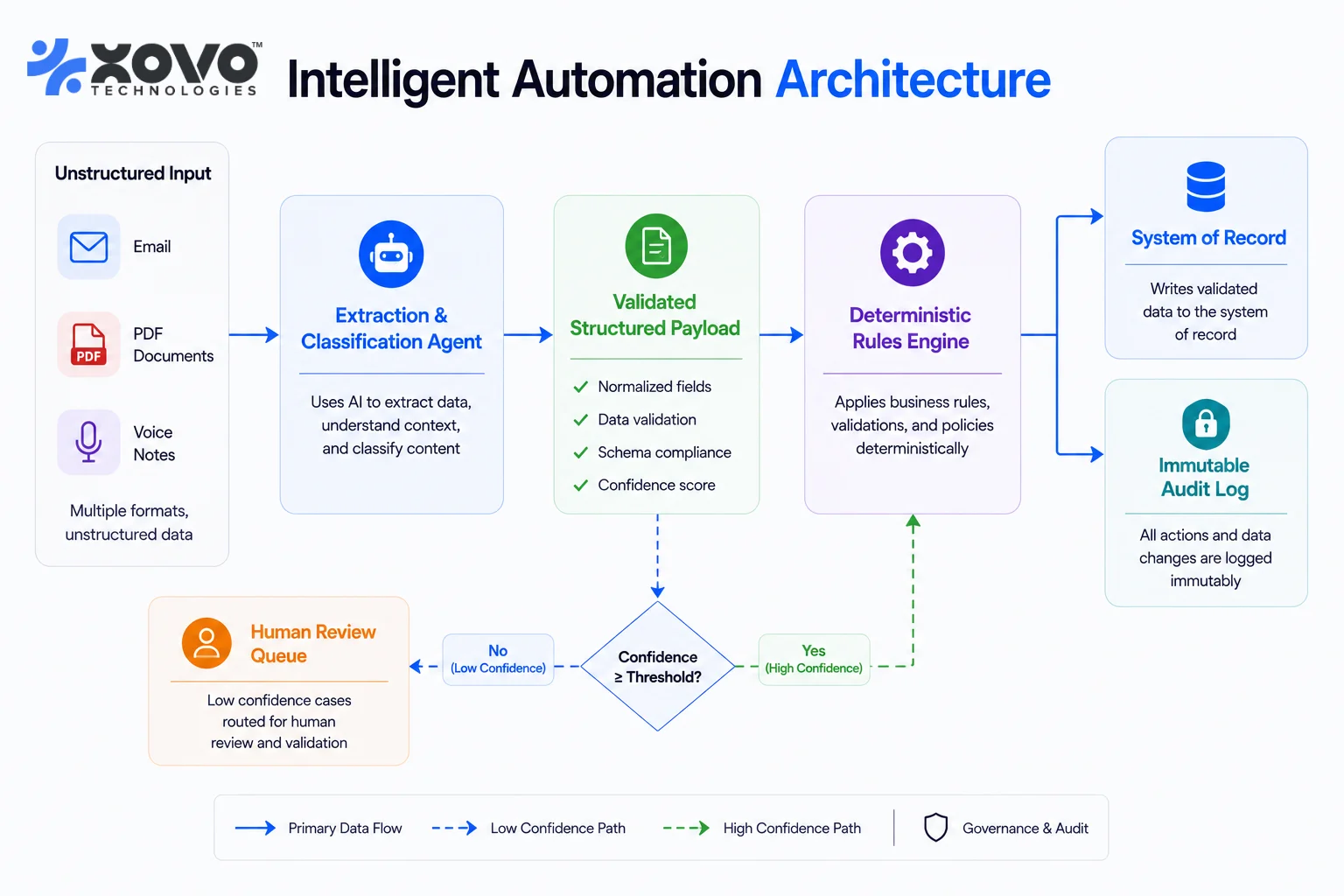
Enterprise workflow automation works best when you match the mechanism to the process, not to whatever your vendor put on its roadmap. Use a rules engine when the logic is deterministic, the input schema is stable, volume is high, and an auditor will eventually ask why a specific decision came out the way it did. Use an AI agent when the input arrives as unstructured text, the exception tail is long, and a human currently applies judgment. Most systems that survive contact with production in 2026 are hybrids: an agent normalises messy input, then hands a clean structured payload to a deterministic engine that executes and logs the decision.
I have sat through a lot of vendor demos in the last eighteen months. Almost all of them opened with the same slide: your rules are brittle, your bots break, agents fix everything. That slide is selling something. The version I would give a board is narrower, because the money is lost in the gap between the two mechanisms, not inside either one.
The decision rule, stated before anything else
Before you evaluate a single piece of workflow automation software, answer four questions about the process itself.
Is the input schema stable? If the same six fields arrive in the same shape every time, you do not need a language model to read them. Is the decision deterministic? If a policy document can be written as a truth table, write the truth table. What does the exception tail look like? If two percent of cases are strange and the rest are identical, automate the ninety-eight and route the rest. Is the decision audit-critical? If a regulator, an external auditor or a court could ask you to reproduce the reasoning behind one specific output from eleven months ago, you need a mechanism that replays identically.
That last question is the one buyers skip, and it is the one that kills enterprise workflow automation projects after go-live rather than during the build.
| Criterion | Rules engine wins | AI agent wins | Hybrid (agent in front of engine) |
|---|---|---|---|
| Input format | Structured records, fixed schema | Email, PDF, chat, voice notes, scans | Unstructured input that must become a structured record |
| Decision logic | Expressible as a truth table or policy matrix | Requires reading context and weighing tradeoffs | Interpretation is fuzzy, execution is not |
| Exception rate | Under roughly 5% and the exceptions are named | Long tail of unnamed one-offs | Long tail on intake, clean path on execution |
| Volume | High and predictable, thousands per day | Low to medium, or bursty | High volume with messy intake |
| Auditability | Replays identically, forever | Non-deterministic output, needs trace capture | Engine holds the audit record, the agent's read is logged as evidence |
| Change frequency | Policy changes a few times a year | Requirements shift monthly | Policy stable, inputs keep mutating |
| Unit cost | Near zero per execution after build | Per token, per action or per credit | Agent cost only on the intake step |
| Failure mode | Silently wrong when policy drifts | Silently plausible when context is thin | Two failure surfaces, two owners |
| Typical label | Classic process automation software | AI agents for workflow automation | Agentic AI workflow automation |
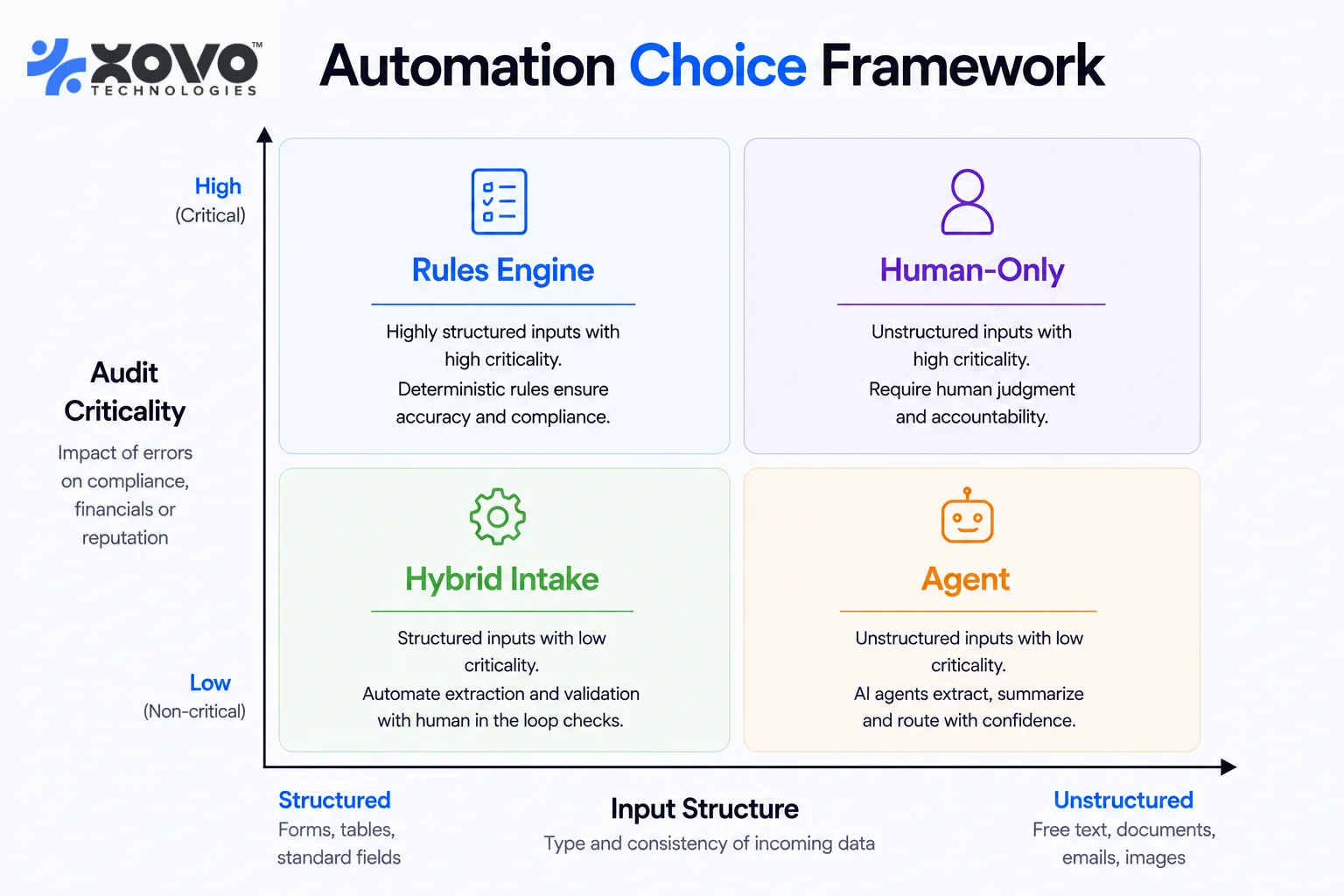
Read that table as a filter, not a scoreboard. A process does not need to win every row to justify an agent. It needs to lose the audit row decisively before you rule an agent out.
Anthropic's engineering guidance on building effective agents makes the same point from the builder's side: find the simplest solution possible, and increase complexity only when it is needed, which sometimes means not building an agentic system at all. Predefined code paths are called workflows for a reason. The case for AI agents for workflow automation rests on the model needing to direct its own process. If you are paying per action for something a case statement could do, you have made a purchasing error, not an architecture decision.
What actually happened to RPA, and why the rpa vs agentic ai framing is wrong
The trade press spent 2025 predicting the death of robotic process automation. The 2026 numbers do not show a death. They show a repricing.
UiPath reported fourth quarter and full fiscal year 2026 results on 11 March 2026: annualised renewal run-rate of $1.853 billion, up 11 percent year over year, full year revenue of $1.611 billion, up 13 percent, dollar-based net retention of 107 percent, and the first full year of GAAP profitability in the company's history. In the first quarter of fiscal 2027, reported 28 May 2026, revenue reached $418 million on 17 percent growth, ARR hit $1.901 billion, and the customer base sat at roughly 10,600 accounts, 374 of them above $1 million in ARR. That is not a category collapsing. That is a category whose growth rate has normalised while its story changed.
On the other side, SS&C launched Blue Prism WorkHQ on 29 April 2026, positioned as a control plane that orchestrates people, AI agents, APIs and digital workers inside one governed environment. Microsoft, Salesforce, ServiceNow and SAP all shipped agent builders sitting on top of the workflow engines they already sold you. ServiceNow replaced its five-tier licensing with three AI-native tiers on 9 April 2026, reserving the fully autonomous agent capabilities for the top tier. SAP's Q2 2026 Business AI release notes, published 20 July 2026, list Joule agents reaching general availability across expense automation, process consulting and ABAP code migration.
So the honest answer to whether agentic ai automation replaces your RPA investment: no, it sits on top of it, and every major vendor has now organised its product line around exactly that arrangement. The rpa agentic ai combination is the default shipping configuration, not a transitional state. Your bots become tools the agent can call. The orchestration layer, the credential vault, the queue management and the audit log all stay where they are.
What genuinely changed is the failure mode. A screen-scraping bot fails loudly when the UI moves. An agent fails quietly by producing something plausible. Teams that treat rpa vs agentic ai as a straight swap end up trading a monitoring problem they had solved for one they have not started.
In our builds, the first thing we do on an agentic ai vs rpa assessment is inventory which existing automations are API-backed and which are UI-backed. The UI-backed ones are worth revisiting, because the fragility everyone complains about lives there. API-backed automations are usually fine and should be left alone. Ernst & Young's automation practice has cited failure rates of 30 to 50 percent on first-wave RPA programmes for years, a figure that predates the current cycle, and in the estates we inherit the failures still cluster almost entirely in bots driven against systems nobody controls. That is the real agentic ai vs rpa boundary: not old versus new, but controlled interface versus uncontrolled one.
A sensible rpa agentic ai migration plan has three moves. Keep the API-backed bots. Wrap the UI-backed ones so an agent can call them rather than replacing them outright. Add agentic ai automation only at the points where a person is currently reading something a machine cannot parse. Framed that way, rpa vs agentic ai stops being a procurement question and becomes an inventory exercise.
Pricing units now decide your architecture
This is the part buyers underweight. Every 2026 platform has picked a consumption unit, and the unit shapes what you can afford to automate. Enterprise workflow automation budgets now break on consumption, not on licences.
| Platform | Billing unit (as of Aug 2026) | Practical implication |
|---|---|---|
| Microsoft Power Automate Premium | $15 per user per month, annual | Cheap for deterministic cloud flows and attended desktop flows |
| Power Automate Hosted Process | $215 per bot per month, annual | Unattended RPA still priced per digital worker |
| Power Automate Process Mining add-on | $5,000 per tenant per month, annual, 100 GB stored | Discovery is a separate capital decision, not a feature |
| Microsoft Copilot Studio | $200 for 25,000 Copilot Credits per month | Pooled at tenant level; premium actions burn credits far faster |
| Salesforce Agentforce Flex Credits | $500 per 100,000 credits, 20 credits (about $0.10) per action | Replaced the earlier $2 per conversation model |
| ServiceNow (Apr 2026 tiers) | Per-seat, agentic features gated to the top tier | Agent access is a licensing upgrade, not an add-on |
| Google Gemini Enterprise Agent Platform | Per seat plus separate agent storage, compute and governance charges | Consumption lines accrue outside the seat price |
Three vendors, three different billable things: a seat, an action, and a credit that maps to an action of unknown size. A workflow with forty agent steps costs forty times a workflow with one under the Salesforce model. Under the Microsoft model it depends entirely on whether your steps count as standard or premium messages. This is why generic ROI calculators from process automation software vendors are close to worthless. The only number that matters is your own cost per completed case, and you cannot compute it until you have counted actions on a real trace.
The rule we use with clients: model the cost of the ugliest realistic case, not the demo case. A three-step happy path is not what you are buying. You are buying the case where the agent re-reads a document four times, calls a search tool twice and escalates anyway. Under per-action pricing, an ai agent workflow automation design that loops is a budget event, not just a quality problem, which is why we cap retries in code rather than in the prompt. AI agents for workflow automation earn their unit cost on intake, where a person was reading something, and lose it on execution steps a rules engine would have run for nothing.
We wrote up the deeper architecture and unit economics in our guide to agentic AI in the enterprise, covering architecture, guardrails and ROI, and it pairs with the buying-side questions in hiring an AI agent development partner. If you are running the numbers on a specific process, our AI and automation service engagements start with exactly this exercise.
Processes that predict automation failure
Some processes are load-bearing and terrible. You can spot them before you commit budget, and no amount of business process automation software will save you from any of these characteristics.
| Process characteristic | Why it breaks automation | What to do instead |
|---|---|---|
| No single system of record; state lives in inboxes | The automation cannot read or write the real state | Fix the data layer first, automate second |
| Policy exists only in one person's head | You will automate their guesses, then they leave | Document with them present, then automate |
| Exception rate above 30% | The exception path becomes the main path | Automate the exception triage, not the process |
| Upstream input quality is uncontrolled | Garbage in, confidently wrong out | Add validation at intake, or fix the supplier form |
| The process exists to create an audit trail | Speed is not the goal, provability is | Rules engine, always, with immutable logging |
| Volume under a few hundred cases a month | Build and maintenance exceed the labour saved | Leave it manual, or use business process automation tools you already license |
| Regulatory logic changes quarterly | Prompt-based logic drifts between releases | Externalise policy into versioned rules |
| Two departments disagree about the correct outcome | Automation forces a decision nobody agreed to | Settle the policy dispute before writing code |
The last row causes more cancelled projects than any technical factor. Automation is a forcing function on organisational ambiguity. If finance and operations have quietly disagreed for four years about which invoices need a second approval, that disagreement has been absorbed by humans making case-by-case calls. Encode it and the disagreement surfaces in week two of user acceptance testing, and it stops the project.
Gartner's forecast of 25 June 2025, that over 40 percent of agentic AI projects will be cancelled by the end of 2027, attributes cancellations to escalating costs, unclear business value and inadequate risk controls. Its follow-up analysis of 26 May 2026 predicts that by 2027, 40 percent of enterprises will demote or decommission autonomous agents because governance gaps only surface after a production incident. Both describe the same failure: the organisation never decided what the agent was allowed to do, so it found out afterwards.
How to automate a process nobody has ever documented
This is the most common starting condition, and it is a smaller blocker than people think.
There are three routes. Process mining reads event logs out of your ERP, ticketing or CRM systems and reconstructs the real path cases take, including the rework loops nobody admits to. Task mining records what people actually do on screen, which is the only way to capture work that happens in spreadsheets and email. Structured observation means sitting with the four people who do the job and writing down every branch, which sounds unfashionable and works well for a process handled by a small team.
Cost separates them sharply. Microsoft lists its Process Mining add-on for Power Automate at $5,000 per tenant per month on an annual commitment with 100 GB of stored process data. Celonis does not publish list pricing, and enterprise entry points reported by buyers in 2026 commonly begin in six figures annually before implementation. If you are automating one process, that is not a rational purchase.
The pattern we see: a fortnight of structured observation plus a raw event-log export gets you to roughly eighty percent of the truth for a single process, for the cost of two people's time. We reserve mining platforms for clients who have already automated four or five workflows and cannot tell which one to do next. Buying discovery software before you have a discovery habit is how organisations end up with a beautiful process map and nothing shipped. The lighter business process automation tools bundled with the platform you already own are usually enough for the first two builds.
One caveat worth stating plainly. Mining shows you what happens, never why. The rework loop your event log surfaces might be waste, or it might be the only reason a compliance check gets done. Ask before you delete it.
The smallest workflow still worth automating
Do the arithmetic rather than trusting a heuristic. Annual hours saved equals monthly volume times minutes of handling time, times twelve, divided by sixty. Multiply by fully loaded hourly cost. Against that, put the build cost, the platform cost per year, and a maintenance provision of roughly twenty to thirty percent of build cost annually.
In our engagements the practical floor for a bespoke build sits near 150 to 200 hours of annual manual effort, which for a five-minute task means roughly 1,800 to 2,400 cases a year. Below that, either the process is a candidate for business process automation software you already license, or it should stay manual. Plenty of teams have Power Automate entitlements sitting unused inside their Microsoft 365 agreement, and a $15 per user per month licence covers a lot of deterministic work that people are paying consultancies to rebuild from scratch as bespoke workflow automation software.
Email workflow automation is the usual first candidate and the usual first disappointment. Routing and templating are trivially automatable. The reason the inbox is full is rarely routing. It is that the underlying request requires a decision nobody has defined. Email workflow automation that only moves messages faster produces a faster queue, not a shorter one. If you want email workflow automation to pay for itself, automate the decision behind the reply, not the reply.
Exceptions, and whether they all come back to you
They do not all come back, but the ones that do should be the ones you chose in advance.
Design three lanes rather than two. Lane one is straight-through, where confidence is high and the action is reversible or low value. Lane two is agent-prepared with human approval, where the system does the reading, the retrieval and the drafting, and a person clicks yes. Lane three is full human handling with the agent's notes attached as context. What determines cost is not the split, it is how much work lane two saves. If your approver still has to open four systems to check the agent's reasoning, you have automated nothing and added a step.
We set explicit confidence thresholds per action type, and we set the value threshold separately. An agent that can issue a $40 refund without approval should not be able to issue a $4,000 one, regardless of how confident it is. Confidence and blast radius are different axes, and Gartner's May 2026 governance analysis draws the same distinction between an agent's ability to act and the scope of access it is granted. Uniform governance across every agent is what causes failures, because it either strangles the trivial agents or under-restricts the dangerous ones. In practice that means ai agentic workflows need per-action permission scoping from day one, not a single service account with everything switched on.
Measuring whether an automated workflow is actually working
Automation rate on its own is a vanity metric. Four numbers matter, and they need to be reported together or not at all.
Straight-through rate is the share of cases completed with no human touch. Quality-adjusted straight-through rate is that same number after subtracting cases a human later corrected or reversed, and it is usually materially lower in month one. Cost per completed case includes the platform consumption charge, not just the labour saved. Time to resolution measured end to end, from first contact to closure, catches the common pattern where an automated step got faster and the overall cycle did not move because the bottleneck was somewhere else.
Sample and re-score. We pull a stratified sample of automated cases weekly for the first quarter, twenty to fifty depending on volume, and a human scores them against the same rubric used in pre-launch evaluation. The delta between production scores and your benchmark is the only trustworthy early warning any ai agent workflow automation programme gets.
For customer-facing work the same discipline applies, and vendor deflection percentages deserve the same scepticism as ROI calculators. Salesforce publishes named customer results for Agentforce, including Reddit at 46 percent case deflection and 1-800Accountant at a 90 percent deflection rate during tax week. Those are real, and they are also the reference accounts. Our companion piece on what customer service automation actually deflects and what it costs works through the economics properly.
What is automated customer service in this framing, and where the boundary sits
The phrase covers everything from a decision-tree bot to an agent with write access to your billing system, which is why buyers get burned. So it is worth being concrete about what is automated customer service in a workflow sense: it is the subset of service interactions where the system both determines the outcome and executes it, with no person in the loop. Teams that set out to automate customer service usually mean that, and often buy the other thing.
By that definition, a chatbot that answers a policy question is not automated customer service. It is search with a friendlier interface. A system that reads an inbound email, identifies an eligible refund, checks it against policy and issues it is. The distinction matters because the second one has to survive the audit-critical column of the decision table and the first one does not. Anyone asking what is automated customer service in a procurement document should define which of those two they are buying, because the price and the risk are not comparable.
This is where robotic process automation customer service patterns still hold up well. If the refund policy is a table, a rules engine should decide eligibility and a bot should execute the transaction, with the agent doing only the reading and classification. For refunds, entitlement checks and address changes, robotic process automation customer service execution remains the cheapest reliable path we know of.
Most automated customer service software sold in 2026 bundles both patterns, so the contract needs to say which one you are switching on. Automated customer service software that pushes the whole decision into a language model is easier to demo and much harder to defend to an auditor. Where we automate customer service end to end, the policy lives outside the prompt, in versioned rules the compliance team can read without a data scientist present. That robotic process automation customer service layer is not legacy. It is the part that makes the decision reproducible.
Two dates belong in the room before you automate customer service in Europe. Under the EU AI Act, Article 50 transparency obligations, which include disclosing to a person that they are interacting with an AI system, apply from 2 August 2026. The Digital Omnibus adopted by the European Parliament and Council in June 2026 deferred the high-risk obligations for stand-alone Annex III systems, including employment and creditworthiness use cases, to 2 December 2027, and Annex I product-embedded systems to 2 August 2028. The deferral bought time on high-risk classification. It did not touch the disclosure duty landing on any automated customer service software that talks to a European consumer today.
Keeping an automated process from silently drifting out of spec
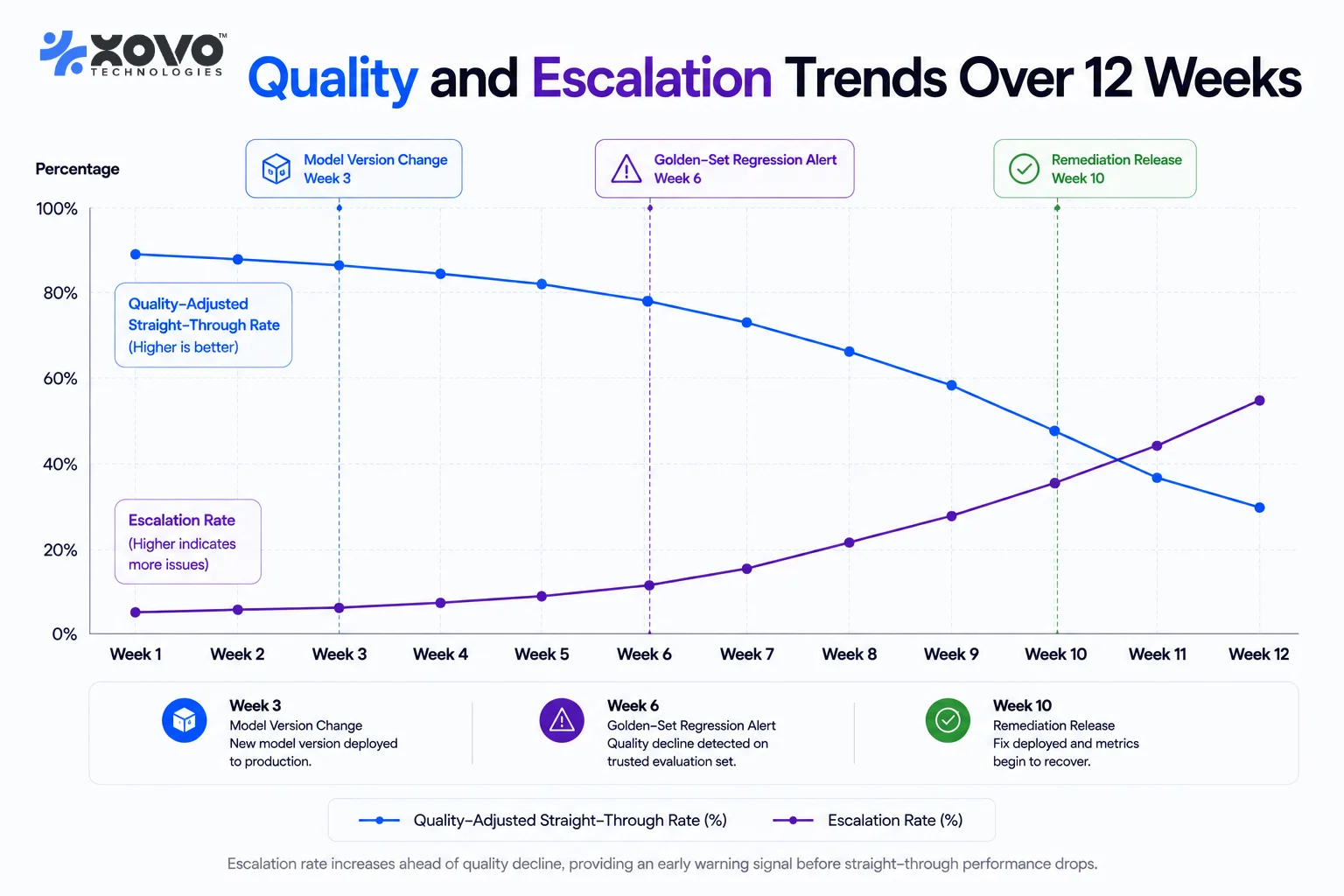
Drift has three sources and they need three separate controls.
Model drift happens when the provider updates the model underneath you. Pin versions where the platform allows it, and treat a model upgrade as a release requiring re-evaluation, not a background event. Data drift happens when the shape of the input changes: a supplier switches invoice templates, a form gains a field, a new market sends documents in a different language. Schema drift happens when a downstream system changes an API contract or a UI, which is the classic RPA break and has not gone away.
The control that catches all three is a golden set. Freeze fifty to two hundred real cases with known-correct outcomes, run them on a schedule, and alert on any regression against the baseline. This is unglamorous and it is the single highest-value thing you can build alongside an automation. Open tooling has caught up: Arize Phoenix, Langfuse, Braintrust and Fiddler all support trace capture with scored evaluations, and OpenTelemetry-based conventions for agent traces are converging, so ai agentic workflows are less locked to one vendor than they were a year ago. Most workflow automation software will not do this for you, because the vendor's monitoring tells you whether the run completed, not whether the answer was right.
Beyond the golden set, watch escalation rate as a leading indicator. A rising escalation rate almost always precedes a visible quality complaint by several weeks, because staff start quietly working around the system before anyone files a ticket. Alert on distribution shifts in the inputs too, not just the outputs. If average document length jumps forty percent, something upstream changed and your evaluation set is now unrepresentative. Ai agentic workflows fail this way far more often than they fail loudly.
Who owns this after the build team leaves
Nobody wants this conversation during procurement, which is why it should happen during procurement. Enterprise workflow automation with no named owner degrades on a predictable schedule, and the degradation is invisible for the first two quarters.
| Function | Owner | Cadence | What it catches |
|---|---|---|---|
| Business rules and policy | Process owner in the business unit | On policy change, minimum quarterly review | Automation enforcing last year's policy |
| Golden set and evaluation | Automation platform team | Weekly scheduled run, plus every release | Model and prompt regressions |
| Exception queue triage | Named operations team, on a rota | Daily | Backlog forming behind an unnoticed failure |
| Integration and schema health | IT and platform engineering | On upstream release, plus automated contract tests | API and UI breaks in connected systems |
| Consumption and cost | Finance with the platform team | Monthly against forecast | Credit burn from a retry loop nobody noticed |
| Access scope and permissions | Security and IAM | Quarterly recertification | Agent permissions that grew during the build |
| Incident response and rollback | Platform team, on-call | Documented runbook, tested twice a year | Nobody knowing how to turn it off at 2am |
Every ai agent workflow automation build we hand over ships with that table filled in and countersigned. The row people leave out is the last one. Every automated workflow needs a documented kill switch, a named person who can pull it, and a rehearsed manual fallback. We test this before go-live by turning the automation off during business hours and watching whether the team copes. If they cannot, it is not ready, because you have created a dependency without a contingency.
Budget for maintenance explicitly. Twenty to thirty percent of build cost per year is the provision we recommend, covering evaluation runs, prompt and rule updates, integration fixes and the quarterly policy review. Programmes that skip this line item do not save the money. They spend it eighteen months later as an emergency remediation project at a worse rate. Whatever process automation tools you standardise on, that provision is the difference between a portfolio that compounds and one that quietly rots.
Day one for your staff
The honest version: on day one, the work gets stranger before it gets lighter.
Volume through the exception queue is highest in the first fortnight because thresholds are set conservatively and everyone is still learning what the system does badly. Staff spend more time reviewing than they used to spend doing, which feels like a downgrade. Around week three, if the evaluation loop is working and thresholds are being tuned weekly, review time drops below the old handling time and stays there.
Tell people this in advance. Agentic ai workflow automation sticks in teams where the operators were told the truth about the first month and where their corrections visibly changed the system's behaviour. It fails where a vendor promised instant relief and staff concluded within a week that the thing does not work.
The job changes shape. Handling cases becomes reviewing decisions, spotting the pattern in what the system gets wrong, and owning the rules. That is a real skill upgrade for most people doing repetitive process work, and it needs to be paid and titled as one, or your best reviewers leave and take the process knowledge with them.
How to choose who builds it
The market for ai automation consulting services in 2026 is crowded and the quality range is enormous. Gartner's June 2025 assessment, that only about 130 of the thousands of self-described agentic AI vendors were building anything real, should calibrate your expectations about the rest.
Most business process automation software now ships an agent builder. Almost none of it ships an evaluation harness, and that gap is what you are actually hiring for.
A few filters work. Ask any ai automation company to show you an evaluation harness from a live client build, redacted as needed. Ask what the maintenance handover looks like and who holds the pager in month four. Ask them to name a process they told a client not to automate, and listen for whether the answer is specific. Published lists of the top ai automation agencies are mostly paid placement, so treat rankings as a source of names to verify rather than a shortlist, and check whether the agencies on any top ai automation agencies roundup have actually shipped agentic ai workflow automation into production or only prototypes. We turn up on some top ai automation agencies lists ourselves, and I would still tell you to verify the shortlist independently. When you compare shortlisted ai automation consulting services, the differentiator is almost never model access, because everyone has the same models. It is whether the ai automation company will still be accountable for the straight-through rate in month nine. The ai automation company that talks you out of automating something is usually the one worth signing.
Research on the automated design of agentic systems, where agents generate and refine other agents, is genuinely interesting and is not where enterprise budgets should go yet. In production the automated design of agentic systems remains a research direction with a thin operational track record, and we have not seen a client case where the automated design of agentic systems beat a hand-designed graph on cost or reliability. We build the boring version: explicit graphs, versioned prompts, deterministic execution wherever it is available. Any list of the best ai agents for business process automation 2026 that leads with autonomy rather than observability was written for an audience that does not have to run the thing on a Monday morning. If you are compiling your own shortlist of the best ai agents for business process automation 2026, sort it by how the vendor answers the drift question, not by how many steps the demo chains together.
The buyer's questions worth asking end to end are covered in our guide to hiring an AI agent development partner, and if data residency is a constraint, private LLM hosting walks through when running models on your own infrastructure changes the economics. A worked example of the hybrid pattern, an agent reading documents in front of deterministic matching logic, is in our three-way matching case study.
Where we would spend the next ninety days
Pick one process with clean upstream data, a stable policy, and an owner who can make decisions without convening a committee. Instrument the manual version first so you have a real baseline. Build the deterministic path with the tools you already license. Add an agent only at the point where a human is currently reading something unstructured, and hold it to a measured accuracy bar before it gets write access to anything.
That sequence produces a smaller result than the demo promised, and it is the sequence that still exists in production a year later. Enterprise workflow automation compounds when each build is boring enough to hand over. The honest answer to the best ai agents for business process automation 2026 question is that the ranking depends on your input formats and your audit exposure, not on the agent, and good ai automation consulting services will tell you that in the first meeting rather than the fourth.
If you want a second opinion on which process to start with, our AI and automation practice and our agentic AI development team run a paid discovery that ends with a build-or-do-not-build recommendation in writing, including the processes we think you should leave alone. You can book a free AI audit if you would rather start with a conversation.