Supplier risk management in 2026 is the practice of watching the suppliers you depend on for early evidence of financial, operational, cyber or compliance failure, then acting before that failure reaches your line. Annual vetting still has a job. It captures certifications, contractual representations and regulatory attestations that only exist as point-in-time documents. What it cannot do is catch a supplier that passes an audit in January and stops acknowledging orders in March. The working model for most buyers is tiered: continuous monitoring on the suppliers you cannot replace quickly, and a lighter questionnaire cycle everywhere else.
The week-three problem
Mountain Valley Express, a regional freight carrier, ceased operations on 7 July 2026. Shippers who had it on their approved vendor list found out the way most companies find out: freight stopped moving. Whatever that carrier scored on its last annual assessment, the assessment was not the thing that told anyone.
Call it the week-three problem. A supplier clears vetting in week one and starts failing in week three, and the file still reads green because nothing in the file is designed to change.
That is the shape of the problem. A questionnaire returned in January describes a company as it was in January. Allianz Trade recorded 327 major insolvencies in the first three quarters of 2025, roughly one every twenty hours, and its April 2026 report forecasts a further 6% rise through 2026 with 2.2 million jobs directly at risk, worst in construction, retail and services. A supplier does not schedule its distress around your review calendar.
The volume side is worse. Resilinc's EventWatchAI logged 26,225 supply chain disruption alerts across 2025, notifications up 38% year over year, with cyber events climbing 64%, regulatory change 92% and geopolitical instability 54%. Thomson Reuters, surveying 225 senior trade professionals for its 2026 Global Trade Report on 12 February 2026, found 72% naming US tariff volatility the most impactful regulatory change, up from 41%, and 39% of organisations absorbing tariff costs rather than passing them on, up from 13%. Absorbing a tariff is a margin decision at the buyer and a solvency question at a thin supplier.
No supply chain risk manager reads 26,225 alerts. That is the argument for automating the first pass, and it is why global supply chain risk management has moved from a quarterly slide deck into a data engineering problem.
I have sat in enough post-mortems to know how this goes. The supplier that failed was sending signals for months. Nobody read them, because managing supplier risk was somebody's annual job rather than a running supply chain risk management program.
What is supply chain risk management, and what annual vetting was built to prove
Here is the plain answer to what is supply chain risk management: it is the discipline of finding, ranking and reducing the ways your external dependencies can stop you from delivering. Supplier risk management is the slice of that discipline aimed at individual counterparties rather than at lanes, ports or commodities. Risk management in supply chain work splits into two jobs with very different clocks, and most arguments about supply chain risk management tools are really arguments about which of the two jobs the buyer had in mind.
The first job is proving a state of affairs at a moment in time. ISO certificates, insurance certificates, beneficial ownership disclosures, signed anti-bribery representations, a SOC 2 Type II report. These are documents, and the date on them is the point. No amount of live monitoring produces a signed representation from a supplier's director, and a supply chain risk management framework that pretends otherwise fails its first audit.
The second job is detecting change. That is where annual cycles collapse. Between two questionnaires a supplier can lose its largest customer, breach a covenant, get acquired, move production to a sanctioned jurisdiction, suffer a ransomware event, or quietly stretch its payables from 12 days beyond terms to 47. No supply chain risk management process built on a twelve-month refresh will see any of it.
So the honest answer to "questionnaires or live monitoring" is both, with each doing only what it is good at. In our builds we keep the annual cycle deliberately thin: attestations, certificates and contractual reps, nothing else. Everything observable from outside gets observed continuously. That split is the whole of how we think about managing supply chain risk, and it is the most useful working answer to what is supply chain risk management for. Documents prove state, signals prove direction. Teams resist it mostly because their questionnaire doubles as their data-collection mechanism for site addresses and sub-tier declarations, and unpicking that takes a quarter of work.
| Dimension | Annual vetting | Continuous supply chain risk monitoring |
|---|---|---|
| What it actually proves | Certifications, contractual reps, regulatory attestations, declared facts as at one date | Direction of travel in observable behaviour |
| Detection latency | Up to 12 months | Hours to weeks, depending on the signal |
| Primary failure mode | Stale by design; suppliers answer aspirationally | False positives and alert fatigue |
| Typical tooling | Questionnaire portal, shared spreadsheet, email chase | Supply chain risk software wired to bureau, registry and transactional feeds |
| Data source | The supplier | Bureaux, registries, customs records, your own ERP and EDI logs |
| Internal cost | 4 to 12 hours of buyer and SME time per supplier per cycle, in the programmes we have measured | Fixed platform cost plus triage time, which scales with alert quality rather than supplier count |
| Role in the supply chain risk management plan | Compliance evidence layer | Detection and escalation layer |
| What the supply chain risk management policy governs | The attestation calendar and who signs | Escalation thresholds, alert owners, response times |
| Where it is legally load-bearing | CSDDD scoping files, LkSG documentation, DORA registers, modern slavery statements | Evidence that due diligence is ongoing rather than annual theatre |
| Blind spot | Anything that changes after the signature | Anything that never appears in public or transactional data |
Which signals actually predict supplier distress, and which are noise
This is the part most supply chain risk management software gets wrong, because vendors are paid on coverage and coverage rewards adding feeds. More feeds is not more foresight.
Payment behaviour is the single best financial predictor I have worked with. Dun & Bradstreet's trade payment file computes a dollar-weighted days beyond terms figure over rolling three-month and twelve-month windows, and the trended version of that data is explicitly used to identify businesses more likely to default or enter bankruptcy. Creditsafe's US trade programme tracks roughly $12.1 trillion in outstanding balances. What matters is not the level but the delta: a supplier whose 3-month DBT has separated from its 12-month DBT is telling you something about its cash position that its sales director will not.
The second best predictor is not bought at all. It sits in your own ERP. Order acknowledgement latency, promise-date slippage, partial-shipment frequency and first-pass yield are early, cheap and specific to your relationship. When a supplier starts triaging its customers, you drop down the queue before you drop off it, and that drift appears in EDI timestamps weeks before a credit bureau can see it. This is why supplier performance risk management and financial screening belong in one pipeline rather than in two teams' spreadsheets. Treating supplier risk and performance management as separate programmes is how a company ends up with a supplier scored green on credit while its on-time delivery quietly halves.
Then there is the noise. Adverse media sentiment scoring is close to useless as a distress predictor for anything below a listed company. Leadership churn fires constantly and predicts almost nothing on its own, with one exception: an unplanned CFO departure at a privately held supplier is worth a phone call. Cyber posture ratings genuinely predict breach likelihood, which is not the same question as delivery failure, and treating a dropped rating as a supply signal is a category error. Sustainability ratings move slowly by construction; EcoVadis analysed roughly 200,000 scorecards for its 2026 index and found 97% of companies have labour and human rights measures in place while only 75% report on them, so much of that gap is reporting maturity rather than real risk. Most supply chain risk management platforms will sell you every one of these feeds. Buying them is not using them.
| Signal | Typical lead time before failure | Noise level | Where the data comes from |
|---|---|---|---|
| 3-month vs 12-month DBT divergence | 3 to 9 months | Low | D&B, Creditsafe and Experian trade payment files |
| Failure or delinquency score movement (delta, not level) | 2 to 6 months | Low to medium | Credit bureaux |
| Order acknowledgement latency and promise-date slippage | 2 to 10 weeks | Low | Your ERP, EDI 855 and 856 timestamps |
| Lead-time drift against quoted lead time | 4 to 16 weeks | Low to medium | PO history inside your own supply chain risk management tools |
| Quality defect rate and first-pass yield | 1 to 4 months | Medium | QMS and receiving inspection |
| Liens, judgments, statutory demands, winding-up petitions | 1 to 4 months | Low, but often late | Court and companies registries |
| Layoffs and WARN notices | 1 to 6 months | Medium, and very noisy for large multinationals | State WARN registers, local press |
| Ownership, sanctions and control changes | Immediate | Low | Sanctions lists, beneficial ownership registers |
| Customs and bill-of-lading pattern shifts | 2 to 12 weeks | Medium | Trade data providers |
| Unplanned senior finance departures | 3 to 12 months | High | Filings, professional networks |
| Cyber posture rating drops | Predicts breach, not delivery | Medium to high | Bitsight, SecurityScorecard and similar supply chain risk software |
| Adverse media sentiment | Unreliable | Very high | News aggregators |
| Named-contact turnover on your account | 1 to 3 months | High | Your own CRM and mailbox metadata |
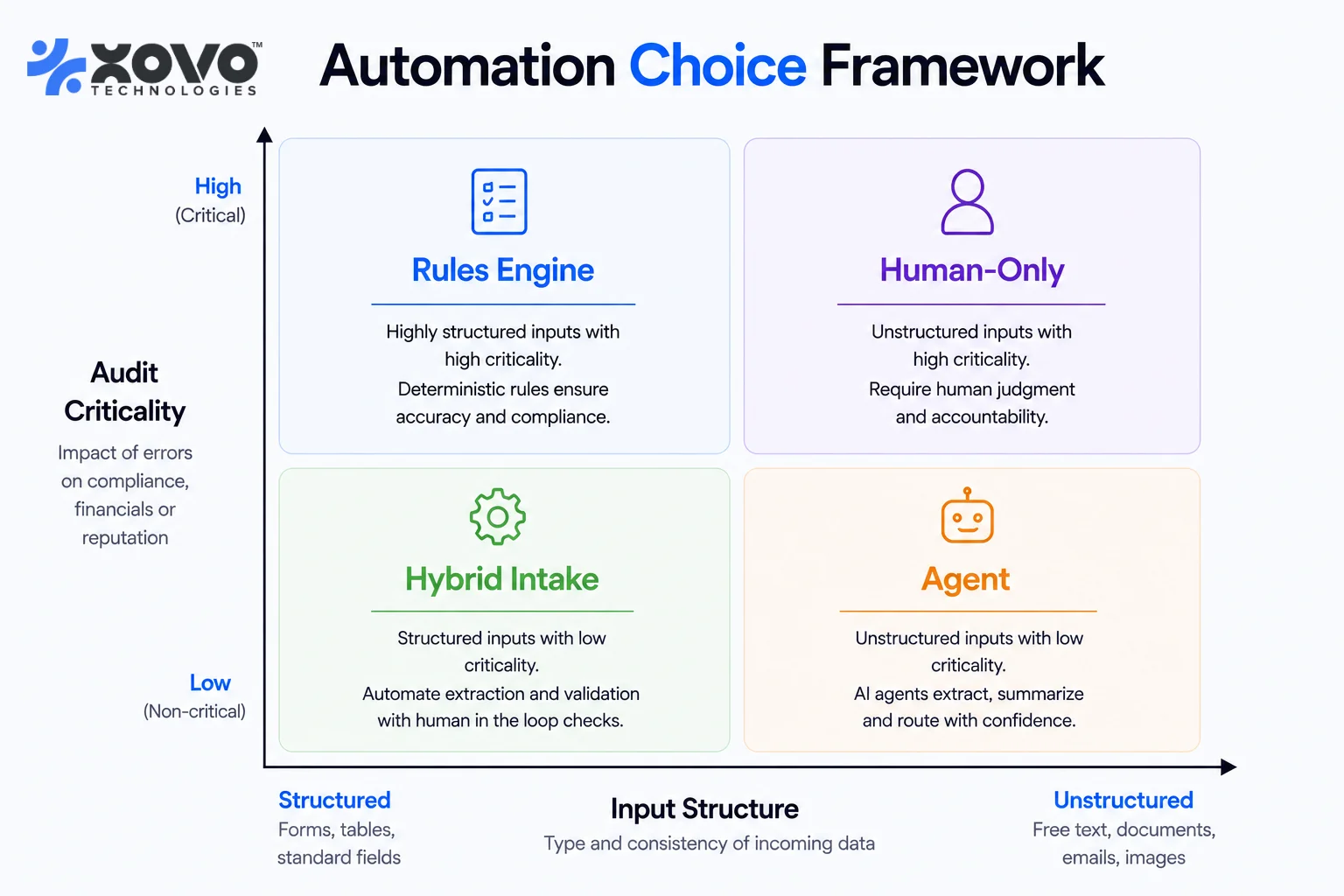
Realistically, continuous supplier risk monitoring buys you weeks to a few months, not certainty. On financial distress with a good payment-data feed, three to six months of warning is normal and nine is a good outcome. On a sudden operational event, a fire, a cyber incident, a port closure, you get hours, and the value is in knowing which of your parts came from that site. Anyone selling supply chain risk management solutions that promise to predict every failure a year out is selling you a backtest.
Risk tiering: monitoring depth by spend and substitutability
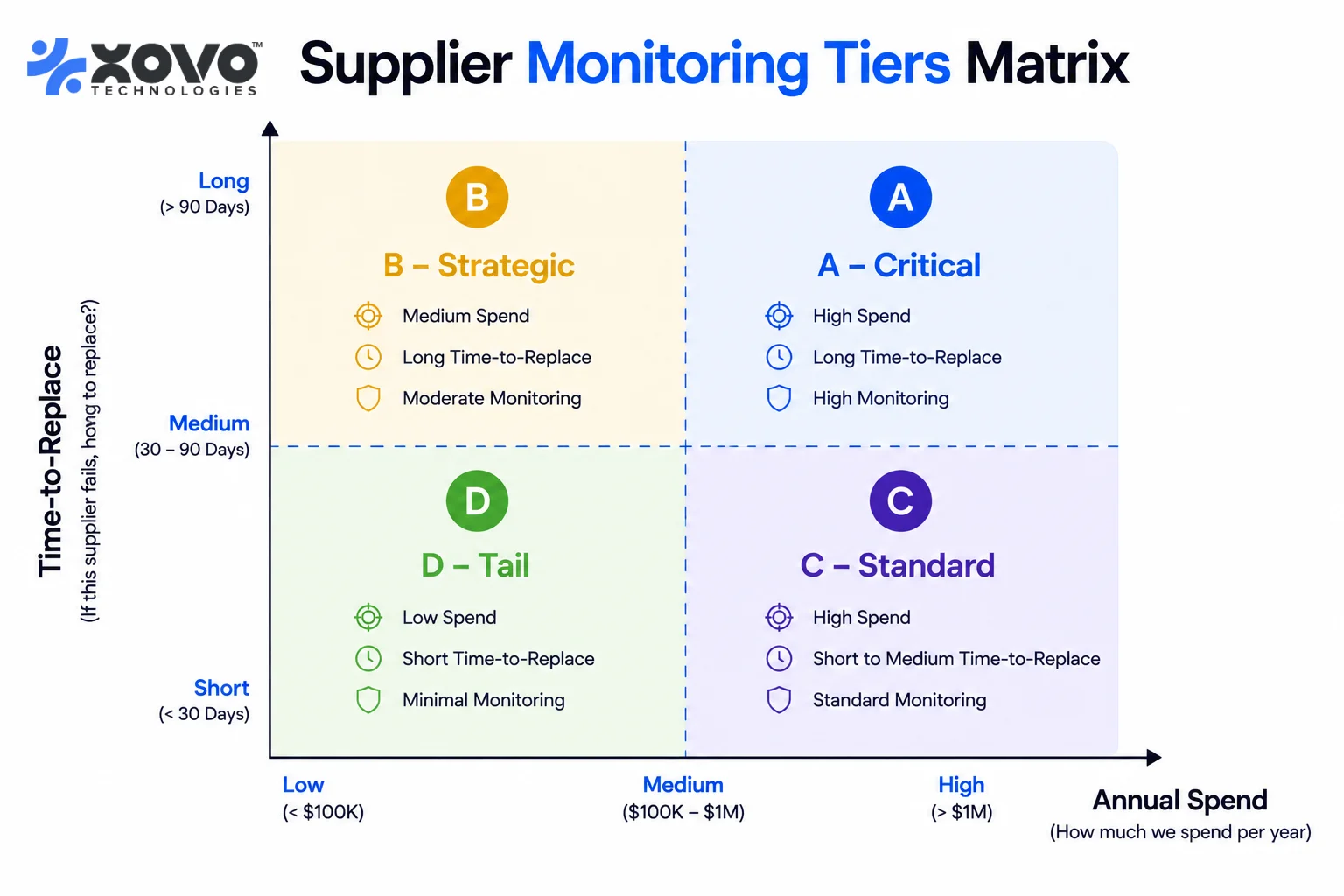
Spend is the wrong sole axis, and it is the one most programmes start with. The variable that actually determines pain is requalification time. A $40,000-a-year sole-source supplier of a qualified medical component can hurt you far more than a $4 million commodity packaging vendor with four drop-in alternates.
Every supply chain risk management plan we build starts by scoring each supplier on two axes: annual spend and time-to-replace. Time-to-replace covers everything from finding an alternate through sampling, qualification, tooling transfer and regulatory sign-off. In pharmaceutical supply chain risk management that number is frequently measured in years because of change control and regulatory filings, which is exactly why life sciences sits near the top of every disruption ranking Resilinc publishes. Pharmaceutical supply chain risk management is also where the annual questionnaire keeps most of its value, because GMP and GDP attestations are the artefacts an inspector asks to see.
| Tier | Profile | Monitoring depth | Cadence | Owner |
|---|---|---|---|---|
| A: critical | Sole-source or time-to-replace over 6 months, at any spend level | Financial signals, operational signals from ERP, cyber posture, sub-tier map, site-level geospatial exposure | Continuous ingest, human review each quarter, named alternate on file | Supply chain risk manager plus an executive sponsor |
| B: strategic | High spend with 2 or 3 qualified alternates, time-to-replace 4 to 12 weeks | Financial signals plus operational drift, sanctions and ownership watch | Continuous ingest, weekly digest | Category manager |
| C: standard | Moderate spend, alternates exist but are not qualified | Automated financial screening, exception alerts only | Monthly review | Buyer |
| D: tail | Low spend, commoditised, immediately substitutable | Onboarding screen, sanctions watch, annual refresh | Annual | Automated, no standing human owner |
Two rules make this work. Tier assignment gets reviewed when spend or sourcing changes, not on a calendar. And tier A always carries a named alternate with a documented switch cost, because a risk alert without a pre-agreed response is anxiety with a timestamp.
That table is the backbone of the supply chain risk management framework we deploy, and the two-axis scoring is what makes supply chain risk management strategies affordable. You are not buying deep monitoring for 4,000 suppliers. You are buying it for the sixty that can stop your line, which is why the supply chain risk management solutions worth paying for price by tier rather than by seat. Every supply risk management budget I have seen fail treated the tail like the core, ran out of money, and never reached the core. Managing supplier risk well is mostly deciding what not to watch.
Tier-2 and tier-n visibility when you hold no contract
You have no leverage over a supplier's supplier. You do have four workable routes, and none of them gives you a complete map.
Contractual cascade is the cheapest: require tier 1 to declare the sub-tier sources for the specific parts you buy, as a condition in the master agreement, refreshed on change rather than annually. Response quality is mediocre at first and improves once you enforce it in sourcing decisions. Second, customs and bill-of-lading records let you infer relationships from actual shipments, which is how most commercial multi-tier mapping is built; it works well for ocean freight into the US and poorly for intra-EU road movements. Third, network data pools, where a provider already maps a supplier because someone else's tier 1 declared it, give you coverage you could never negotiate alone. Fourth, in regulated sectors, a supplier's own filings often name sites you would otherwise never see.
Start narrow. Map the sub-tier for your top twenty parts by revenue exposure, not your top twenty suppliers by spend. In our engagements that takes six to ten weeks, and the finding is nearly always the same: two or three unrelated tier-1 suppliers converge on one tier-2 plant and nobody knew. That single output justifies more spend than any dashboard, and it is the part of the supply chain risk management process no software buys you outright. Write the result into the supply chain risk management plan as a named concentration risk with an owner, because it will not show up in any per-supplier score. Global supply chain risk management at tier-n remains detective work with data assistance.
The regulatory layer in 2026, and why it changed the argument
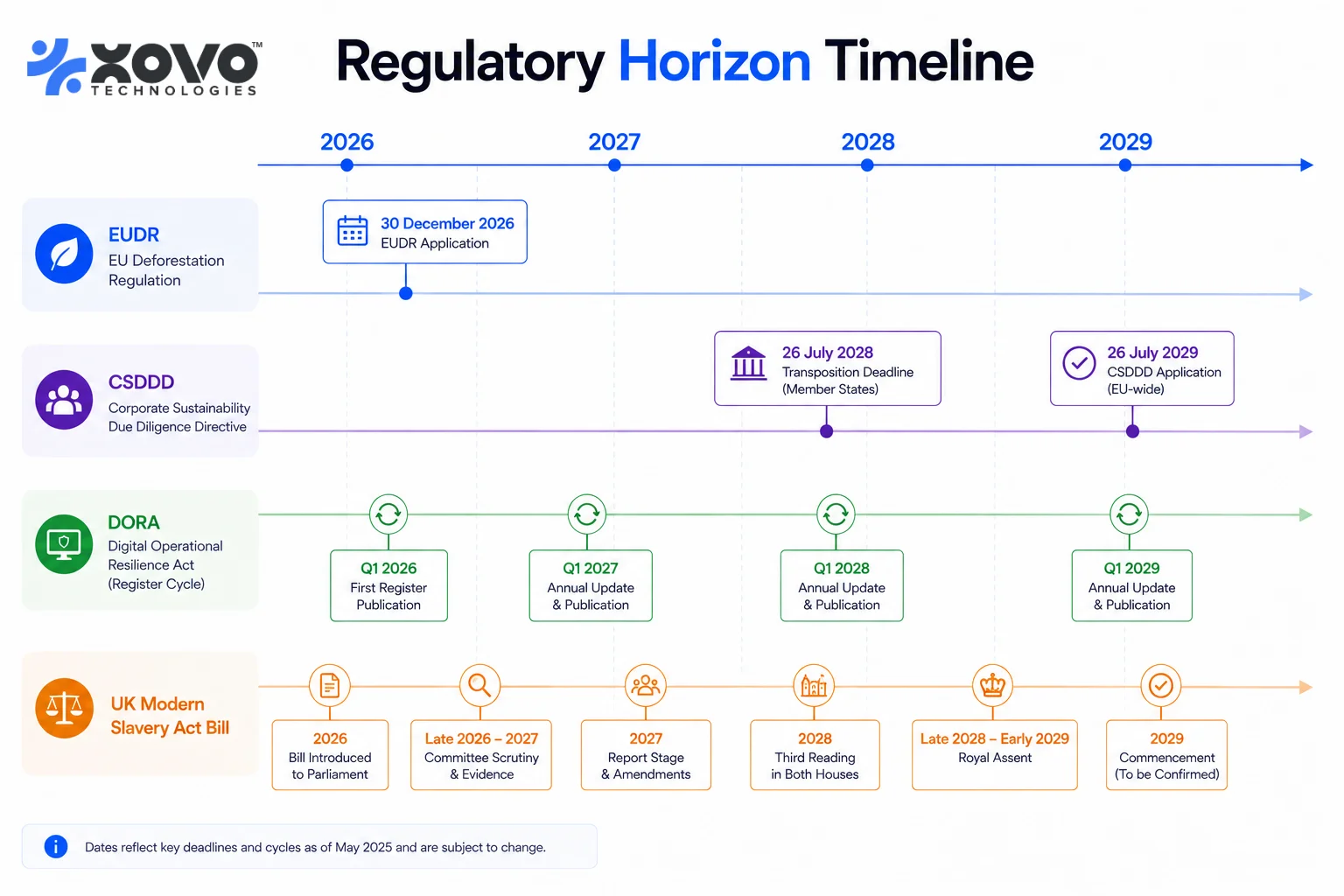
Regulation is now the reason many boards fund this work, and several of these dates moved in the last eighteen months. Verify against the current text before you build a supply chain risk management policy on any of them.
The EU's Omnibus I amendment to the Corporate Sustainability Due Diligence Directive was published in the Official Journal on 26 February 2026 as Directive (EU) 2026/470 and entered into force on 18 March 2026. Member states transpose by 26 July 2028, with a single application date of 26 July 2029 replacing the staggered phase-in. Scope narrowed sharply: EU companies above 5,000 employees and EUR 1.5 billion net worldwide turnover, and non-EU companies generating EUR 1.5 billion inside the EU. The operationally important change is that the revised text drops the direct-versus-indirect partner distinction for a two-step risk-based process: scope for high-risk areas using reasonably available information, then assess in depth only where you found something. That is continuous screening followed by targeted investigation, written into law, and the clearest official endorsement of continuous supply chain risk monitoring published so far.
Germany's LkSG survives in the interim. The annual reporting obligation was abolished retroactively from 1 January 2023, but risk analysis, preventive and remedial measures, the complaints procedure and documentation duties all remain until CSDDD transposition. Dropping the report is not dropping the due diligence, and any supply chain risk management policy written on the assumption that Berlin has walked away will not survive an inspection.
Three more dates belong in the calendar. The EU Deforestation Regulation applies from 30 December 2026 for large and medium operators and 30 June 2027 for micro and small ones, after a second one-year postponement. Under DORA, the European Supervisory Authorities published the first list of designated critical ICT third-party providers on 18 November 2025, nineteen firms including the major cloud platforms, and the register of information exercise repeats in 2026 with narrower scope. And the UK is moving: the Immigration and Asylum Bill introduced on 30 June 2026, with second reading on 13 July 2026, would rewrite section 54 of the Modern Slavery Act with mandatory disclosure topics, senior accuracy declarations and penalties up to the greater of GBP 1 million or 1% of turnover. It stops short of mandatory human rights due diligence.
NIS2 is the directive that pulls cyber supply chain risk management into procurement. Transposition has been slow enough that the Commission escalated to reasoned opinions against nineteen member states on 7 May 2025, but where it is in force the supply chain security obligations sit on the entity, not the vendor, which means your contracts and your evidence. Verizon's 2026 Data Breach Investigations Report, published 19 May 2026, found third parties involved in 48% of breaches, a 60% jump year over year. Cybersecurity supply chain risk management stopped being an IT-only concern the moment that number crossed a third, and a supply chain risk management framework that has no named owner for vendor cyber posture will not answer a regulator's first question.
One clarification that saves months of argument. Software supply chain risk management is a different discipline: SBOMs, transitive packages, build system integrity, signing, all of it inside the code you ship and all of it owned by engineering. It overlaps with cyber supply chain risk management at the vendor boundary and diverges everywhere else. Fold software supply chain risk management into the procurement programme and you get a combined register neither buyers nor engineers read. Share the data, separate the workflows.
This is where annual vetting earns its keep. Attestations, declarations and signed representations are the artefacts regulators inspect. Continuous monitoring is what makes the file credible between signatures, and managing supply chain risk under CSDDD now explicitly requires both halves.
Alert design and the economics of a false positive
A supply chain risk management program dies of alert fatigue, not of missed risk. Security operations learned this expensively: false positive rates across security tooling commonly sit between 50% and 80%, and the predictable result is analysts who stop reading. Procurement teams are smaller and have less tolerance still.
The false positive in supplier risk carries a cost a security false positive does not. It lands on a relationship. Call a supplier's CFO because a credit score dipped after a routine refinancing and you have told a partner you think they are failing. In the programmes we have run, the second unfounded escalation is where the supplier starts routing your questions through their legal team, and commercial goodwill you spent years building goes in one call. That is why we separate the alert from the outreach. Most alerts should trigger internal verification against your own ERP data first, and only a small class should ever produce a phone call.
Four supply chain risk management alert classification rules we apply on every build:
- No single-source alert reaches a human. A credit score move on its own is a watchlist entry. A credit score move plus DBT divergence plus acknowledgement latency is an alert.
- Every alert carries a pre-written action. If nobody could write down what to do about this signal at design time, the signal does not get an alert channel.
- Alerts are scoped by tier. A tier D supplier cannot generate an interrupt, only a monthly line item.
- Precision gets measured monthly and published to the team. We tag every alert as actioned, watched or dismissed, and any rule below roughly 30% actioned is retuned or retired within two cycles.
That last rule is what keeps the whole thing alive. Most supply chain risk management platforms ship with default thresholds tuned for demo impressiveness rather than for your supply base. Retuning them against your own outcome data in the first ninety days is not optional, and it is the step teams skip. Good supply chain risk management alert classification rules are the difference between a system people trust and a folder people mute.
Two more design notes. Cybersecurity supply chain risk management alerts need their own channel and their own on-call, because response time is hours rather than weeks and the responder is not a buyer. And if an autonomous agent is doing the triage, agentic ai risk management discipline applies: log every suppression decision the agent makes, because a silently dropped true positive is the failure mode nobody catches until the post-mortem. No supply chain risk management technology should be allowed to delete the evidence of its own judgement.
Data plumbing, scale, and whether one system can cover everything
Three practical questions come up in every scoping call.
Does your ERP need cleaning first? Partly. You need reliable supplier master identity, meaning a stable ID mapped to a DUNS number or company registration number, deduplicated across entities, plus PO and receipt history with usable timestamps. You do not need clean spend classification, category taxonomy or contract metadata to start, and waiting for those is how programmes stall for a year. We typically start with the top 300 suppliers by criticality, fix identity for those only, and expand. If your supplier master holds the same company under four names, external data will not match and every downstream score is wrong. That is the one blocker worth pausing for. The same identity work pays off across procurement generally, which is why we treat it as shared infrastructure with procure-to-pay automation rather than as a risk-only project.
At what point does manual supply risk management stop working? In practice, somewhere between 150 and 400 active suppliers, driven far more by how many are tier A and B than by the total. One person can genuinely hold thirty to fifty critical relationships in their head, refresh credit reports quarterly and notice when something feels off. Beyond that the failure is silent: the analyst keeps working, coverage quietly narrows to the loudest suppliers, and the tail goes unwatched. The tell is not a complaint, it is that risk reviews start arriving late. That is the point at which supply chain risk management software stops being optional, where supply chain risk management platforms start earning their licence fee, and where supplier risk monitoring becomes a scheduled job rather than a habit.
Can one system cover financial, geopolitical and ESG risk together? Yes for ingestion and scoring, no for judgment. The pipelines converge cleanly and a single supply chain risk management technology stack should hold all three. The workflows do not converge. A financial alert goes to a category manager who can dual-source. A geopolitical alert goes to logistics and legal. An ESG finding goes to sustainability and may require remediation with the supplier rather than exit. Buying one platform and assuming one process is the standard mistake. We build one data layer and three response paths, and we keep supplier risk and performance management scores in the same view so a buyer never opens a second tool to answer "is this supplier getting worse". In pharmaceutical supply chain risk management we usually add a fourth path, because quality and regulatory findings go to QA rather than to procurement at all. Cybersecurity supply chain risk management belongs in the same data stack but routes through your security on-call, and software supply chain risk management stays out of the procurement view entirely.
A note on cost discipline. Supply chain risk software licensing is usually priced per monitored supplier, so the tiering table above is also your budget model. Monitoring 4,000 suppliers at tier A depth is not a stretch goal, it is a way to spend six figures learning nothing.
What to do with an alert you cannot act on
Sometimes the supplier is sole-source, requalification is eighteen months, and the alert is real. You cannot switch. Doing nothing is still the wrong answer.
The moves that work: size buffer stock to the requalification clock rather than to a generic weeks-of-cover rule; qualify a second manufacturing site at the same supplier, which is far cheaper than qualifying a new supplier; negotiate access to tooling, drawings and inventory under an insolvency scenario before you need it, because after a filing you are an unsecured creditor arguing with an administrator; shorten payment terms in exchange for capacity commitments, which sounds like a giveaway and is cheap insurance on a supplier whose problem is working capital; and start the alternate qualification anyway, since that eighteen-month clock only gets longer the more you defer it.
Those are the supply chain risk management strategies that actually apply when leverage is missing, and they are all slow, which is precisely why early detection matters. Managing supply chain risk without switching power is a scheduling problem: the earlier the signal, the more of these options are still open.
Log the decision either way. When a supplier fails and someone asks what you knew, "we saw it, we assessed it, here is the memo and the mitigation we chose" is defensible. Silence is not. Where an agent made the call, agentic ai risk management practice says the agent's log is the memo and a named human signs it.
How we build this at XOVO
Our AI Procurement Agent treats supplier risk as a data pipeline problem rather than a dashboard problem. It ingests bureau and registry feeds alongside your own PO, receipt and invoice history, computes the delta signals that matter instead of restating vendor scores, and applies the classification rules above before anything reaches a person. Because the same agent already runs three-way matching, it observes payment and delivery behaviour as a byproduct of work it is doing anyway, which is the cheapest supplier performance risk management data anyone has. Our three-way matching case study covers how that transactional layer gets built, and the wider cycle-time economics are in our guide to AI procurement automation.
Where the exposure is network-shaped rather than counterparty-shaped, lane concentration, port dependency, weather and geospatial site risk, that work belongs in the AI Supply Chain Optimizer instead. Two different questions, two different models, and conflating them is how risk management in supply chain programmes end up with a scorecard that answers neither.
If you are deciding whether to extend an existing suite or build the monitoring layer yourself, read our procure-to-pay build, buy or extend analysis first. Most mid-market teams should extend: the supply chain risk management technology you already own inside your P2P suite usually covers tiers C and D adequately, and the gap is at tier A. The build case only holds when your risk logic is genuinely proprietary, which for a handful of regulated manufacturers it is. On how much autonomy an agent should have before a human sees anything, our agentic AI architecture and guardrails guide sets out the pattern we use, and agentic ai risk management is the one area where we keep a human in the loop on every tier A action, without exception.
A candid limitation to close on. Continuous monitoring does not make a fragile supply base resilient. If you are sole-sourced on forty critical parts, the best supply chain risk management solutions on the market will tell you sooner and more precisely how much trouble you are in. The structural fix is qualification of alternates and inventory policy, and it costs real money. Monitoring buys you the time to spend that money deliberately instead of in a panic. Want to see what the pipeline looks like against your own supplier master? Book a free AI audit and we will run the signal design with your data.