An accounts payable automation software comparison should rank vendors on exception rate and ERP write-back, not on claimed OCR accuracy. Ardent Partners put the all-buyer average invoice exception rate at 18.4% in January 2026. Exceptions are where AP cost survives automation, so the demo you need is your own messy invoices, not the vendor's clean ones.
What does an accounts payable automation demo actually show?
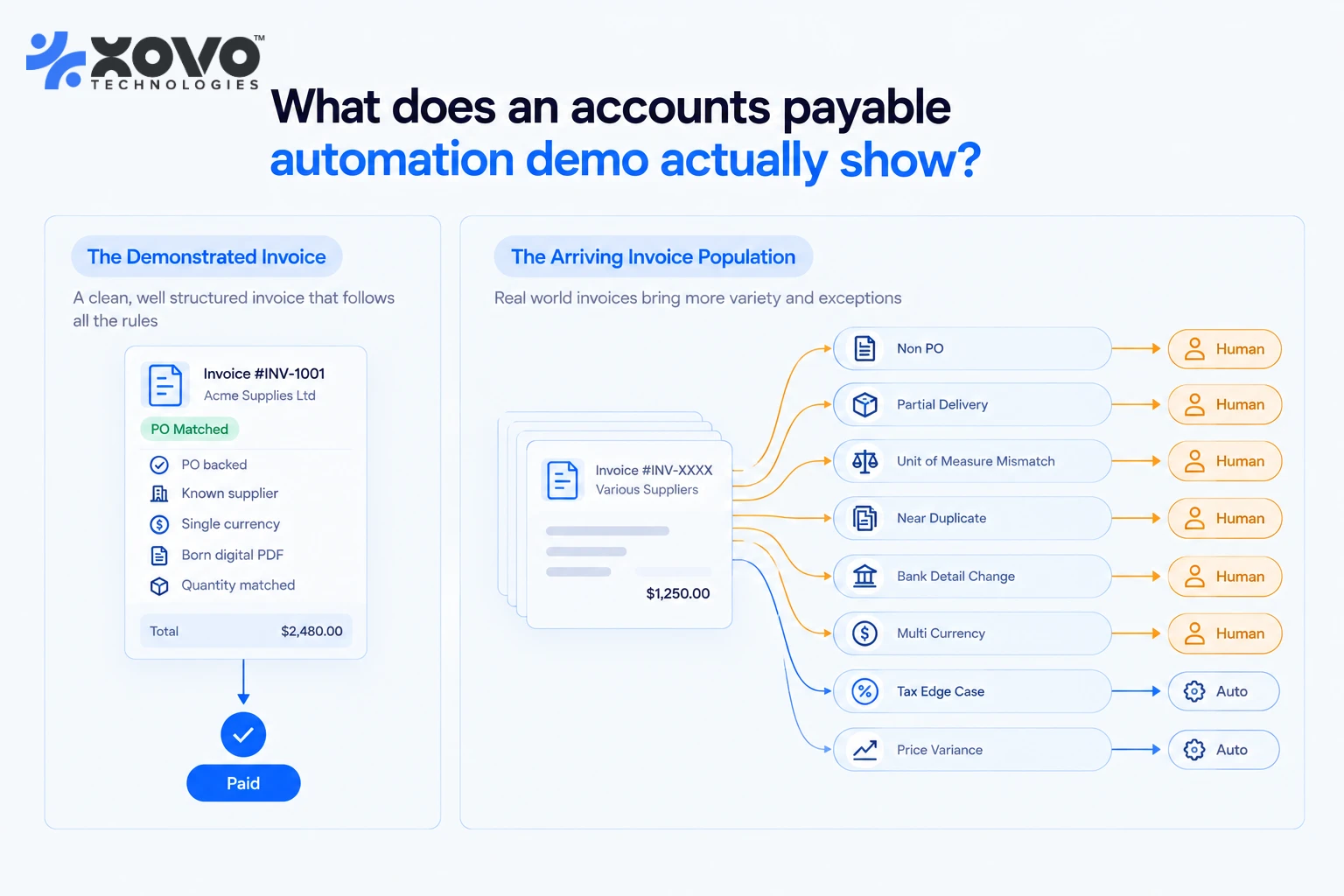
It shows one invoice. That invoice is almost always the same invoice, whichever logo is on the slide deck.
It is PO-backed. It comes from a supplier already set up in the vendor's sandbox, with bank details on file and a tax registration that validates. It is a born-digital PDF, not a phone photograph of a delivery note stapled to a remittance slip. It has three line items, all in one currency, all in the same unit of measure as the purchase order. The quantity billed equals the quantity received, because the goods receipt note was posted the day before by someone whose job in the demo is to have already done it. Tax is a single rate on the whole document. Nobody changed the supplier's bank account last Tuesday.
Invoice capture reads it in about two seconds. Purchase order matching lights up green. The approval routes to a named approver who clicks once on a phone. Payment is scheduled. The whole thing takes ninety seconds and it is genuinely impressive, because that invoice is genuinely easy and the software is genuinely good at easy invoices.
Now look at what your AP inbox received yesterday. Non-PO spend from a marketing agency with a scanned signature. A partial delivery where the supplier billed for twelve and the warehouse received nine, with three on backorder. A supplier who prices in cases and a buyer whose purchase order is in eaches. A duplicate that is not an exact duplicate, because the second copy carries a different invoice number and one extra freight line. An invoice in euros against a purchase order raised in sterling, with the exchange rate applied on a different date than your treasury policy assumes. A credit note referencing an invoice from a legal entity you merged eighteen months ago. And an email from a supplier contact nobody recognises, asking you to update their bank details before the next payment run.
Every one of those lands on a human desk. That is the exception rate, and it is the only number in an accounts payable automation software comparison that changes the answer.
The gap between the demo and the queue is not vendor dishonesty. It is a sampling problem. A demo is a sales asset built from the easiest 80% of the population, because the easy 80% is where the technology is unambiguously strong. Your business case, meanwhile, is built almost entirely from the hard 20%, because that is where the labour still sits after go-live.
What does a demo environment hide?
Five things are missing from every sandbox, and each of them generates exceptions that have nothing to do with how well the software reads a page.
A real supplier master is the first. The vendor's sandbox holds a few dozen supplier records, each created once, each with one bank account, one tax registration and one remit-to address. Yours holds thousands of records accumulated over a decade of trading and at least one acquisition. The same legal entity appears three times under different spellings. Records marked active last traded years ago. Two records share a VAT number and neither is flagged. Matching an invoice begins with identifying the supplier, so a duplicated supplier record produces a fallout that the invoice itself did nothing to cause.
Historic pricing disputes are the second. In the sandbox the contract price, the purchase order price and the invoice price are the same number. In a live supply base there are open disputes carried for months, rebates agreed verbally and never written into the item master, price increases notified by email to a buyer who has since left, and suppliers billing the new price against an old purchase order. All of that arrives as price variance, and no model can tell you which instances are legitimate, because the answer lives in an email thread rather than on the document.
A live ERP with custom fields is the third. The demo posts into a near-vanilla instance. Yours has a mandatory custom field added for a project that ended in 2019 and never removed, a validation rule that blocks postings into closed periods, document number ranges that need extending each year, an intercompany posting rule, and at least one workflow written by a contractor who no longer answers email. Every one of those is a place where a technically successful write-back still fails.
Month-end volume is the fourth. Demos process one invoice at a time. Real accounts payable volume is lumpy: it clusters around supplier billing cycles and around month end, which is exactly when approver attention is thinnest and the accrual deadline is hard. Ask a vendor what the exception queue looks like on the third working day of a month, not on an average day.
The approval chain with people missing is the fifth. Every approver in a demo is present, notified and responsive. In production the budget holder is on annual leave, the delegate was never configured, the cost centre owner has left, and one step in the chain can only be completed by a person in a different time zone. Out-of-office handling and delegation tend to be configured late, and they account for a large share of the cycle time that later gets blamed on the platform.
The fix is cheap to ask for and rarely offered. Request a sandbox loaded with an export of your own supplier master and your own chart of accounts before the second demo. A vendor who can do that in a week is telling you something true about their implementation team.
Why the exception rate decides the business case
Straight-through processing is the share of invoices that travel from receipt to approval to payment with no human keystroke. The exception rate is its complement in practice: the share that falls out and needs a person. Those two numbers govern whether an AP automation ROI model holds together, and they are the two numbers most vendor comparison pages do not print.
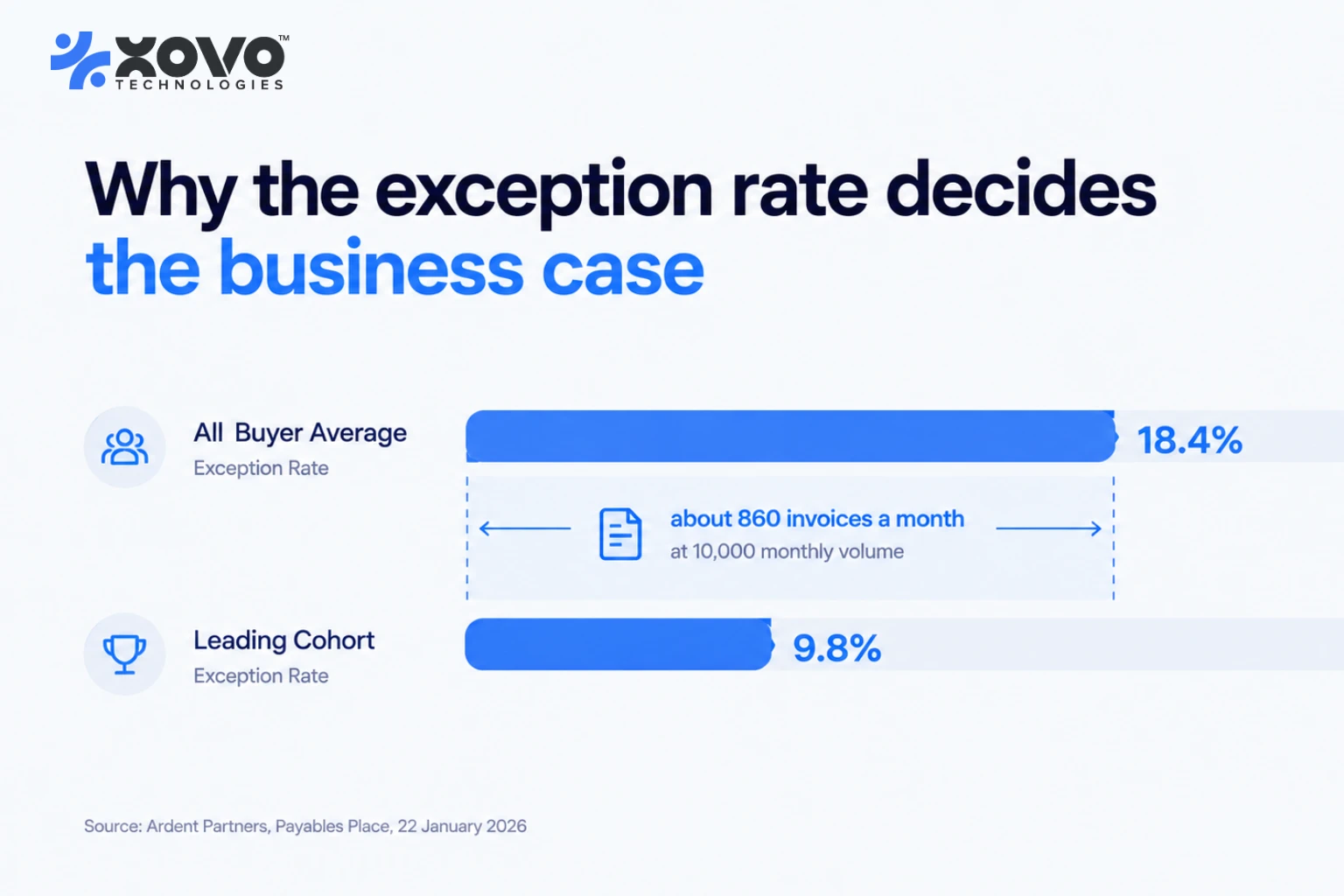
Ardent Partners, whose State of ePayables research has run for two decades, published its 2026 benchmark set on Payables Place on 22 January 2026. The all-buyer average cost to process a single invoice was $9.84. Average invoice cycle time was 8.2 days. The average exception rate was 18.4%, and 57% of suppliers were enabled to submit invoices electronically. Ardent reported that its leading cohort ran exception rates 47% below the rest of the market, processed invoices in a straight-through manner at roughly 1.8 times the rate of everyone else, and carried a cost per invoice 79% below their peers.
Do the arithmetic on the exception line, because it is the line that pays for the project. A 47% reduction against an 18.4% baseline lands near 9.8%. That is a gap of roughly 8.6 percentage points of invoice volume. In a department handling 10,000 invoices a month, 8.6 points is about 860 invoices a month that stop being someone's afternoon. This is arithmetic on Ardent's published figures, not a vendor claim, and it is the whole argument.
| Metric | All-buyer average, Ardent Partners January 2026 | Ardent's leading cohort | What the gap is worth on 10,000 invoices a month |
|---|---|---|---|
| Invoice exception rate | 18.4% | 47% lower, near 9.8% | About 860 fewer invoices a month reaching a person |
| Cost per invoice | $9.84 | 79% lower than peers | The saving depends on how much of that cost is labour |
| Invoice cycle time | 8.2 days | 79% faster than other groups | Early-payment discount capture becomes reachable |
| Straight-through processing | Baseline | About 1.8 times the volume | The single metric a pilot should be scored on |
| Suppliers enabled for electronic invoicing | 57% | 1.4 times more suppliers enabled | Supplier onboarding, not software, sets this ceiling |
Ardent kept measuring through 2026, and the follow-up is blunter. In the State of AP 2026 series published on Payables Place on 11 August 2026, high exception rates and slow invoice and payment approvals tied as the top challenge reported by AP leaders, each named by 48%, with lack of visibility into invoice and payment data third at 22%. Ardent makes the causal link explicit in that post: exceptions slow approvals, and delayed approvals create payment bottlenecks and supplier friction. The research draws on 194 accounts payable, procure to pay and finance leaders.
Read those two datasets together and the conclusion is uncomfortable for the category. Adoption of accounts payable automation technology is no longer the constraint. In Ardent's 8 September 2026 instalment, document imaging and scanning was deployed at 72% of organisations, automated routing and approval workflows at 68%, and automated data capture and extraction at 62%. Most finance teams already own invoice automation software. They still have an exception problem. Buying more capture accuracy does not fix a matching and master-data problem, which is why the shortlist question is not "which vendor reads invoices best" but "which vendor makes the fewest invoices stop". It is the same evidence-over-claims discipline we set out for scoring a screening model on its own outputs: judge the tool on your data, not on the vendor's.
What counts as an invoice exception, and what does not?
An exception is any invoice that cannot complete its intended path without a human decision. That definition matters because vendors and finance teams count it differently, and a comparison built on incompatible definitions is worthless.
Three distinctions are worth pinning down before you ask any vendor for a number. First, a capture failure is not a matching failure: an invoice where the OCR misread a total is a data problem, while an invoice where the quantity billed exceeds the quantity received is a business problem, and only the first one improves when the model improves. Second, an approval is not an exception. An invoice routed correctly to a budget holder who approves it in the normal invoice approval workflow has not fallen out of anything, and counting routine approvals as touches makes a straight-through processing figure look far worse than it is. Third, an invoice that a rule auto-resolves inside a tolerance is a resolved exception rather than a clean invoice, and you want it counted separately so you can watch the tolerance drift.
When you ask a vendor for its exception rate, ask which of those three it is counting. If the answer is vague, the number is decorative.
Three-way matching, two-way matching and tolerance thresholds
Two-way matching compares the supplier invoice against the purchase order: price and quantity ordered. Three-way matching adds the goods receipt note, so the comparison becomes purchase order against receipt against invoice, and the question changes from "did we agree to buy this" to "did we actually get it". A four-way match, used mainly where inspection is contractual, adds a quality or acceptance document. Services spend usually runs two-way, or against a service entry sheet, because there is nothing to receive into a warehouse.
The choice is not a preference. It follows from what you buy. A distributor moving physical goods needs the receipt leg, because that is where over-billing shows up. A professional services firm buying mostly time and subscriptions gets nothing from it, and configuring three-way matching on spend with no receipting discipline manufactures exceptions rather than catching them.
Tolerances are the dial that decides how many of those comparisons need a person. A tolerance threshold is the variance the system will absorb without stopping the invoice, and it is normally expressed two ways at once: a percentage and an absolute cap, applied per line or per document, with separate settings for price and for quantity. A tolerance of 2% or 25 pounds, whichever is lower, means a 12 pound rounding difference posts and a 400 pound surcharge stops. Set the percentage alone and a small variance on a large invoice passes unexamined. Set the cap alone and low-value lines clog the queue.
Two design points matter more than the numbers themselves. Tolerance should be asymmetric: under-billing in your favour can post automatically, over-billing should not, and a system that treats both the same is either losing you money or wasting your time. And tolerance consumption should be reported, not merely applied, because a threshold that quietly absorbs 4% on every line from one supplier is an unmonitored spending authority rather than an efficiency. Whoever owns the number should see a monthly report of what it absorbed, by supplier.
The full exception taxonomy, and what each type costs you
Here is the part no vendor comparison page prints. Every product in this category is sold on its exception handling, and almost none of them publish the exception population they handle. Below is that population, enumerated, with our read on whether an agent can close each type unattended and what drives the cost of clearing it by hand. The last column is the demonstration to demand.
Print this table and take it into the vendor call. Work down it row by row. Note which rows the vendor offers to show on your data, which rows they offer to show on their own, and which rows they talk around. That distribution will tell you more than any scorecard, and it is the thing you cannot get from a features page.
The ordering comes from our own deployment work on procurement and accounts payable invoice workflow automation, so treat it as first-party observation rather than survey data. We have deliberately not attached frequencies to the rows. Frequency is a property of your spend profile, and any percentage we printed would be somebody else's.
Cost to clear by hand follows a simple shape: C = (T x R) + D. T is the median handling time in minutes for that exception type, R is your fully loaded AP cost per minute, and D is the cost of delay, which is zero unless the invoice is discount-eligible or the supplier puts your account on stop. You have to fill in T and R from your own data; we cannot give you either without inventing them. What we can tell you is what drives T, and it is almost never the difficulty of the decision. It is the number of parties who have to respond. An exception a clerk resolves inside one system takes minutes. An exception that needs a buyer to reply takes a day. An exception that needs the supplier to send a document takes a week, and the clock includes their internal process, not only yours.
| Exception type | Why it happens | Can an agent close it unattended? | What drives the cost to clear by hand | What to make the vendor demonstrate |
|---|---|---|---|---|
| Quantity variance | Billed quantity exceeds received quantity, or a receipt was posted against the wrong line | Partly. Auto-close inside tolerance, otherwise it is a commercial decision | Two parties: the warehouse to confirm, the buyer to accept or dispute | An over-billed line against a posted receipt, routed to the buyer rather than to AP |
| Missing goods receipt | Goods arrived, nobody posted the GRN, so the invoice has nothing to match against | Yes, with a wait-and-retry rule and an ageing alert | One party, and the delay is the cost rather than the labour | The retry window, who gets chased, and what happens on day seven |
| Price variance | Contract price moved, a rebate was never loaded, or the PO carries a stale price | Yes inside tolerance, no outside it | The buyer, and often the supplier's account manager as well | Breaches routing to the buyer with PO price and contract price side by side |
| Unit-of-measure mismatch | PO raised in eaches, invoice billed in cases, or metric against imperial | Yes, if a conversion factor exists per supplier and item | Low labour, high repeat rate until the item master is corrected | Import your item master, then show a missing conversion failing safely rather than guessing |
| Partial delivery | Supplier bills twelve, warehouse receipts nine, three on backorder | Yes, with open-quantity logic and a PO that stays open | One party, but it recurs on every later delivery against the same PO | A three-way match against a partial receipt, then the follow-on invoice for the balance |
| Missing purchase order | Services, subscriptions and professional fees bought with no requisition | Partly. Needs GL coding plus a named cost-centre owner to approve | Finding the owner is the cost, not the coding | Coding accuracy on 200 of your own non-PO invoices, unedited |
| Duplicate and near-duplicate | Resubmission under a new number, a statement chased as an invoice, or an extra line added | Partly. Exact-match detection is trivial, fuzzy matching is not | Low per item, high in aggregate, and the failure mode is a double payment | The near-duplicate rather than the exact duplicate, with match confidence shown |
| Freight and surcharge lines | Delivery, fuel, packaging or small-order charges that were never on the PO | Partly. Only where unplanned delivery costs have a defined account and a cap | Low labour per item, very high volume, and the place tolerance leaks | An unplanned freight line posting to a named account within a cap |
| Tax mismatch | Reverse charge, mixed rates on one document, withholding, or an unregistered supplier | Partly. Rules are configurable, judgement is not | Escalates to tax or finance, so it waits for a specialist | A reverse-charge invoice posting correctly into your ERP with the tax code visible |
| Currency and FX rounding | Invoice currency differs from the PO, or the rate date differs from treasury policy | Yes, if rate source and rate date are configurable per company code | Low labour, but it leaves small unexplained balances that audit will query | The posting entry including the exchange rate difference account |
| Credit notes and rebills | Returns, short deliveries, pricing corrections, or a credit against a merged legal entity | Partly. Referenced credits yes, unreferenced credits no | Matching a credit to the right original is the work, and it is manual | An unreferenced credit note, and how it is applied against a future payment run |
| Supplier bank detail change | A change request arriving by email mid-cycle | No. This is a control, not an automation | Should be expensive on purpose | Where the change is held, who approves it, and what independently verifies it |
Four rows deserve more than a table cell.
Quantity variance and a missing goods receipt look identical in the exception queue and are completely different problems. Both present as "invoice quantity does not agree with received quantity". One means the supplier over-billed and you have a commercial dispute on your hands. The other means your own warehouse has not done its paperwork and the invoice is perfectly correct. If your platform collapses both into a single reason code, you cannot tell whether to call the supplier or the site manager, and your reported exception rate will make the supply base look worse than it is. Ask every vendor whether a zero receipt and a short receipt carry separate reason codes. Plenty do not.
Freight and surcharge lines are the quiet expensive one. Individually they are small, which is exactly why they sit inside tolerance and post without review, and collectively they are a line of spend nobody owns. The correct handling is not a looser tolerance. It is a defined account for unplanned delivery costs, a per-document cap, and a monthly report of what landed there. Unplanned delivery cost is a standard concept in every major ERP and most platforms support it. Few implementations configure it on day one, because it never appears in a demo.
Supplier bank detail changes are the row where automation is the wrong instrument. This is fraud surface, not throughput. The Association for Financial Professionals reported on 14 April 2026, from its 2026 Payments Fraud and Control Survey of 465 treasury practitioners fielded in January 2026, that 76% of US organisations experienced attempted or actual payments fraud during 2025 and that 74% were affected by business email compromise. The FBI's Internet Crime Complaint Center put 2025 business email compromise losses at $3.05bn in its 2025 annual report. The category is responding: Basware announced a binding agreement to acquire the Paris-based payment fraud prevention firm Trustpair on 26 August 2026, explicitly to extend invoice controls into supplier bank account verification, and Ardent's coverage of that deal noted Trustpair's database of more than 10 million validated supplier-bank account pairs across over 190 countries. If your shortlist treats supplier onboarding and bank detail verification as a settings page rather than a controlled process with an independent verification step, the automation is running ahead of the control.
Missing purchase order is the row that decides the size of the prize. If 35% of your invoice volume has no purchase order behind it, three-way matching cannot touch that 35% by definition, and a vendor demonstrating flawless 3 way matching in accounts payable is demonstrating excellence on the part of your problem you did not need help with. Get your non-PO percentage before the first demo. It reorders the shortlist. It is also the strongest argument for attacking tail spend management at the requisition end rather than the invoice end, which is a procure to pay design question rather than an AP one, and we have written separately about when to build, buy or extend a procure-to-pay stack.
One warning about the "can an agent close it unattended" column. Partly means partly, and the boundary is judgement rather than configuration. Rule-based automation and scripted bots fail on these rows in a particular way: they close the cases that were already closable and escalate everything else, which is why so many teams found their exception rate unmoved after a bot programme, an outcome we picked apart in why RPA stalls on accounts payable. An agent that can read the contract, the email thread and the previous three invoices from that supplier closes more of them. It still should not close a bank detail change, and a vendor who says it can has told you what their control model is worth.
A comparison table that encodes a decision
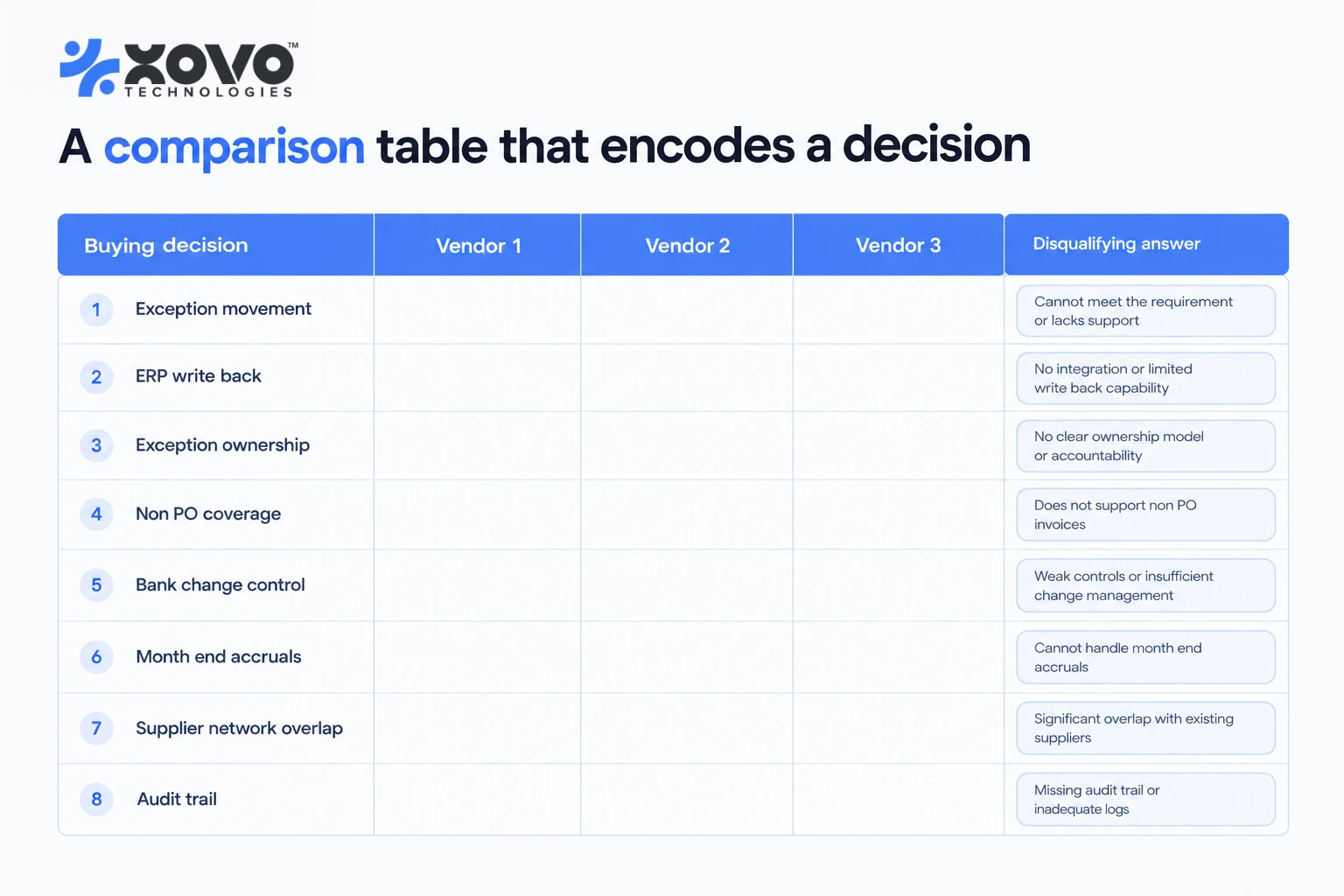
Feature matrices are easy to write and useless to read, because every vendor ticks every box. A useful accounts payable automation software comparison asks what decision you are making, what evidence would settle it, and what answer should end the conversation.
| The decision you are actually making | Test it with your own data this way | Evidence that qualifies a vendor | Answer that should disqualify one |
|---|---|---|---|
| Will exceptions fall, or just move? | Load 500 real invoices including your worst 50. Count how many complete with no human keystroke | A measured straight-through rate on your file, with exception reasons broken out | "Our OCR is 99% accurate." That is a different question |
| Does the ERP write-back close the loop? | Post 50 invoices into a copy of your ERP, including a credit note and a reverse-charge invoice | Posted documents you can open in your ERP, with correct GL, cost centre and tax codes | An integration that produces a CSV for someone to import |
| Who resolves an exception, and where? | Break a match deliberately and follow the invoice | The buyer or budget holder resolves it in their own tool, not AP in a second inbox | Every exception routes to the AP queue by default |
| Can it handle non-PO spend? | Run only your non-PO invoices through, with no purchase order to lean on | Coding accuracy measured against your own historical postings | A demo that only ever shows PO-backed invoices |
| Are supplier bank changes controlled? | Ask to see the change request workflow end to end | An independent verification step and an approver who is not the requester | "The supplier updates it in the portal" |
| What happens at month end? | Ask how unposted and unapproved invoices become accruals | An accrual report that reconciles to the ERP without manual adjustment | Silence, or a spreadsheet |
| Will your suppliers actually use it? | Count how many of your top 100 suppliers already transact on that network | Named supplier overlap and a documented onboarding programme | A supplier portal with no onboarding resource attached |
| Does it survive an audit? | Ask for the audit trail on one exception that was overridden | An immutable log naming the person, the reason, and the before and after values | Logs that show the system user for human decisions |
Run that table against three vendors with the same 500 invoices and the shortlist orders itself. Run a feature matrix instead and you will choose on price, which is how organisations end up with accounts payable automation technology that performs well and changes nothing.
One caveat on analyst research, because buyers ask. Gartner published its 2026 Magic Quadrant for Accounts Payable Applications on 18 June 2026, authored by Miles Onafowora and David Condon, evaluating 12 vendors, with Basware, Coupa and Medius among those placed as Leaders and HighRadius placed as a Challenger, according to those vendors' own announcements. Ardent Partners, in its 27 August 2026 guide to the AP automation and payments technology market, assessed solutions across 32 capabilities in six categories and noted that the wider market holds more than 200 providers, of which it examined 10 in depth. Both are useful for building a longlist. Neither can tell you your exception rate, because neither has seen your invoices. Use gartner accounts payable invoice automation research to find candidates, and your own 500-invoice file to rank them.
Mid-article CTA. If you are at the shortlist stage and want the 500-invoice test run properly, our AI Procurement Agent team will put your own invoice file through a matching and exception test and give you the breakdown by reason code, whether or not you end up buying anything from us.
Does the ERP write-back work, or does someone re-key it?
This is the second question that reorders a shortlist, and it is almost never asked in a demo, because the demo ends at approval.
An invoice is not finished when it is approved. It is finished when it is a posted document in your ERP, with the right general ledger account, the right cost centre, the right tax code, the right period, and a payment term your treasury team recognises. Everything between approval and that posted document is where ERP integration quietly becomes a person with two screens open.
Four things go wrong, in our experience, and they go wrong in this order.
The integration is a file, not an interface. A vendor says it integrates with SAP or Oracle, and what that means is a nightly export that a finance clerk imports. It works. It also means every failed record becomes a manual investigation, and there is no idempotency, so a re-run creates duplicates in the ledger.
The write-back is one-directional. The invoice posts, but nothing comes back. Payment status, clearing documents and reversals stay in the ERP, so the automation platform's dashboard and the ledger drift apart within a quarter, and the team stops trusting the dashboard.
Master data is not synchronised. The supplier exists in both systems under different identifiers, or a cost centre was closed in the ERP and is still selectable in the automation tool. Every invoice coded to a dead cost centre becomes an exception with no business cause at all. This is the single most common source of avoidable exceptions we see in the first ninety days after go-live.
Tax and credit notes are handled last. Straightforward invoices post. Reverse charge, withholding, mixed-rate documents and credit notes were scoped for phase two, and phase two is where the project's credibility gets spent.
Ask for a posted document. Not a screenshot, not a confirmation message inside the automation tool. Ask the vendor to post fifty invoices into a copy of your ERP and then open them in your ERP in front of you. A vendor whose write-back is real will say yes quickly. A vendor whose write-back is a file will offer to show you the file.
How does GL coding and cost-centre assignment actually work?
For PO-backed spend, coding is inherited rather than predicted. The general ledger account and cost centre come from the purchase order line, which took them from the requisition, which took them from the requester's default. Nothing has to be guessed. This is the strongest argument for pushing more spend onto purchase orders, and it is an argument about coding accuracy rather than about matching.
For non-PO spend there is no source to inherit from, so the platform has to propose the coding itself. The usual mechanism is a model trained on your own historical postings for that supplier, sometimes narrowed by the invoice line description, with a confidence score and a threshold below which it asks a person. Accuracy is therefore a property of your history rather than of the vendor. A supplier that has always been coded to one account is easy. A supplier whose spend splits across eleven cost centres depending on which project consumed it is not, because the answer is not on the invoice at all.
That gives you a test to run. Take 200 non-PO invoices you have already posted, hide the coding, and ask the platform to predict it. Compare against what you actually did. Two numbers come out: the share coded correctly without human input, and the share the platform correctly declined to code. The second number matters more than the first. A system that guesses confidently on genuinely ambiguous spend creates a reclassification exercise at year end rather than an exception at invoice time, and reclassification is harder to see and far more expensive to fix.
Cost-centre assignment carries one requirement that coding accuracy hides. Somebody has to own each cost centre, and that ownership list has to be current. A correct code routed to a person who left in March is still an exception, and it is an exception the vendor will quite reasonably tell you is not their fault.
Can QuickBooks or Xero carry accounts payable automation on their own?
Sometimes, and the honest answer depends on whether you raise purchase orders.
Intuit's own documentation describes QuickBooks Online AP Automation as extracting information from bills you upload or that arrive through the QuickBooks Business Network and creating the transaction automatically, accepting PDF, JPEG, JPG, GIF and PNG files, and notes that the feature may not be available in all accounts yet. That documentation describes capture and transaction creation. It does not describe purchase order matching or three-way matching. For a services business with mostly non-PO spend, accounts payable automation quickbooks users need is often exactly that: good capture, sensible coding, approval routing, and nothing else. For a distributor receiving goods against purchase orders, capture alone leaves the hard part untouched.
Xero accounts payable automation has a similar shape with one notable addition. Xero supports e-invoicing over the Peppol network, and according to Xero's own product documentation, e-invoices received that way arrive as draft bills without manual data entry, because the data is structured at source rather than extracted from an image. That is a materially different mechanism from OCR, and it is worth more than any capture accuracy claim, since a structured invoice cannot be misread. The constraint is coverage: it only helps for the suppliers who send that way.
The practical rule we use. If your invoice volume is under roughly 500 a month, your spend is mostly non-PO, and your approvals are simple, native tooling plus disciplined coding is usually enough, and accounts payable automation for small business buyers rarely justifies a separate platform. Above that, or as soon as goods receipting and purchase order matching enter the picture, you are buying a matching engine, and the accounting package is the destination rather than the solution.
PO flip, self-billing and supplier portals: who does the data entry
Every exception type in the taxonomy above assumes the supplier typed the invoice and you received it. Three mechanisms change that assumption, and they are worth more than capture accuracy because they remove the discrepancy at source instead of detecting it afterwards.
PO flip means the supplier logs into your portal, opens the purchase order you sent them, and converts it into an invoice with quantities and prices already populated. They can amend quantities to reflect a partial delivery. They cannot invent a price the purchase order does not carry, and they cannot bill in a unit of measure you did not order in. Price variance and unit-of-measure mismatch become structurally impossible on flipped documents, which is a stronger result than catching them reliably. The cost is supplier effort, and small suppliers sending a handful of invoices a year resent portals, so flip earns its keep on your highest-frequency suppliers by document count rather than by spend.
Self-billing, also called evaluated receipt settlement, goes further. You generate the invoice yourself from the purchase order and the goods receipt, and the supplier sends nothing. There is then nothing to match, because both sides of the comparison came from your own records. It is common in automotive and grocery supply chains with high-frequency deliveries and contractually fixed pricing. It also requires a written self-billing agreement with each supplier and correct tax treatment on documents you raise on their behalf, which is why it remains a niche rather than a default. Where it fits, it is the only mechanism on this page that takes an entire exception class to zero rather than reducing it.
Supplier portals are the enabling layer for both, and they are also the most over-sold item in the category. Ardent's 8 September 2026 data shows self-service supplier portals deployed at only 35% of organisations, with a further 42% planning implementation within 24 months, the highest planned adoption of any category Ardent tracked. Read that gap between deployed and planned carefully. A portal is not a feature you switch on; it is an onboarding programme with a licence attached, and the work is chasing suppliers rather than configuring software. Count how many of your top 100 suppliers by invoice count already transact on a candidate vendor's network before you give the portal any weight at all.
The design question underneath all three is who does the data entry, and the honest ranking is that structured submission beats portal entry, portal entry beats capture, and capture beats typing. Most comparison pages only discuss the last two, because those are the two a software vendor can sell you on their own.
How much does accounts payable automation cost, and when does ROI arrive?
Vendors price per invoice, per user, per module, or as a platform fee with a volume band, and the headline number is rarely the number you pay. Build the model from the exception side instead, because that is the side that varies.
Start with the metric you can source. Ardent Partners put the all-buyer average fully loaded cost at $9.84 per invoice in its January 2026 benchmark. Multiply by your monthly volume for a current-state number. Then split that volume into the portion that is already clean and the portion that is not, using your own data rather than an assumption, and be honest that software attacks the clean portion first.
The AP automation ROI case then rests on three movements, and they arrive at different times. Capture and routing savings arrive in month one, and they are real but smaller than the business case usually assumes, because those steps were partly automated already. Cycle time savings arrive around month three and only convert to cash if you hold supplier agreements with early-payment terms to capture. Exception reduction arrives in month nine or later, because it depends on master data cleanup, tolerance tuning and supplier behaviour, none of which the vendor controls.
That timing is why so many implementations are judged a disappointment at month six. The accounts payable automation benefits that show up first are the least valuable ones. The benefit that justifies the project shows up last.
Dynamic discounting deserves its own line in the model, because it is the benefit that converts most directly into cash and the one most often claimed without qualification. A static early-payment term is fixed: 2/10 net 30, the same offer to every supplier. Dynamic discounting is a sliding scale where the discount shrinks as the payment date approaches, so settling on day four is worth more than settling on day nine. Both depend on the same precondition, which is an approved invoice early enough to pay early. Ardent put average cycle time at 8.2 days in its January 2026 benchmark, and a ten-day discount window against an 8.2-day average cycle leaves most invoices arriving at the decision point with a day or two of runway, assuming nothing goes wrong. Cut the cycle and the window opens. That is why cycle time is a cash metric rather than a comfort metric. The constraint that stops most programmes is not the software: the discount has to be funded from working capital, and treasury has to agree that paying early beats holding the cash, which is a conversation that should happen before the business case is written rather than after.
Two cost lines get left out of business cases, and both are yours rather than the vendor's. Supplier onboarding is one, and a portal with no onboarding programme behind it is a licence fee. Master data remediation is the other, and it is the unglamorous work that determines your exception rate more than any model does.
We published a three-way matching deployment on the accounts payable side showing the shape of this for a mid-market distributor, where around 78% of invoices cleared with no human touch. It is labelled a representative engagement rather than an audited third-party result, which is the only honest way to read any vendor's accounts payable automation case study, including ours. Read the exception reason codes in a case study before you read the headline percentage.
A pilot scorecard: what to measure in week one and month three
A pilot that reports "it went well" has failed, because nobody can act on it. Score it against a fixed set of numbers agreed before the first invoice goes in, and measure the same numbers twice, because what week one tells you and what month three tells you are different things.
Week one tells you about your data. Month three tells you about your process. Neither tells you much about the software until you separate them, and separating them is the entire reason for measuring twice instead of once.
| Measure | Week one: what it tells you | Month three: what it tells you | Where the number comes from |
|---|---|---|---|
| Straight-through rate | The ceiling your current data allows | Whether configuration moved the ceiling | Invoices completed with no human keystroke, over total invoices |
| Exception reason distribution | Which two or three codes own most of the volume | Whether the top codes changed or merely shrank | Platform reason codes, mapped to your own taxonomy |
| Master-data share of exceptions | How much of the problem needs no licence to fix | Whether the remediation actually happened | Exceptions caused by supplier, item or cost-centre records |
| Resolver split | Nothing yet. AP resolves everything in week one | Whether work moved to buyers and budget holders | Share of exceptions closed by someone outside AP |
| Median touches per exception | Baseline handling effort | Whether resolution got shorter or simply moved desks | Count of human actions per exception, not per invoice |
| ERP posting failure rate | Whether the interface is real | Whether it holds under month-end volume | Documents rejected by the ERP, over documents sent |
| Tolerance auto-resolve share | How much is passing without review | Whether tolerance is absorbing more than it should | Invoices closed inside tolerance, broken out by supplier |
| Accrual reconciliation | Untested at this point | Whether month end works without a spreadsheet | Variance between the accrual report and the ledger |
Two of those predict whether the rollout succeeds, and neither is the one that gets presented to the steering committee.
The first is the master-data share of week-one exceptions. If a large part of your fallout is caused by duplicate supplier records, missing unit conversions, closed cost centres and stale tax registrations, that is good news. None of it requires the vendor and all of it is fixable by your own team inside a few weeks. If instead your fallout is mostly genuine commercial disagreement, over-billing, disputed prices and unreferenced credits, the ceiling is lower and no amount of configuration will move it, because those invoices are supposed to stop. Knowing which case you are in during week one prevents you from committing to a month-nine target you were never going to hit.
The second is the resolver split at month three. If AP is still clearing every exception, the cost has not gone anywhere; it has been re-housed in a nicer interface. The programme only pays when the person who created the discrepancy is the person who resolves it, which means a buyer who raised a purchase order in the wrong unit of measure sees that exception in their own tool rather than in an AP queue. That is a routing and change-management outcome rather than a software feature, which is precisely why it is the first thing quietly dropped when a project runs late. We covered the routing design itself in where agents replace the rules engine in enterprise workflows.
Set the pilot up so both numbers are actually available. That means agreeing a shared exception taxonomy with the vendor in week zero, mapping their reason codes onto yours, and insisting that every exception record carries the identity of the person who closed it. If the platform cannot report who resolved what, you cannot measure the only outcome that matters, and you will spend month four arguing about whose fault that is.
Accounts payable automation best practices that survive go-live
Most published accounts payable automation best practices are process hygiene that was true before software existed. These are the ones that change outcomes, ordered by when you should do them.
Measure your baseline exception rate before you shortlist, broken out by reason. You cannot argue with a vendor's straight-through processing claim without your own denominator, and the exercise usually reveals that two or three reason codes account for most of the volume.
Fix supplier master data before go-live, not after. Duplicate supplier records, stale bank details, missing tax registrations and dead cost centres generate exceptions with no business cause. This is the highest-return week of work in the entire programme, and it needs no licence.
Push exception resolution to the person who caused it, and put a date in the plan for when that routing change happens. It is the item that slips.
Review tolerances quarterly against what they absorbed, by supplier, and write down who owns each number.
Separate the supplier bank change process from everything else, with an independent verification step and an approver who is not the requester. Tie it to your wider supplier due diligence rather than treating it as an AP task, which is the argument we made in continuous supplier monitoring versus annual vetting.
Instrument straight-through processing and exception reason codes from day one, and report them monthly to the same audience that approved the business case. Spend under management and cost per invoice are useful accounts payable KPIs, but the exception reason distribution is the one that tells you what to fix next.
Do not automate an approval chain you would not defend in an audit. Digitising a weak control multiplies it.
What e-invoicing mandates do to the shortlist in the UK, Canada and Australia
Regulation is quietly resolving part of the capture problem, because a structured invoice does not need to be read.
The mechanism is worth stating precisely, because it decides which part of the exception taxonomy a mandate helps with. A Peppol invoice arrives as structured XML under the BIS Billing profile, with supplier identifier, line quantities, unit codes, tax categories and totals sitting in named fields. The French regime also permits a hybrid format that carries the structured data inside the PDF. In both cases there is no extraction step, so capture failures disappear as a class: nothing was read, so nothing could be misread. What does not change is matching. A perfectly structured invoice can still bill twelve against a receipt for nine, still quote a price your purchase order does not carry, still arrive with no purchase order reference and still come from a supplier whose bank details changed last week. Mandates fix the input format. They do not fix the disagreement, and a vendor who conflates the two is selling you the easy half.
France is the live example this month. The French tax administration confirms that from 1 September 2026, businesses subject to the rules must use an approved platform, a plateforme agréée, to transmit and receive electronic invoices and to send transaction and payment data to the administration. Reception capability applies to every registered business from that date regardless of size, while issuance obligations are phased, with the smallest businesses following in September 2027. Any organisation with a French entity has a dated requirement in its inbox right now, and it is a reception requirement first, which makes it an accounts payable problem rather than a billing one.
For accounts payable automation uk buyers the timeline is longer and the direction is set. Following the consultation that closed in May 2025, the UK government published its response on 26 November 2025 confirming mandatory electronic invoicing for all VAT invoices from 2029, and in June 2026 confirmed Peppol as the interoperability framework, with a detailed roadmap expected at the Budget in November 2026. Nothing forces action in 2026. Everything argues against buying a platform in 2026 that cannot speak Peppol.
Accounts payable automation australia buyers sit between the two. Electronic invoicing for business-to-government transactions with federal agencies has been mandatory since July 2022, and the Australian Peppol Authority, administered by the Australian Taxation Office, has set adoption targets for non-corporate Commonwealth entities through 2026, reported by Avalara in September 2025 as at least 30% of invoices received via eInvoicing by 1 July 2026 and automated sending and processing by December 2026. Business-to-business adoption remains voluntary. If you supply the Commonwealth, the network question is already decided for you.
Accounts payable automation canada buyers have the most freedom and the least forcing function, since Canada has no federal business-to-business e-invoicing mandate and electronic invoicing stays voluntary outside federal procurement. That makes network support a commercial choice rather than a compliance one, which in practice means weighting supplier coverage in your own supply base far more heavily than standards compliance in the abstract.
The comparison implication is the same in all four markets. Ask every vendor which networks it is certified on, not whether it supports e-invoicing. The second question has only one answer.
What we would ask a vendor before signing
Eight questions, in the order we ask them.
What was the measured straight-through processing rate at the last three clients of our size and industry, ninety days after go-live, and what were the top three exception reason codes at that point? A vendor that has never measured this at a client will change the subject.
Can we run 500 of our own invoices, including the fifty worst, before contract signature, and will you publish the exception breakdown by reason?
Will you post 50 of those into a copy of our ERP, including a credit note and a reverse-charge invoice, and let us open the posted documents ourselves?
Which of our top 100 suppliers already transact on your network, by name?
Who resolves a quantity mismatch in your default configuration, and what change is needed to route it to the buyer instead?
What happens at month end to invoices that are received but unapproved, and does your accrual report reconcile to the ERP without manual adjustment?
Show us the audit trail for one exception that a human overrode, including the reason, the approver and the prior values.
What does the contract say about the exception rate? If a straight-through processing figure appears in the sales deck, ask whether it can appear in the service schedule. The answer to that last question tells you how much the vendor believes its own number.
We would not choose an AP platform on capture accuracy, because intelligent document processing is now a commodity and the difference between 96% and 99% field accuracy is a rounding error against an 18.4% exception rate. We would not choose one on the strength of a Leaders placement alone, because analyst research ranks vendors against a market definition rather than against your invoice mix. And we would not run a pilot on invoices the vendor selected.
The teams that get the most out of accounts payable invoice workflow automation treat the first year as a data project with a software component, rather than a software project with a data component. The best accounts payable automation programme we have seen inside a mid-market finance function spent its first six weeks on supplier master data and its budget on nothing at all.
Closing CTA. If you are comparing the top accounts payable automation software options and want a second read on the shortlist, we run a fixed-scope evaluation that takes your own invoice file, measures the exception rate by reason code, and scores each candidate against the eight decisions above. Start with our AI automation practice, see how the same exception logic gets built in our agentic AI development work, or read how the pattern applies upstream in procurement cycle time and margins. If you would rather talk it through, book a free audit session and bring last month's exception log.