MVP development services in 2026 typically cost $30,000 to $150,000 for an agency build and run eight to sixteen weeks, and the price is driven far more by scope than by hourly rate. A 90-day MVP is achievable when the product ships one workflow end to end, for one user type, with real authentication, real payments if money moves, and usage instrumentation from day one. Everything that only matters at scale can wait. The decisions that cost the most to reverse later are the data model, the tenancy model, and the paperwork that says who owns the repository.
The failure you are actually buying insurance against
CB Insights rebuilt its startup post-mortem dataset with roughly four times more data and found poor product-market fit behind 43% of failures, ahead of bad timing at 29% and unsustainable unit economics at 19%. Running out of capital showed up in about 70% of cases, but CB Insights now calls that the final symptom rather than the cause. Companies rarely die because the software was bad. They die because nobody wanted it and the money ran out while they were finding that out.
That should decide your scope. An MVP is a question you are paying to have answered, and the only thing worth building is the shortest honest path to the answer. That is what is mvp in software development, stripped of ceremony: the smallest thing that produces a real signal from a real user who could have walked away.
Ask five founders what is mvp in software development and you get five answers, because "minimum" reads in opposite directions across the table. A founder means "everything I need to look credible in front of a customer." A vendor quoting mvp software development services means "the fewest tickets I can defend in a status call." The real definition is evidential: does this build change what you believe about the market? If not, cut it, however cheap it looks. Every other definition of mvp in software development is a project plan wearing a research badge, and a software development mvp that cannot fail is a demo with a login screen.
We run scoping calls every week where a founder arrives with a 60-item feature list and leaves with 9. The 9 are not the easiest 9. They are the ones where, if a user completes them, we learn something no interview would have told us. Our mvp developers do not open an editor until that list exists and the founder has signed it.
What belongs in an MVP, and what is scope creep in a costume
Scope creep rarely announces itself. It arrives dressed as a requirement, usually phrased as "we obviously need." The tell is that the feature protects you against a scenario you have not reached yet.
| Feature | In the MVP | Out of the MVP | Why |
|---|---|---|---|
| One end-to-end workflow for one persona | Yes | Without it there is no signal at all | |
| Email and password plus one SSO provider | Yes | Login friction distorts your activation data | |
| Payments, if money changes hands | Yes | Willingness to pay is the answer you are buying | |
| Event instrumentation and error tracking | Yes | You cannot read the result without it | |
| Admin actions performed by a human in the database | Yes | A person with SQL access is cheaper than an admin panel | |
| Role and permission matrix | Yes | Ship two roles, not a permission engine | |
| Enterprise SSO, SCIM provisioning | Yes | Buy this when a contract requires it, not before | |
| In-app notification centre | Yes | Email covers it for the first hundred users | |
| Custom reporting and dashboards | Yes | Export to CSV and let users pivot in a spreadsheet | |
| Multi-language and multi-currency | Yes | Each one multiplies your QA surface | |
| Mobile app alongside web | Usually | Responsive web answers the same question faster than mvp app development services | |
| SOC 2 controls and evidence collection | Yes, unless regulated | Cost detail below, and it is larger than founders expect |
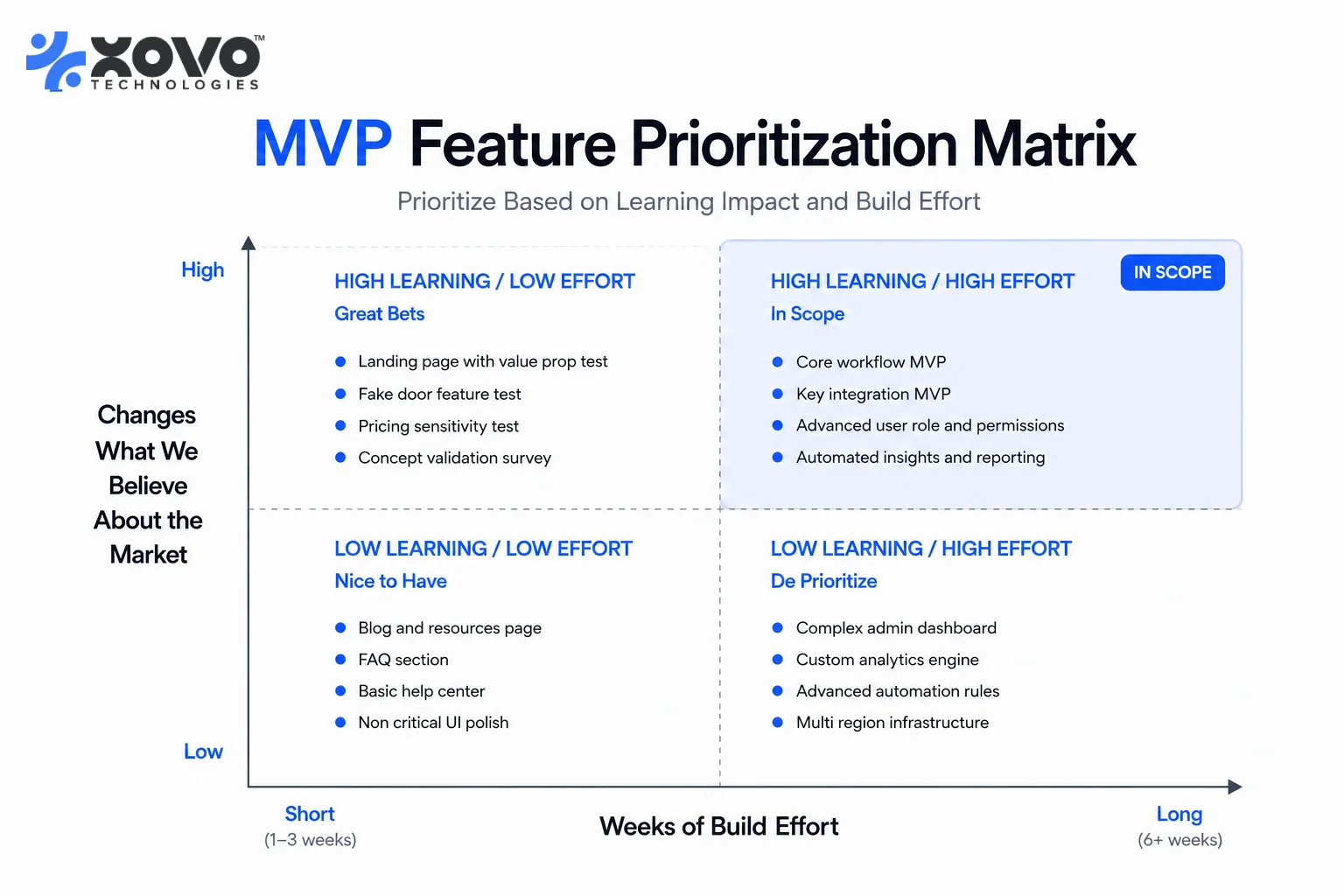
The awkward rows are the ones founders fight over. Admin panels are the classic. Building one costs two to three weeks of a mvp development team's capacity, and for your first fifty accounts a support engineer with database access does the same job in fifteen minutes a day. Custom reporting is the other. It is genuinely hard to build well and almost nobody uses the first version of it.
The honest counter-case: if you are selling into a regulated buyer, or into an enterprise procurement process, some of the "out" rows move up. Scoping mvp development for enterprises is a different exercise from mvp development for startups, because the enterprise buyer's security questionnaire is part of the product. If the deal cannot close without SSO and an audit log, those are not scope creep. They are the workflow. This is also the one situation where custom mvp development genuinely beats a thinner build, because the compliance surface and the product surface are the same surface.
Scoping by product type: web, mobile and SaaS
The type of build changes what "minimum" means. For mvp web development the honest floor is a responsive browser app carrying one workflow, and we would ship mvp web development before anything else because it removes app review from your learning cycle and lets you deploy a fix at eleven at night.
For mvp app development services the floor is higher. Store listings, device permissions, crash reporting and a release process add roughly two weeks before a single feature exists, and every learning cycle after that inherits review latency. Buy mvp app development services when the product depends on camera, location, push or offline behaviour, not because your deck has a phone mockup in it. If you go native, an mvp app development company that already ships to both stores weekly beats a cheaper generalist.
For saas mvp development the floor is different again, because tenancy and billing are load-bearing from the first commit. Any team quoting custom mvp development should be able to name which of the three shapes your product is on the first call, without a spec.
What MVP development services cost in 2026
Pricing for mvp software development services is not secret, but the public numbers need reading carefully. Two named sources beat any listicle here. Clutch, which collects pricing from verified client reviews, reports in its July 2026 pricing guide that most software development companies on the platform bill $24 to $49 per hour, that the full range runs $25 to $150 and above, and that custom software projects typically start around $25,000 and can exceed $500,000. Accelerance, in its 2026 Global Software Development Rates and Trends guide published 24 November 2025, gives senior rates of $60 to $75 per hour in Latin America, $64 to $76 in Central and Eastern Europe and $31 to $41 in Asia, and recorded rates falling year on year: down 7.1% in Latin America, 4.4% in Europe, close to 8% in Asia.
Rates fell. Total mvp development cost mostly did not, because scope expanded to fill the gap. The mvp development cost worth planning against is the cost of the scope you refuse to cut, not the number on anyone's rate card.
| Tier | Typical scope | Indicative range | Realistic timeline |
|---|---|---|---|
| Validation build | One workflow, one persona, no payments, hosted primitives | $15,000 to $35,000 | 4 to 7 weeks |
| Standard startup mvp development | One workflow plus billing, two roles, instrumentation | $35,000 to $80,000 | 8 to 13 weeks |
| SaaS mvp development with integrations | Multi-tenant, two or three external systems, webhooks | $70,000 to $150,000 | 12 to 18 weeks |
| Regulated custom mvp software development | Audit logging, SSO, data residency, compliance evidence | $120,000 to $300,000+ | 16 to 30 weeks |
Ranges beat false precision, and the tier you land in is a scope decision, not a vendor decision. The same mvp development agency will quote all four numbers depending on what you insist on keeping. A general custom software development company with an enterprise practice tends to quote the top two tiers for the same brief, because its process assumes obligations your experiment has not earned yet. The distance between mvp development for startups and mvp development for enterprises is mostly this table, read left to right. In our own SaaS product development engagements the quote moves by tier and never by discount, because discounting a scope you should have cut is how builds end up half-funded and fully committed.
At what point does it stop being an MVP? Our working rule is calendar, not currency. Past roughly sixteen weeks with no real user touching the product, you are not running an experiment, you are building on assumptions and calling it an MVP. In dollars the line sits near $150,000 for most consumer and B2B SaaS. Above that, you should be able to name the regulated obligation or integration contract that forced it.
The cost drivers founders underestimate
Compliance is the biggest one. Sprinto's 2026 cost analysis puts a first-year SOC 2 programme at $30,000 to $150,000 all in, with most small and mid-sized companies landing between $30,000 and $80,000, and notes that the auditor's fee is only 40% to 60% of the total once readiness work, penetration testing and platform subscriptions are counted. Independent audit-cost breakdowns published in 2026 put a standard SaaS penetration test at $8,000 to $25,000, dropping to roughly $4,000 to $8,000 for a seed-stage single web app, and compliance automation tooling at $7,500 to $25,000 per year. Year two typically runs 30% to 50% cheaper. None of that is engineering, and all of it competes with engineering for the same runway. Regulated custom mvp software development has to carry it from week one. Everybody else should defer it until a signed contract forces the issue.
Payments are the second. Marketplaces and payout platforms inherit KYC and KYB obligations, and Stripe's Connect documentation is explicit that verification requirements shift as financial regulators and card networks update them, with a seven-day grace period once an account has unresolved issues. In our builds, connected-account onboarding is the longest-tail item in a payments MVP, because the failure modes are documents, not code.
Third is tenancy. Microsoft's Azure SQL guidance sets out the options plainly: database per tenant, sharded multi-tenant, or one shared database with tenant keys. That choice touches every query you will ever write, and changing it once you have paying customers means migrating data under load with no downtime budget.
Fourth is the AI feature nobody costed. Public API pricing in August 2026 spans roughly $0.10 per million input tokens at the small end to $30 per million for frontier reasoning tiers, with common production choices near $2.50 to $3.00 input and $10 to $15 output. That looks trivial per request and stops looking trivial when one user session fans out into eight model calls carrying a large retrieved context. Model cost per active user per month, not cost per call.
Fixed price or time and materials
We quote fixed price for discovery and for the 90-day build when scope is genuinely frozen, and time and materials for everything after launch. That split keeps both sides honest.
Fixed price transfers estimation risk to the mvp development agency, and every mvp development agency prices that risk in, usually 15% to 30%, itemised or not. It also creates an incentive to argue about what counts as in scope, which is a terrible way to spend week seven. What it buys a founder is a board-defensible number and a hard stop, which is worth paying for when you are raising against a milestone.
Time and materials hands the risk back and works when you can read the work. In startup mvp development the decision comes down to exactly that: with a technical co-founder or fractional CTO reviewing pull requests, T&M runs 10% to 20% cheaper for the same output. Without one, it is a blank cheque with a burndown chart attached.
What we refuse is the middle: a fixed price attached to a scope document written in marketing language. "User management" is not a scope line. "A user can invite a teammate by email, the teammate accepts, and both see the same workspace" is.
Can a real MVP ship in 90 days
Yes, on one condition: scope is fixed before week one and the client decides inside 48 hours. Across our own engagements MVP delivery has run eight to sixteen weeks, which puts 90 days in the middle of that band rather than at the optimistic edge. What kills the date is decision latency, not engineering speed.
Here is how we sequence it.
| Weeks | Phase | What ships | The gate |
|---|---|---|---|
| 1 | Scope lock and product design process | Signed feature list, user stories, success metric | Founder names the one question the build answers |
| 2 | Architecture and design system | Data model, tenancy decision, auth choice, core screens | Architecture decision record approved in writing |
| 3 to 4 | Foundations | Auth, tenancy, CI/CD, staging, error tracking, analytics events | A test user can sign up and see an empty state |
| 5 to 7 | Core workflow | The one end-to-end path, built and demoable weekly | Internal user completes the workflow unaided |
| 8 to 9 | Billing and integrations | Payments, webhooks, the one or two external systems | A real card charges a real amount in test mode |
| 10 | Hardening | Edge cases, permissions, rate limits, backups verified | Restore from backup tested, not assumed |
| 11 | Private beta | 5 to 15 named users, daily triage, no new features | Activation and drop-off visible in the analytics |
| 12 | Launch and handover | Production cutover, runbook, credentials transfer, walkthrough | Client team deploys once, unaided, while we watch |
| 13 | Paid support window | Bug fixes only, roadmap session at the end | Decision to continue, pivot or stop, made on data |
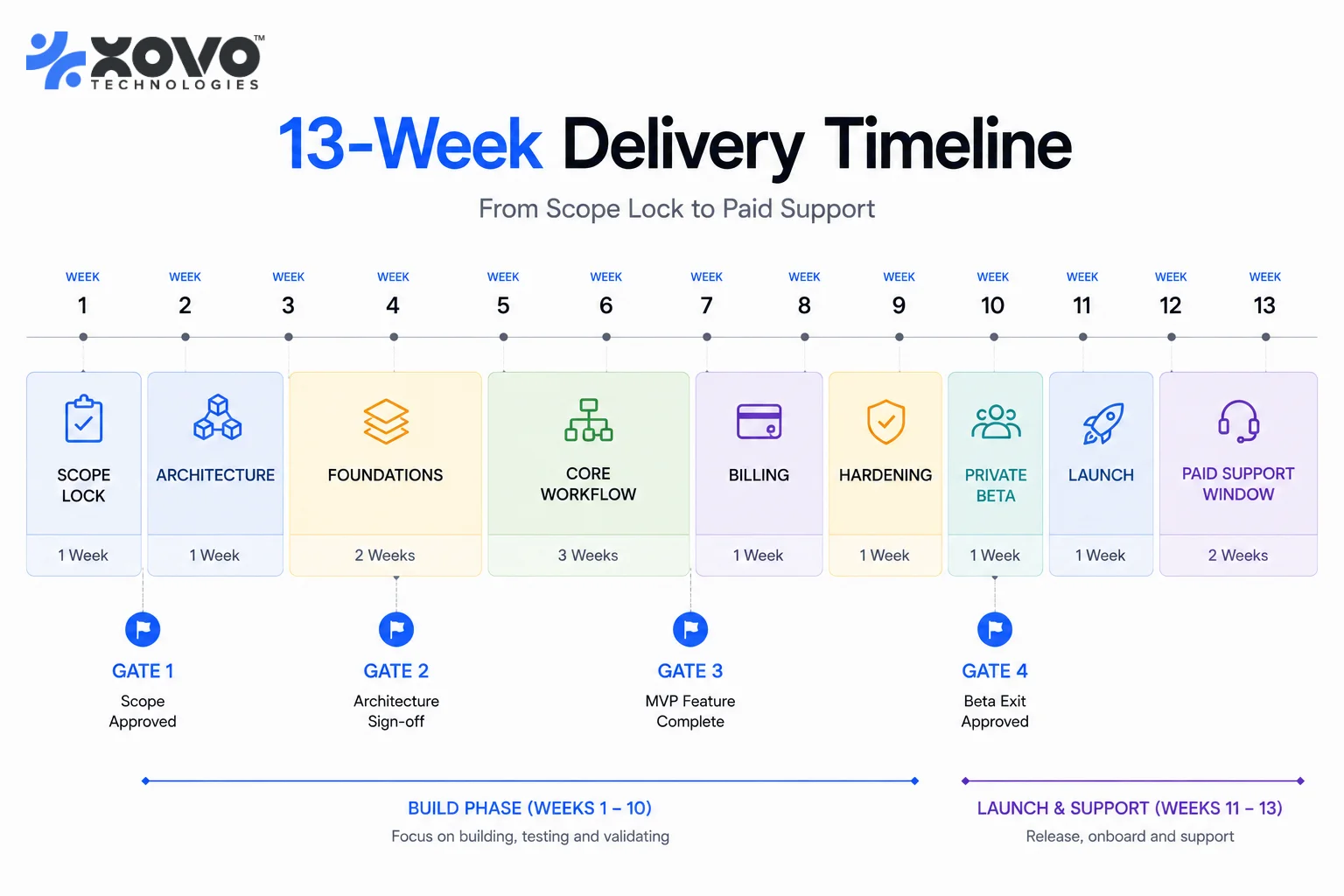
Two rows get cut in almost every rushed engagement and should not be: week 10's backup restore test, because untested backups are not backups, and week 12's unaided deploy, because a handover that has never been executed is a document rather than a handover.
The product design process in week 1 is deliberately short. It is the minimum needed to stop the build arguing about screens in week 6: user flows, a small design system, and the four or five screens carrying the workflow. Deeper product design services and a full design system belong to the version after product-market fit. When founders ask for digital product design services alongside a 90-day build, we scope those digital product design services to the same ninety days, because a product design process that outruns the engineering is expensive research. Founders buying digital product design services and engineering from two different vendors should also budget a week of integration overhead they did not plan for.
For the wider build-services picture, our B2B website development playbook and complete 2026 guide to custom website development cover marketing sites, CMS choices and delivery models. This guide stays on product scoping and the 90-day path.
Should AI features go in the MVP or wait for version two
The evidence in 2026 points in both directions and you should see both before deciding.
Against shipping AI in v1: METR's randomized controlled trial, published 10 July 2025, put sixteen experienced open-source developers through 246 real tasks on repositories averaging over a million lines of code and found that access to AI tools made them 19% slower, confidence interval +2% to +39%, while the same developers believed they had been about 20% faster. METR's 24 February 2026 update expanded to 57 developers and more than 800 tasks across 143 repositories, reporting roughly 18% speedup for the returning subset (CI -38% to +9%) and about 4% for new recruits (CI -15% to +9%). METR is candid that selection effects make this weak evidence: the developers who most expect AI to help increasingly decline a study that asks them to work without it. Stack Overflow's 2026 Developer Survey of about 49,000 developers in 177 countries put adoption at a record 84% with trust at a low, 46% distrusting the accuracy of AI output against 33% who trust it, and the most experienced respondents the most sceptical. Google's DORA research found higher AI adoption correlating with more delivery throughput and more delivery instability at the same time.
For shipping AI in v1: if the AI is the product, there is nothing to defer. A support triage tool without triage is not an MVP of anything. Our AI chatbot development services guide walks through scope and cost for that case specifically, and the architecture and guardrails piece on agentic AI covers what changes when the feature can take actions rather than just answer.
There is a regulatory input too. Article 50 of the EU AI Act applies from 2 August 2026, which is this month. The Omnibus agreement, politically agreed 6 May 2026 and confirmed by Council on 13 May, pushed most standalone high-risk obligations to 2 December 2027 and product-embedded ones to 2 August 2028, but left Article 50 transparency on its original date, with a grace period to 2 December 2026 for watermarking on systems already on the market. If your MVP has a chatbot, generates synthetic media or does emotion recognition, disclosure is a launch requirement in the EU, not a v2 nicety.
App-generation platforms deserve an honest line here, because founders ask about them in every scoping call. Lovable's own 2026 comparison guide concedes that Bolt is fast to start but that production readiness takes further work, and that the last stretch of polish, edge cases and error handling is where the time actually goes. That matches what we see. These tools are genuinely good for a clickable proof of concept in an afternoon and for settling an internal argument about a screen. They are not yet a substitute for a tenancy decision, a migration strategy or a payments integration that has to reconcile.
Our position: ship AI in the MVP when it is the mechanism the product is testing, and keep it out when it would improve a workflow you have not yet proven anyone wants. If you ship it, model inference cost per active user before launch. Founders planning to run models on their own infrastructure should read our private LLM hosting guide first, because the break-even against API pricing arrives later than most people assume.
Which week-one decisions are hardest to reverse
Not all early decisions are equal. Some are reversible in an afternoon and some are a funded project. Rank them before week one and spend your architecture time on the top of the list.
| Decision made in week one | Cost to reverse later | Why |
|---|---|---|
| Tenancy model (shared, schema-per-tenant, database-per-tenant) | Very high | Touches every query, every migration, every backup policy |
| Core data model and identity of the primary entity | Very high | Renaming a concept after launch means migrating live data and every integration |
| Repository, IP and infrastructure ownership | Very high | This is legal, not technical, and it does not fix itself |
| Payments provider and money-movement design | High | Historical transactions, payout records and reconciliation do not port cleanly |
| Authentication provider | Medium to high | User credentials and sessions migrate, but every user notices |
| Primary datastore (relational vs document) | Medium to high | Feasible early, brutal after real usage patterns exist |
| Cloud provider and region | Medium | Painful but mechanical, unless data residency is contractual |
| Frontend framework | Low to medium | Expensive in hours, cheap in risk |
| Component library and styling approach | Low | Replaceable incrementally |
| Analytics vendor | Low | Re-instrument and backfill, annoying only |
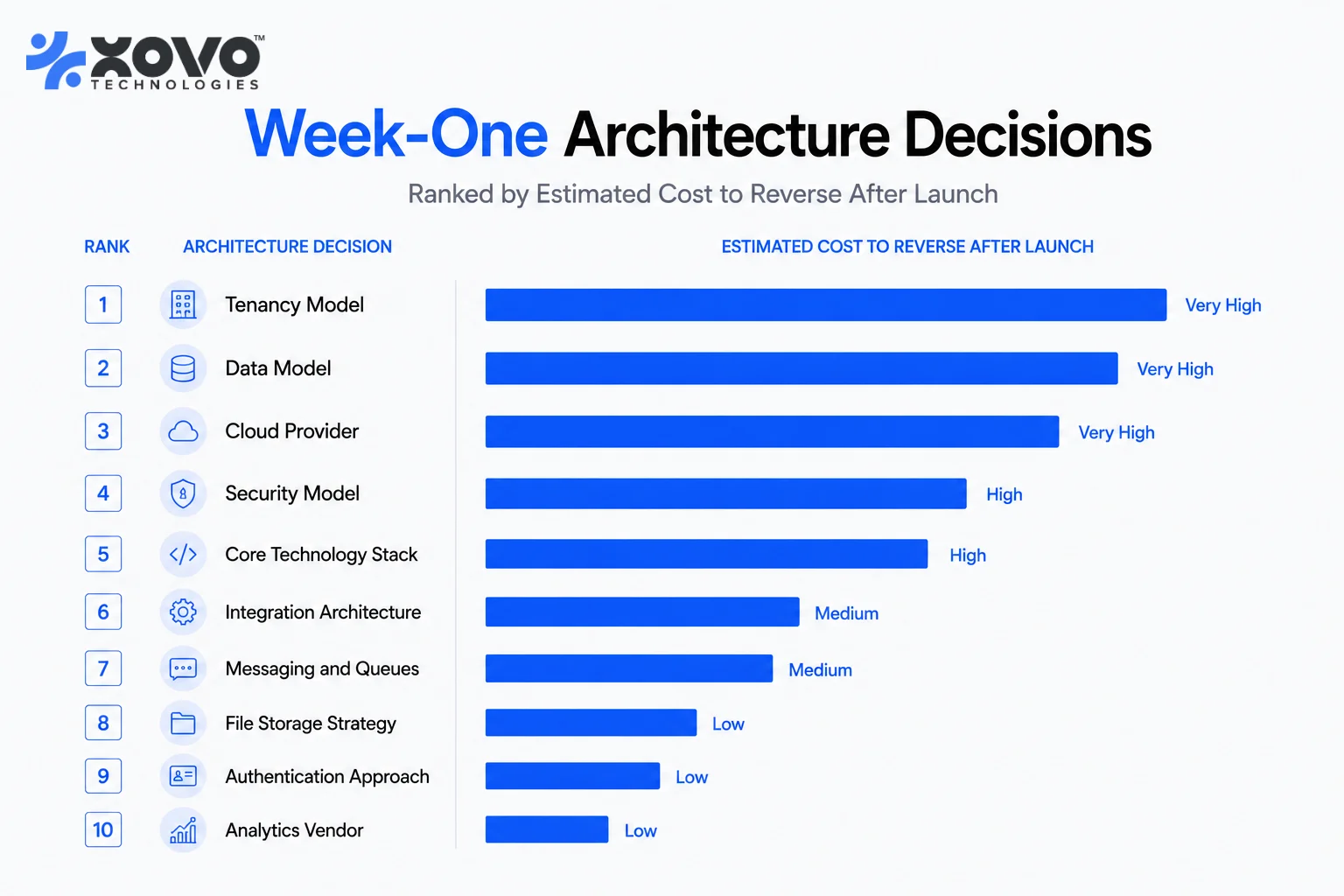
The three "very high" rows are where a competent mvp development consulting engagement earns its fee. Everything below them can be decided by whoever is writing the code that day. In mvp development for enterprises the ownership row climbs to the top of the list, because procurement asks about it long before your users do.
Who owns the code, the repo and the infrastructure
Ask this in the first commercial conversation, not at handover.
Under US copyright law, code written by an independent contractor belongs to the contractor by default. Software is not one of the nine statutory categories that can be made a work made for hire by agreement, so a contract that merely calls the code a work for hire may transfer nothing. What transfers ownership is a present-tense assignment: "Contractor hereby assigns all right, title and interest." A promise to assign in future is weaker, and it surfaces as a problem during diligence on your next raise.
Three more clauses to check, because we have been asked to rescue all three:
- What is assigned versus licensed. Vendors legitimately reuse internal frameworks, so you need to know which parts you own outright and which you hold a licence to, and that licence should be perpetual, irrevocable and transferable on a change of control.
- Where the repository lives. Your organisation from commit one, with the vendor added as a collaborator. Not the other way round.
- Whose name is on the cloud account, domain, DNS, store listings and payment processor. If any of those sit in the vendor's account, you do not control your own product.
The handover pack we ship, and the one to demand from any mvp development company, is: repository with full history in the client's organisation, infrastructure-as-code for every environment, an environment variable inventory with secrets rotated at transfer, CI/CD the client can run, an architecture decision record explaining the tenancy and data model choices, a runbook covering deploy, rollback, backup restore and escalation, migration history, third-party account list with owners, and a recorded walkthrough by the mvp developers who wrote the code. Then the client's engineer deploys once while the mvp development team watches and says nothing. That last step is the only real test.
The week after real users arrive
The week after launch is the most information-dense week of the entire project, and most teams waste it building. It is also the part of startup mvp development that no contract covers and almost every founder underestimates.
Freeze the feature backlog for seven days. Instead: watch session recordings of the first fifty signups, read every support message in full rather than in summary, and check whether the activation event you instrumented in week 3 is actually firing. In our engagements the most common launch-week discovery is that the funnel breaks at a step nobody counted as a step, usually email verification, an empty state with no obvious first action, or an integration needing credentials the user does not have to hand.
Then triage into three buckets and be strict: broken (fix now), confusing (fix within two weeks), missing (do not touch until three unrelated users raise it). The third bucket is where discipline pays, because every founder's instinct in launch week is to build what the loudest user asked for, and the loudest user is rarely the median user.
Instrumentation is what makes this possible, which is why it sits in week 3 rather than after launch. A software development mvp without analytics is a very expensive opinion.
Avoiding the rebuild after product-market fit
A software development mvp rarely gets rebuilt because the code was bad. It gets rebuilt because the data model could not express what the business turned out to be.
The practical defence is to keep the data model slightly more general than the feature set exactly where you are uncertain, and no more general than needed everywhere else. If you might sell to teams rather than individuals, put an organisation entity in from day one even when every organisation has one member. If you might charge per seat, model seats. If you cannot say whether the core object is a project or a document, that is a discovery problem, and it needs resolving before week 2.
The second defence is boring: migrations, tests on the money paths, and a CI pipeline from week 3. Not full coverage. Coverage where a bug costs cash or trust. Teams that skip this for speed pay in week 11, when every change breaks something invisible.
The third is knowing what an MVP may leave behind. Hardcoded configuration, manual admin work, single-region deployment and a thin permission model are acceptable debt, because they are cheap to repay. A wrong tenancy model and a wrong core entity are not debt, they are structural. Custom mvp software development that gets those two right survives a pivot; everything else is refactoring, and refactoring is a schedule problem rather than an existential one.
Choosing a partner without reading another ranking list
Directory rankings of top mvp development companies and top saas development companies measure review volume and profile completeness, not fit. The lists of top mvp development companies founders send us run 40 names deep and hold maybe three shops that have shipped in their category, and rankings of top saas development companies have the same flaw: good for finding names, useless for ordering them.
Four shapes of supplier exist and they are not interchangeable. A specialist mvp development company sells a fixed outcome in a fixed window, which is the right default for a first custom mvp development engagement. A general custom software development agency sells capacity, which suits you once the roadmap outlives the experiment. A staffed mvp development team embedded alongside your own engineers works when you already have a technical lead to point it. And mvp development consulting without delivery, meaning scoping, architecture review and vendor selection, is worth buying alone when the build is committed elsewhere. Hiring a custom software development agency for the first shape is where most waste happens, closely followed by hiring a custom software development company whose day job is internal tooling for large enterprises. A custom software development company optimised for change control will apply change control, because that is what its process is for.
Region matters less than it did, and Accelerance's rate data shows why: senior rates in Central and Eastern Europe and Latin America now sit within a few dollars of each other. Overlap hours are the real difference. A US founder and a Latin American team share most of a working day. The same founder and a South or Southeast Asian mvp app development company share two or three hours, which works if decisions are batched and fails if they are not. If your build is mobile-first, a mobile app development company and a web-first product team are different shops, and hiring one to do the other's job is how 90-day plans become 150-day plans. Ask any mobile app development company for its median time from code freeze to store approval before signing.
Four questions separate vendors: show me an architecture decision record from a past build, who specifically writes the code and are they employees or subcontractors, what happens in week 11 if you are behind, and can I speak to a client whose project you cancelled. The last one tells you more than the case studies. Our own three-way matching case study is public for the same reason, and we hand the same four questions to anyone evaluating our SaaS product development practice. A longer version of this for AI work sits in hiring an AI agent development partner.
What we would not do
We would not build an MVP without a named success metric agreed in week 1. We have taken those projects before and they end in a status meeting where everyone is technically satisfied and nobody can say whether it worked.
We would not accept a scope change in weeks 10 to 12 without moving the launch date, and we say so in the contract.
We would not recommend a native mobile build as a first experiment unless the product depends on a device capability, and that holds whether the work goes to an mvp app development company or to a general mobile app development company, because app review adds a week of latency to every learning cycle.
We would not ask you to pick us off a list of top mvp development companies or top saas development companies. Ask for the architecture decision record from someone else's build instead.
And we would not tell a founder that AI-assisted coding has collapsed MVP timelines. The evidence is contested, the strongest study in the field is honest about its own limits, and the constraint on a 90-day build was never typing speed. It was deciding what not to build.
If you are scoping a build now, our SaaS product development team runs a fixed-fee scoping week that ends with a feature list, an architecture decision record and a firm number. That week is the front door to our mvp software development services, and it is the same process we run when a client hires us only for mvp development consulting and takes the build elsewhere. If you would rather start with an outside read, book a free audit session and bring the feature list you already have. We will tell you which nine items matter.