Enterprise conversational AI is a retrieval-grounded language system wired into company records, with access control, audit logging and human escalation. A chatbot widget answers from a script. Enterprise conversational AI answers from your data, records who asked, and hands the conversation to a person when the confidence threshold is not met.
That distinction is the whole reason the category exists. Most of what still gets sold as conversational AI is a scripted decision-tree bot with a language-model coat of paint. The enterprise version is a different animal. It has to answer accurately at high volume, connect to the systems your business actually runs on, respect access controls and compliance rules, and stay maintainable as those upstream systems change.
This guide covers what enterprise conversational AI is, how it is built, what it costs in 2026 under five different pricing models with the vendor pages and the dates we checked them, what the regulated-sector constraints look like in healthcare and financial services, where the technology stops working, how to measure it, and a 90-day sequence for putting one into production.
We build these systems at XOVO Technologies, and the pattern is consistent: the model is rarely the hard part. The hard part is everything around it, and the second hardest part is agreeing what counts as success before anyone writes code.
What is enterprise conversational AI?
Enterprise conversational AI is a class of software that handles conversations at organisational scale, grounded in a company's own knowledge and wired into its operational systems. Conversational AI for enterprise implies three things a consumer chatbot never needs to worry about: accuracy under regulatory and reputational risk, throughput measured in thousands of simultaneous conversations, and integration with the CRM, helpdesk and databases where the real answers live.
The intelligence layer is a large language model. On its own, an LLM can hold a fluent conversation but knows nothing about your refund policy, your inventory, or a specific customer's account. Enterprise conversational AI closes that gap with retrieval, so the model answers from your documents and records, and with integrations, so it can look something up or change it. A consumer-grade bot answers questions. An enterprise system resolves them.
There is also a disclosure obligation attached to the category now. Article 50 of the EU AI Act requires providers to ensure that systems intended to interact directly with natural persons are designed so those people are informed they are interacting with an AI system, unless that is obvious to a reasonably well-informed observer. Article 50 came into force on 2 August 2026 under Article 113. If you operate in the EU, whether it is clear to the customer that this is a machine became a design requirement rather than a brand choice.
How enterprise conversational AI differs from a basic chatbot
The gap between a basic chatbot and enterprise conversational AI is not really about model quality. It comes down to what the system is allowed to know and do. A basic chatbot matches a question to the nearest pre-written branch. Enterprise conversational AI reads the question, retrieves the relevant fact from your data, decides whether it can act, and either resolves the issue or escalates it.
We cover the mechanics of wiring a bot into your stack in our guide on connecting AI chatbots to websites, CRMs and Google Workspace, so here I will stay at the level that matters for a buying decision: the enterprise-specific dimensions a basic tool ignores.
| Dimension | Basic chatbot | Enterprise conversational AI |
|---|---|---|
| Answer source | Scripted branches or model training only | Retrieval from your own knowledge base and live records |
| Actions | None, or a fixed menu | Authorised API actions: order status, ticket creation, account updates |
| Concurrency | Limited before performance drops | Thousands of simultaneous conversations |
| Governance | Little to none | Access controls, audit logging, defined compliance posture |
| Escalation | Dead end or generic handoff | Handoff with full context and risk-based routing |
| Maintenance | Manual script edits | Automated knowledge sync and integration monitoring |
| Record of the conversation | Vendor's rolling log, often short | Exportable transcript held in your own retention system |
The two dimensions that divide a toy from a production system are governance and scale. A consumer bot can afford to be wrong and can afford to stall under load. An enterprise system handling financial or healthcare queries cannot, which is why the governance layer and the retrieval layer end up mattering far more than which model you picked. The last row in that table is the one that gets discovered late, usually by a compliance officer, and the financial services section below explains why.
The architecture behind enterprise conversational AI software
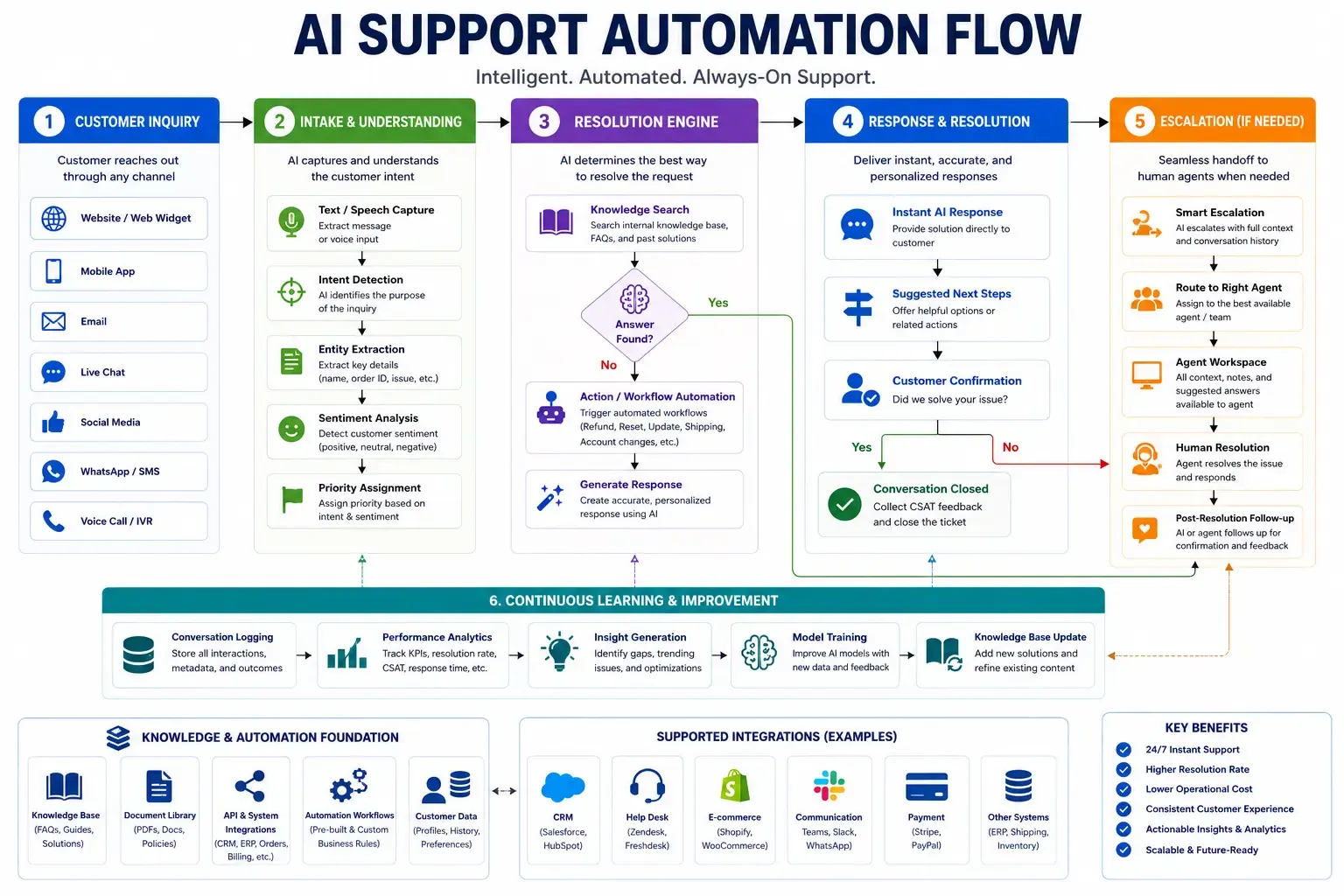
Enterprise conversational AI software is built from five layers, and each one fails in a different way. That is exactly why the model choice alone tells you almost nothing about whether a system will work in production. The layers are the language model, a retrieval pipeline over a vector database, the integration layer, an orchestration and governance layer, and the escalation path back to humans.
The language model
The LLM understands the question and drafts the answer. In 2026 enterprise deployments we most often use GPT-5.5, Claude Opus 4.7 or Gemini 3.1 Pro for reasoning-heavy conversations, and open-weight models such as Llama 4 or Mistral for high-volume, low-complexity traffic. A common pattern in our builds is routing: a small, cheap model handles routine questions while a larger one handles anything nuanced, which keeps cost down without a quality drop users would notice. Keeping the model layer separate from retrieval and integration also means switching providers is a configuration change rather than a rebuild, which matters because model pricing moves every few months.
Retrieval and the vector database
This is where accuracy comes from. Your documents, FAQs and policies are converted into embeddings and stored in a vector database such as Pinecone, Weaviate, Qdrant or pgvector. When a customer asks something, the system retrieves the closest-matching passages and hands them to the model as grounding, so the answer reflects your real policy instead of a plausible guess. Retrieval-augmented generation is the main defence against hallucination. It is not a complete one, and the section on where conversational AI stops working explains the specific way it fails.
The integration layer
Retrieval tells the system what is true. Integrations let it act. REST APIs, webhooks and increasingly the Model Context Protocol connect the conversation to your CRM, helpdesk, ERP and commerce platform, so the bot can pull a live order status or open a ticket instead of describing what a human would need to do next. This layer breaks most often, because every upstream system it touches can change its API or its authentication without much warning. Somebody has to own that. If the answer to who fixes this when Salesforce changes an endpoint is nobody, the deployment has a shelf life.
Orchestration and governance
Between the model and the outside world sits the layer that decides what the AI is allowed to do: which actions it can take, what data it can read, when it must escalate, and how every step gets logged. For anything that behaves like an agent, this is where the guardrails live, and we go deeper on that design in our piece on agentic AI architecture and guardrails.
The escalation path
No enterprise system should try to answer everything. The escalation path hands a conversation to a human with the full history attached when a question falls outside the knowledge base, when the customer's sentiment turns, or when the intent itself is one you have decided a machine should not hold. For sensitive workflows we tune it to hand off slightly too early rather than too late, because a wrong answer costs more than an extra human touch.
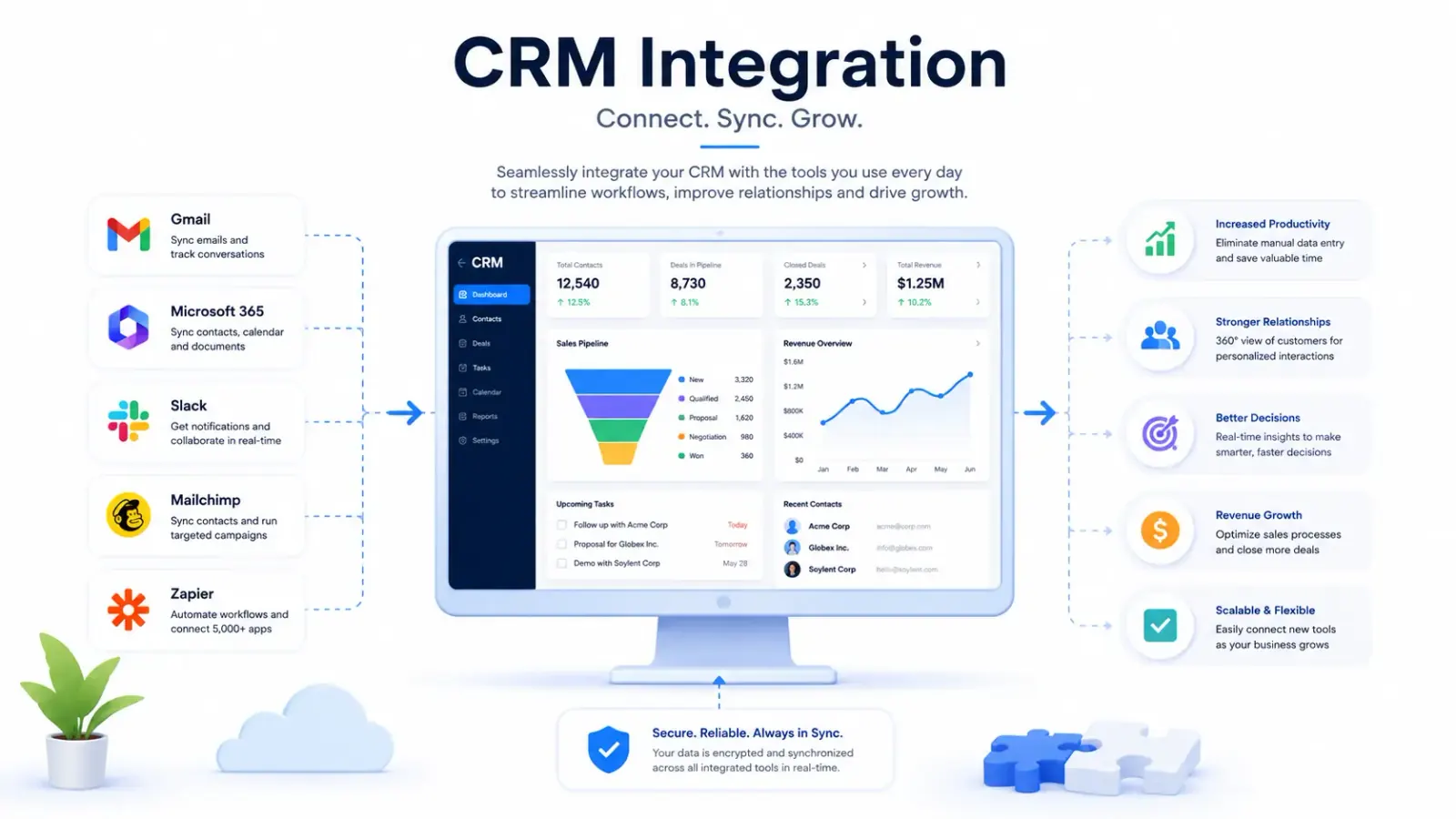
Which systems does enterprise conversational AI need to connect to?
Enterprise conversational AI needs to reach whatever system holds the answer a customer or employee is actually asking for. Order status lives in the ERP, ticket history lives in the helpdesk, account details live in the CRM. A system that can only read from a document library will fall back to "let me connect you with someone" for exactly the questions people ask most, and those questions make up the bulk of the volume.
The integration categories that recur in almost every build:
- CRM and support platforms: Salesforce, HubSpot, Zendesk, Freshdesk
- Productivity and messaging: Google Workspace, Microsoft 365, Slack, Microsoft Teams
- Commerce and operations: ERP systems, inventory platforms, order management tools
- Internal knowledge: Confluence, SharePoint, internal wikis, policy documents
- Identity and access: SSO providers, which determine what the system is permitted to retrieve and say to a given user
The identity row changes the architecture rather than just adding a connector. Once the system answers differently depending on who is asking, retrieval has to be filtered by entitlement at query time, not after the model has already seen the passage. Filtering after retrieval means the model has read something the user was not allowed to see, and the transcript now contains it.
Build versus buy: should you licence a platform or build your own?
The build-versus-buy decision comes down to how far your requirements diverge from what a packaged product assumes. If your support is standard and your integration needs are light, an off-the-shelf enterprise chatbot platform gets you live in days and is the sensible call. If your value depends on deep integration, data control or industry-specific workflows, a custom build pays for itself. Most mid-market companies we work with land on a third option: a dedicated build with an engineering partner, which gives the control of a custom system without the year-long hiring cycle of an in-house team.
| Approach | Time to live | Data and integration control | Cost pattern | Best fit |
|---|---|---|---|---|
| Licence a SaaS platform | Days to weeks | Limited to the vendor's connectors | Subscription or usage fee that scales with volume | Standard support, light integration |
| Build in-house | Two to four quarters | Full | High fixed cost in salaries and infrastructure | AI is a core part of your product |
| Dedicated build with a studio | Weeks to a few months | Full | Project cost plus a maintenance retainer | Mid-market enterprises needing real integration |
The trap runs in both directions: buying a platform for a problem that genuinely needs a build, or building for a problem a platform already solves well. There is a third trap that is easier to miss. Moving off a licensed platform later usually means rebuilding every integration and retraining staff on a new interface, because the workflows and the conversation history live inside software the vendor controls. Ask, before you sign, what an export of two years of transcripts and escalation rules actually looks like. The staffing side of a build carries its own decisions, and we wrote about freelancer versus agency versus dedicated team in choosing a hiring model for a custom chatbot build.
What does enterprise conversational AI cost in 2026?
Conversational AI platform pricing in 2026 splits into five billing models, and they are not variations on a theme. They meter different things: a human seat, a resolved conversation, an API request, an agent action, or an org-wide licence with a usage pool attached. The same traffic can produce wildly different invoices depending on which one you signed. Every figure below comes from the vendor's own published pricing page, checked on 13 September 2026.
Per-seat licence
You pay for human agents, not for AI work. Zendesk's plan pricing lists Support Team at $19 per agent per month paid yearly, Suite Team at $55 and Suite Professional at $115, with Copilot as a $50 per agent per month add-on and Contact Center at $83 per agent per month. Intercom's published plans list Essential at $29 per seat per month, Advanced at $85 and Expert at $132, with its Copilot add-on at $35 per user per month billed monthly.
Where it breaks: the bill is indexed to headcount, so automation that removes 30% of contacts changes nothing on the invoice until you remove seats. It also creates a quiet incentive to under-licence, keeping supervisors, quality reviewers and back-office staff out of the tool where they would have caught bad answers.
Per-resolution and per-outcome
Intercom's Fin is $0.99 per outcome with a 50-outcome monthly minimum, and $0.99 per outcome plus $29 per helpdesk seat per month when it runs on top of another helpdesk such as Salesforce or HubSpot. Intercom defines a billable outcome precisely: a Resolution, where no further help is requested after Fin's last answer; a Procedure handoff, where Fin completes a procedure you configured to end with a human; or a Disqualification. Those are $0.99 each. A Qualification is $9.99. One outcome per conversation regardless of how many actions the agent took, and no charge when a conversation is simply passed to your team without an outcome.
Zendesk bills its AI agents on Automated Resolutions, which it defines on the same pricing page as customer requests "successfully resolved by the AI agent, without any escalation to a human agent". Zendesk does not publish a per-resolution rate. Salesforce lists Help Agent Resolutions at $2 on its Agentforce rate card.
Where it breaks: the definition. Intercom's Resolution is an absence-of-recontact test and its Procedure handoff bills you for a transfer to a person. Zendesk's Automated Resolution explicitly excludes anything that reached a human. Those are different products wearing the same word. The other break is arithmetic. Divide the quoted rate by your genuine resolution rate to get your real cost per solved problem. At $0.99 per outcome with half your conversations ending at a person, you are closer to $2 per problem actually solved.
Per-message or per-request
Google bills Conversational Agents by request. For chat agents, deterministic Flows cost $0.007 per request and generative Playbooks $0.012 per request; voice agents are $0.001 and $0.002 per second respectively. Data store index storage is free to 10 GiB per month and $5.00 per GiB of additional raw data after that. Amazon charges Lex at $0.004 per speech request and $0.00075 per text request.
Where it breaks: the unit is not the conversation. Google's pricing page states that a request is any API call to the platform and that "the number of requests needed for an end-user to accomplish a task can vary". You cannot forecast this bill without first measuring requests per task on real traffic. The low Lex rate also reflects a narrower capability, since intent matching is a smaller job than generative reasoning over your documents, and model calls in a generative design may be billed separately.
Per-action and per-credit
Salesforce sells Agentforce usage as Flex Credits at $500 per 100,000 credits, £400 per 100,000 in sterling. An Agentforce action costs 20 credits, about $0.10; an Agentforce Voice action costs 30 credits, about $0.15. Salesforce's own worked example on that page describes a "where is my order" self-service agent using two actions per request, 40 credits or $0.20 per request, reaching 24,000 credits and $120 a month at 20 requests a day. The alternative on the same page is a Conversations SKU at $2 per conversation, £1.60 in sterling, regardless of how many actions the conversation consumed. An Agentforce User License is $5 per user per month and still requires Flex Credits; Flat Fee Access is $125 per user per month.
Microsoft sells Copilot Studio as tenant-wide packs of 25,000 Copilot Credits at $200 per pack per month, roughly $0.008 per credit, with a varying number of credits consumed whenever an action or response is completed by an agent, plus a pay-as-you-go meter with no upfront commitment. Microsoft 365 Copilot is $30 per user per month paid yearly and includes usage of agents published to Microsoft 365 Copilot.
Where it breaks: the crossover. At $0.10 an action, a three-action ticket costs $0.30 against $2.00 on the conversation SKU. The two models cost exactly the same at 20 actions per conversation, and above that the flat conversation price wins. Your average action count per conversation decides which SKU you should sign, it is usually unknown before launch, and it is worth more than any discount you will negotiate.
Platform licence plus build
Salesforce lists Agentforce 1 Editions from $550 per user per month, with the Agentforce add-on included and 2.5 million Flex Credits per org per year. At 20 credits an action, that pool is 125,000 actions for the whole organisation for a year.
Where it breaks: the pool is org-level, and a single customer-facing deployment can drain it. Ten thousand conversations a month at three actions each consumes 600,000 credits a month, so the annual allowance covers roughly four months of that one workload before overage begins. Read the included-usage line as a floor, not a budget.
Fully custom
There is no list price, because there is no list. The cost is engineering time, model inference, and the standing cost of keeping the knowledge base and the evaluation set current. We do not publish a build range for this, because the two variables that move it most, the number of write-capable integrations and the state of the documentation going in, differ by an order of magnitude between clients whose requirements look identical on paper. A company with a clean, current help centre and two read-only integrations is a different project from one that needs its policies reconciled before anything can safely answer from them.
Where it breaks: inference and upkeep are recurring, and they get underestimated because they never appear on a quote. Budget the knowledge and evaluation work as a standing line, not a launch task.
Conversational AI pricing models compared
Assumptions are stated in each cell so the row can be checked. All vendor rates were verified on the vendor's published pricing page on 13 September 2026.
| Pricing model | What triggers a charge | Minimum commitment | Cost at 10,000 conversations a month | Where the model breaks |
|---|---|---|---|---|
| Per-seat licence | A human agent having access, not AI work | Per-seat monthly or annual term | Unchanged by volume. 30 agents on Zendesk Suite Professional at $115 is $3,450 a month whether the AI handles none of the traffic or all of it | Savings from automation never reach the invoice until seats are removed, and under-licensing hides bad answers from the reviewers who would catch them |
| Per-resolution or per-outcome | A conversation the vendor counts as resolved, and for Intercom also a configured handoff or a disqualification | Intercom Fin: 50 outcomes a month | At $0.99 with a 55% billable-outcome rate, 5,500 outcomes is $5,445, plus $29 per helpdesk seat if run on a third-party helpdesk | Each vendor defines the billable event differently, so the unit price is not comparable. True cost is the rate divided by your genuine resolution rate |
| Per-message or per-request | Each API request to the platform, or each second of audio | None published; usage-based | Google Playbooks at $0.012 per chat request and 6 requests per conversation is $720, plus index storage above the free 10 GiB | Requests per task vary with agent design and the vendor says so, so forecasts stay unreliable until you have measured real traffic |
| Per-action or per-credit | Each action the agent executes, metered in credits | Credit packs, for example Microsoft at $200 per 25,000 credits | Salesforce Flex Credits at $0.10 an action and 3 actions per conversation is 30,000 actions, or $3,000. The same traffic on the $2 Conversations SKU is $20,000 | Cost scales with agent complexity rather than customer count. A workflow redesign that adds two steps raises the bill with no change in volume |
| Platform licence plus build | A per-user platform licence with a usage pool, plus implementation | Salesforce Agentforce 1 Editions from $550 per user per month | Licence plus overage. The included 2.5M Flex Credits per org per year covers about four months of the 600,000 credits a month above | The included pool is organisation-wide, so the second and third use case compete with the first for the same allowance |
| Fully custom | Nothing per conversation. Engineering time, inference and upkeep | None | Inference and infrastructure only, with no licence line | Recurring knowledge and evaluation work has no invoice to remind you it exists, so it gets skipped and quality decays |
The cost that catches teams off guard is not the licence, it is the combination of inference and knowledge upkeep. Every conversation makes one or more model calls, and at high volume the token bill adds up, which is precisely why we route routine traffic to cheaper models. For a fuller treatment of the unit economics, including what happens to cost per resolved contact as deflection rises, see our analysis of what customer service automation actually deflects and what it costs.
If you want a second opinion on a vendor quote before you sign it, we will read it with you. Book a free AI audit and bring the pricing sheet.
Conversational AI in healthcare
Conversational AI in healthcare runs into a contractual constraint before it runs into a technical one, and before either of those it runs into the question of what the system is allowed to say at all, which we work through task by task in conversational AI in healthcare. Under 45 CFR 164.504(e), the business associate contract standard, a covered entity has to have a business associate contract in place with any vendor processing protected health information on its behalf, and that contract must require the business associate to ensure that any subcontractors which create, receive, maintain or transmit PHI agree to the same restrictions and conditions. A conversational stack has several of those: the model provider, the vector database, the transcription service if voice is involved, and the hosting layer. Each is a link in a chain that has to hold end to end.
The rule also puts the risk on you rather than on the vendor's marketing. A covered entity is not in compliance if it knew of a pattern of activity by the business associate that constituted a material breach of the contract and failed to cure it or, failing that, terminate the arrangement where feasible. So a vendor saying it is HIPAA compliant is not a control, and HIPAA compliance is not a certification anyone issues. What to ask for instead: the signed business associate agreement covering the specific endpoints you will call, the subprocessor list, the retention configuration in writing, and whether zero retention is contractual or a console setting somebody can toggle.
De-identification is the alternative route rather than a supplement to it. Safe harbour under 45 CFR 164.514(b)(2) requires the removal of eighteen categories of identifier, including biometric identifiers such as voice prints, all geographic subdivisions smaller than a state, and all date elements other than year. A clinical conversation names people, places and dates continuously, so de-identifying a transcript after the fact is a best-effort exercise rather than a control you can rely on.
Two design consequences follow. The retrieval index has to be partitioned so a query from one care setting cannot surface another's records, enforced at query time through the identity layer rather than by filtering results afterwards. And escalation in healthcare is a clinical safety control, not a customer experience feature. Appointment scheduling, prescription refill status, billing questions and pre-visit instructions are appropriate work for conversational AI. Anything shading into symptom assessment or treatment advice is a different regulatory category entirely and should route to a person by rule, regardless of how confident the model is.
Data residency is a separate question from HIPAA, which does not require US storage. Residency comes from your own contracts and, in the UK and EU, from UK GDPR and GDPR restrictions on international transfers. Where residency commitments make a hosted model unworkable, running the model inside your own environment is the usual answer, and we cover the trade-offs in our guide to private LLM hosting.
Conversational AI in financial services
Conversational AI in financial services is constrained by record-keeping and supervision rules written for communications generally, which apply to generated text without amendment. FINRA said so directly in Regulatory Notice 24-09 on generative AI and large language models, published on 27 June 2024: its rules are intended to be technology neutral and continue to apply when member firms use generative AI, including when the firm is using a third party's technology or an embedded feature inside an existing product. The Notice points at Rule 3110 on supervision, which requires a reasonably designed supervisory system addressing technology governance, model risk management, data privacy and integrity, and the reliability and accuracy of the model. It also points at Rule 2210, where FINRA has previously said the content standards apply whether a member firm's communications are generated by a human or by a technology tool.
The record-keeping side is more concrete than most vendors' answers to it. SEC Rule 17a-4(b)(4) requires originals of all communications received and copies of all communications sent relating to the business, together with any approvals of them, to be preserved for not less than three years, the first two in an easily accessible place. FINRA Rule 4511(b) sets at least six years for FINRA books and records with no specified period elsewhere, and Rule 4511(c) requires the format and media to comply with SEA Rule 17a-4. Rule 17a-4(f)(2)(i) then gives an electronic recordkeeping system two acceptable designs: preserve each record for its full retention period with a complete time-stamped audit trail capturing every modification and deletion, the date and time of each, and the identity of whoever made it; or preserve the records exclusively in a non-rewriteable, non-erasable format.
That combination has a blunt implication for platform selection. A customer chat transcript is a communication, and a vendor's rolling conversation log with a 30 or 90 day window is not a records system. Export into your own retention store has to be designed in from the first deployment, with the audit trail intact, because the retention clock starts at the conversation and not on the day someone notices the gap.
The suitability line matters just as much. FINRA's suitability rule, 2111(a), requires a reasonable basis to believe that a recommended transaction or investment strategy is suitable for the customer, based on that customer's investment profile. A conversational system that answers "should I move my balance into the higher-yield product" has made a recommendation. The design rule we apply is that anything resembling advice is an escalation trigger by intent, not by confidence score, and the retrieval index for a customer-facing deployment should not contain product-recommendation content at all.
UK-regulated firms face a different constraint pointing the same way. The FCA's Consumer Duty applies its consumer support rules in PRIN 2A.6 at 2A.6.1R regardless of the channel used and explicitly including where a firm outsources its interactions with retail customers to a third party. PRIN 2A.6.2R(4) requires that retail customers do not face unreasonable barriers, including unreasonable additional costs, when they want to make general enquiries, amend or switch a product, submit a claim, make a complaint or cancel a contract. The guidance at PRIN 2A.6.4 says a firm would be unlikely to meet that obligation if its support causes disproportionately longer call waiting times to cancel an existing product than to buy a new one. The cross-cutting obligations at PRIN 2A.2 set the wider duty at 2A.2.8R to avoid causing foreseeable harm to retail customers. The FCA last updated both sections on 26 June 2026.
Read that against how conversational AI is usually tuned and the conflict is plain. A system optimised to maximise containment on cancellation and complaint intents is building precisely the barrier the rule prohibits, and the metric the vendor reports as success becomes the evidence against you. Our working rule for UK financial services builds is that complaint, cancellation and financial-hardship intents route to a human on first detection, and containment is measured with those intents excluded from the denominator, so nobody is rewarded for holding them. PRIN 2A.6.2R(3) makes the same point from the other direction, requiring appropriate friction in customer journeys where friction gives customers time to understand their options. That is an unusual thing for a regulator to ask of a channel everyone else is trying to make frictionless, and it is worth reading before you set a containment target.
Where conversational AI stops working
Every deployment has a containment ceiling, and the data sets it rather than the model. A contact can only be resolved without a human if three conditions hold at once: the answer exists somewhere in writing, the retrieval layer can find it, and the system is authorised to take whatever action the answer requires. Those probabilities multiply. If 80% of your contacts have a documented answer, retrieval surfaces the right passage 85% of the time, and the system is permitted to act in 70% of the cases that need an action, the ceiling sits nowhere near the number on the vendor's slide. Raising it means fixing whichever term is lowest, and it is almost never the model.
The failure mode at the edge of the retrieval index is specific and worth naming. When no good passage exists, the retriever still returns its nearest neighbours, because that is what a nearest-neighbour search does. The model receives a passage that is semantically adjacent and factually wrong, and it has no signal distinguishing "this is the answer" from "this is the closest thing in the index to the answer". The result is not wild invention. It is a confident, well-written paraphrase of the wrong policy, which is considerably harder for a reviewer to spot than an obvious fabrication. The mitigations are a minimum similarity threshold below which the system abstains, an explicit no-answer class in the evaluation set, and requiring the model to cite the passage it used so a human can check the grounding rather than the prose.
Intent distribution is the other ceiling. The top twenty intents in a support queue are repetitive, well documented and cheap to automate. The tail is long, each item is rare, and each still needs its own knowledge, its own testing and sometimes its own integration. Cost per additional point of containment rises steeply once the head is done, and there is a point at which writing the twelfth rare-intent flow costs more than the humans handling it ever would.
Escalation thresholds are where these constraints get encoded, and they should be set on two independent axes. The first is model confidence, tuned against a labelled evaluation set with a stated tolerance for false containment rather than against aggregate containment, because tuning against the aggregate always pushes the system to hold conversations it should release. The second is business risk, and it overrides the first. Complaints, cancellations, financial hardship, safeguarding concerns, clinical questions and formal disputes go to a person on detection, whatever the confidence score says. Getting this wrong in the generous direction produces a metric that looks excellent and a complaints file that does not.
Handoffs also have to carry context. Passing a conversation to an agent with no transcript means the customer repeats themselves, which converts a recoverable interaction into a bad one. Pass the full transcript, a short summary, and the list of actions already attempted, every time.
How do you measure enterprise conversational AI?
Four numbers carry most of the weight: containment rate, deflection rate, cost per resolved contact and first-contact resolution. Containment is the share of conversations that ended without a human. Deflection is the share of contacts that never reached an agent queue at all, which is a wider and more flattering measure. Cost per resolved contact is the total cost of the programme divided by the contacts it genuinely finished. First-contact resolution asks whether the customer came back.
The problem is that the first of those is not comparable across vendors, because the vendors define it differently in their own billing documentation.
| Metric | What it should measure | How the definition varies | What to instrument yourself |
|---|---|---|---|
| Containment or resolution | Conversations finished by the AI with no human involvement | Intercom bills a Resolution when no further help is requested after Fin's last answer, and also bills a configured handoff to a human as an outcome. Zendesk defines an Automated Resolution as a request resolved without any escalation to a human agent | Your own count of conversations with zero agent touches, over a fixed window, published with the window stated |
| Deflection | Contacts that never entered an agent queue | Most vendor dashboards include abandoned sessions, which inflates it | Separate abandonment from resolution. An abandoned chat is a failure being counted as a success |
| Cost per resolved contact | Total programme cost divided by genuinely finished contacts | Vendors quote a unit rate, not a cost per outcome achieved | The rate divided by your real resolution rate, plus inference, engineering and knowledge upkeep |
| First-contact resolution | Whether the customer had to come back | Rarely measured against the AI conversation at all | Re-contact rate at 24, 48 and 168 hours, tied to the original conversation ID |
The practical consequence is that an RFP question such as "what containment rate do your customers achieve" returns three numbers measured three different ways, and comparing them means nothing. Ask instead for the definition in writing, the measurement window, and whether a handoff counts as a billable or reportable success.
One number is comparable, because you compute it yourself: cost per resolved contact, where resolved means no agent touch and no re-contact inside a window you fixed in advance. Everything else is vendor arithmetic. Set the window before launch rather than after the first report, because the temptation to shorten it later is considerable.
Security and compliance for conversational AI in the enterprise
Security in conversational AI for enterprise depends on how the integration layer is built, not on which model sits behind it. The moment a conversational system connects to your CRM, billing or patient records, it inherits the security requirements of those systems. A production deployment needs OAuth 2.0 on every API connection, role-based access so the AI reads only what it needs, encryption in transit and at rest, and audit logging of every action it takes.
Compliance frameworks such as GDPR, HIPAA and SOC 2 have to be satisfied at that access-control and data-residency level, not with a policy statement pasted into a contract. A gap we see often is a vendor advertising a certification at the model or platform level while leaving the integration layer, the middleware and the logging unreviewed. That is where the customer data actually flows, so that is where the review belongs.
For organisations that cannot send data to a third-party model at all, private hosting keeps both the model and your data inside your own environment. It costs more to run and takes more engineering to stand up, but for regulated industries it is sometimes the only acceptable option. Where the same constraints apply to telephone channels, our write-up on AI voice agents for business covers the additional problem that audio is itself identifying data.
A 90-day implementation sequence
This is the sequence we run, and the order matters more than the durations. Most failed deployments failed in weeks one to four, not at launch.
Weeks 1 and 2, intent census. Pull 90 days of real transcripts and count them. Rank intents by volume multiplied by average handle time, then pick eight to twelve to build against. In the same fortnight, write down the containment definition, the re-contact window and the false-containment tolerance you will hold the system to. Doing this before anyone builds anything is what stops the definition being retrofitted to the result later.
Weeks 3 and 4, knowledge audit. For each chosen intent, establish whether a correct, current, written answer exists. Where it does not, write it. This is the gate, it is the step that gets compressed under deadline pressure, and it determines the ceiling for the next two years. A deployment cannot answer what the organisation has never written down.
Weeks 5 and 6, retrieval build. Chunking strategy, embeddings, index, and an evaluation set of 150 to 300 real questions with graded expected answers including an explicit no-answer class. We instrument retrieval quality and hallucination rate in LangSmith against that curated set from day one, so every later prompt or content change can be measured rather than argued about.
Weeks 7 and 8, integrations, read-only first. Connect the systems that hold the answers and let the assistant read them. Write access comes second, with each write action behind a confirmation step and an audit record, because a wrong read is an embarrassment and a wrong write is an incident.
Weeks 9 and 10, escalation design. Build the risk-based routing list, the confidence threshold, the context package that travels with a handoff, and the agent-side view. Test the handoff with the agents who will receive it, and time how long it takes them to pick up a transferred conversation cold.
Weeks 11 and 12, shadow mode. Run against live traffic with no customer exposure. The system proposes an answer, the agent answers as normal, and you compare the two. This is the only cheap way to find where the retrieval index is thin, and it produces the evidence you need to set the confidence threshold honestly.
Week 13, limited launch. One channel, the chosen intents, a kill switch, and daily human review of every escalated conversation and every low-scoring one. Expand by intent, not by channel.
What does not fit into 90 days: multi-channel rollout, voice, write access to a system of record with no sandbox, and anything requiring a signed business associate agreement or a security review by a regulated client's own committee. Compliance review is the most common reason a timeline slips, and most of that time belongs to the client's approval process rather than to engineering.
What results should you expect?
Our Enterprise AI Chatbot is designed around resolving up to 80% of customer queries without a human agent, with the remainder escalated to a person who receives the full conversation history. That 80% is XOVO's own product design target, taken from our product specification. It is not a measured industry average, and you should treat any vendor quoting a single headline resolution figure the same way, because the number depends almost entirely on the deployment rather than on the software.
What separates a deployment that approaches its target from one settling far below it is rarely the language model. It is whether the answer exists in writing, whether retrieval can find it, and whether the system is permitted to take the action the customer is asking for, such as rebooking an appointment or issuing a refund. The pattern differs by use case in a predictable direction: a customer support deployment answering order and billing questions resolves more on its own than an internal IT helpdesk fielding access requests, because customer questions repeat more predictably than employee ones. The fix for a low resolution rate is almost always connecting the system to more of the real data source, not buying a larger model.
How to choose an enterprise chatbot platform
Choosing an enterprise chatbot platform comes down to a handful of questions that separate a system working in production from one that only works in a demo. Ask how it grounds answers, because a platform without real retrieval over your data will hallucinate confidently. Ask what it does when it does not know something, because the honest answer is escalation. Then push on the operational realities a sales demo never shows.
The questions worth asking any vendor:
- How does the system retrieve and ground answers in our own data, and which vector database does it use?
- What exactly counts as a resolution in your billing, and does a handoff to a human count as one?
- What happens when a question falls outside the knowledge base, and how is that escalation handled?
- How long are conversation transcripts retained, and how do we export them into our own retention system with the audit trail intact?
- How many concurrent conversations can it hold during a traffic spike before latency climbs?
- Who maintains the integrations when our CRM or helpdesk changes its API six months from now?
If you want a partner that treats the integration and governance layers as the real product rather than an afterthought, that is what our AI chatbot building and integration service is built around. For support operations that need orchestration across web, WhatsApp, email and social channels while keeping conversation context intact as a customer moves between them, AI Support Architect extends the same approach across those channels.
Where XOVO Technologies fits
XOVO Technologies builds enterprise conversational AI as production systems rather than demos. We build on retrieval-augmented generation rather than fine-tuning, because retrieval keeps answers current the moment a document changes and makes every response traceable to a source passage. Content is chunked, embedded and indexed in a vector store such as Pinecone or Weaviate, one shared session and identity layer keeps a customer recognised whether they start on a web widget, move to WhatsApp or land in Slack, and retrieval quality and hallucination rate are tracked in LangSmith against a curated question set before anything ships.
The way we work is dedicated rather than project-and-run. A team learns your data, your systems and your compliance posture, then stays close enough to fix an integration when an upstream API shifts. That continuity is the difference between a system still resolving the same share of queries a year after launch and one quietly decaying as the systems around it change. Every engagement starts with a technical discovery pass over your stack and your data quality, because that determines the timeline and the price far more than the model does.
If you are weighing a build, comparing platforms, or trying to work out where enterprise conversational AI would pay off in your operation, book a free AI audit. We will look at your current stack, your data readiness and the queries eating your team's time, and tell you honestly whether conversational AI is the right fix and which intent it should start with.