AI agent development services cover the commercial half of shipping an agent: scoping the work, pricing it, assigning the intellectual property, and handing the system over. In 2026 a first production agent lands between roughly £120,000 and £400,000 for a mid-market build over four to six months, with year one running costs adding 15 to 25 percent on top. What moves that number is how many systems the agent must touch and the state of your data. The model is rarely the expensive part. The contract terms that decide whether you got value are ownership, evals, and handover.
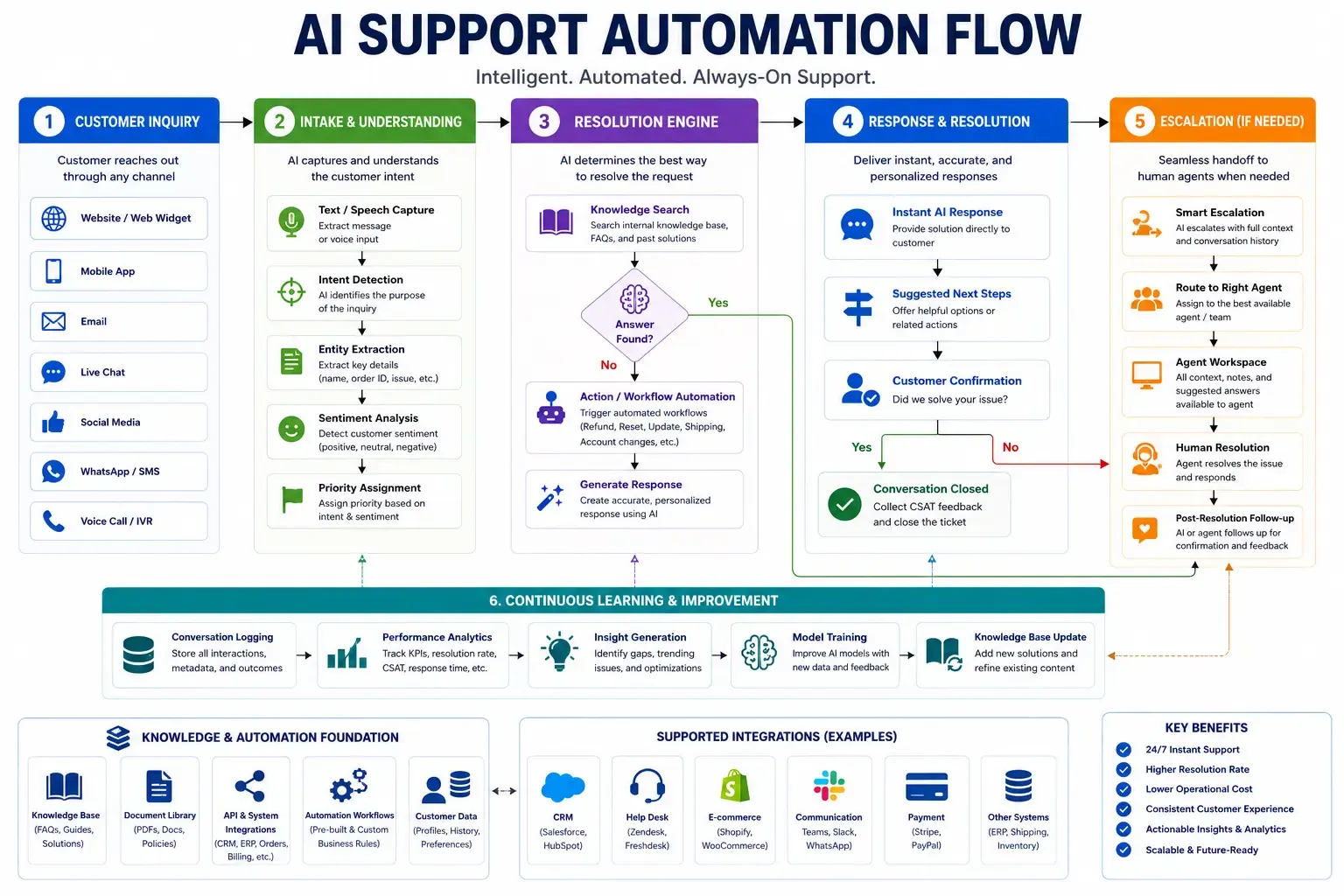
I have written the technical side of this already. Our guide to agentic AI architecture, guardrails and ROI covers orchestrators, tool schemas, memory, evaluation harnesses, observability, human-in-the-loop gates and prompt injection, and this piece deliberately repeats none of it. What follows is the money and the paperwork: how agentic AI development engagements are actually scoped, priced and signed.
I run engineering at an agency that sells this work, so treat the conflict of interest as declared. It also means I know where agencies, ours included, quietly overcharge. That section is near the end and I did not soften it.
What you are actually buying
Start with vocabulary, because vocabulary is where budgets go wrong.
The question of AI agent vs agentic AI is not academic when you are signing a statement of work. A single agent is one loop: a model, a tool set, a stopping condition. Agentic AI is the property of a system that plans across steps and commits to actions with consequences. A vendor quoting for the second while scoping the first is quoting for something cheaper than the words imply. Get the AI agent vs agentic AI distinction written into the scope section, not the marketing preamble.
The same applies to agentic vs generative AI. Generative work produces an artefact a human then acts on. Agentic work takes the action itself, which brings authorisation, audit and rollback obligations, and those obligations are most of the engineering cost. Treating agentic vs generative AI as a branding difference is how a vendor underquotes the expensive half.
Gartner named the underlying problem in June 2025 and the term stuck: agent washing, the rebranding of assistants, RPA scripts and chatbots as agents without substantial agentic capability. Gartner estimated that only around 130 of the thousands of vendors then calling themselves agentic AI companies were building genuinely agentic systems, and forecast that more than 40 percent of agentic AI projects would be cancelled by end of 2027 on cost, unclear value or weak risk controls. A July 2026 Forbes analysis added the point worth carrying into every vendor meeting: because of agent washing, some of those cancellations will be projects that were never agentic to begin with.
So how do you spot a wrapper around someone else's API? Ask for three artefacts. Typed tool definitions with input schemas and permission scoping, rather than a system prompt that says "use the CRM". An eval suite, because a wrapper has no way to prove version four beats version one. And a control plane that can disable an action at 2am without a redeploy. Reselling access to an ai agents platform is not custom AI agent model development, and that is fine as long as the proposal says which one you are buying. Both the AI agent vs agentic AI split and the agentic vs generative AI split belong in the definitions clause of the contract rather than the brochure.
What drives the price more than anything else
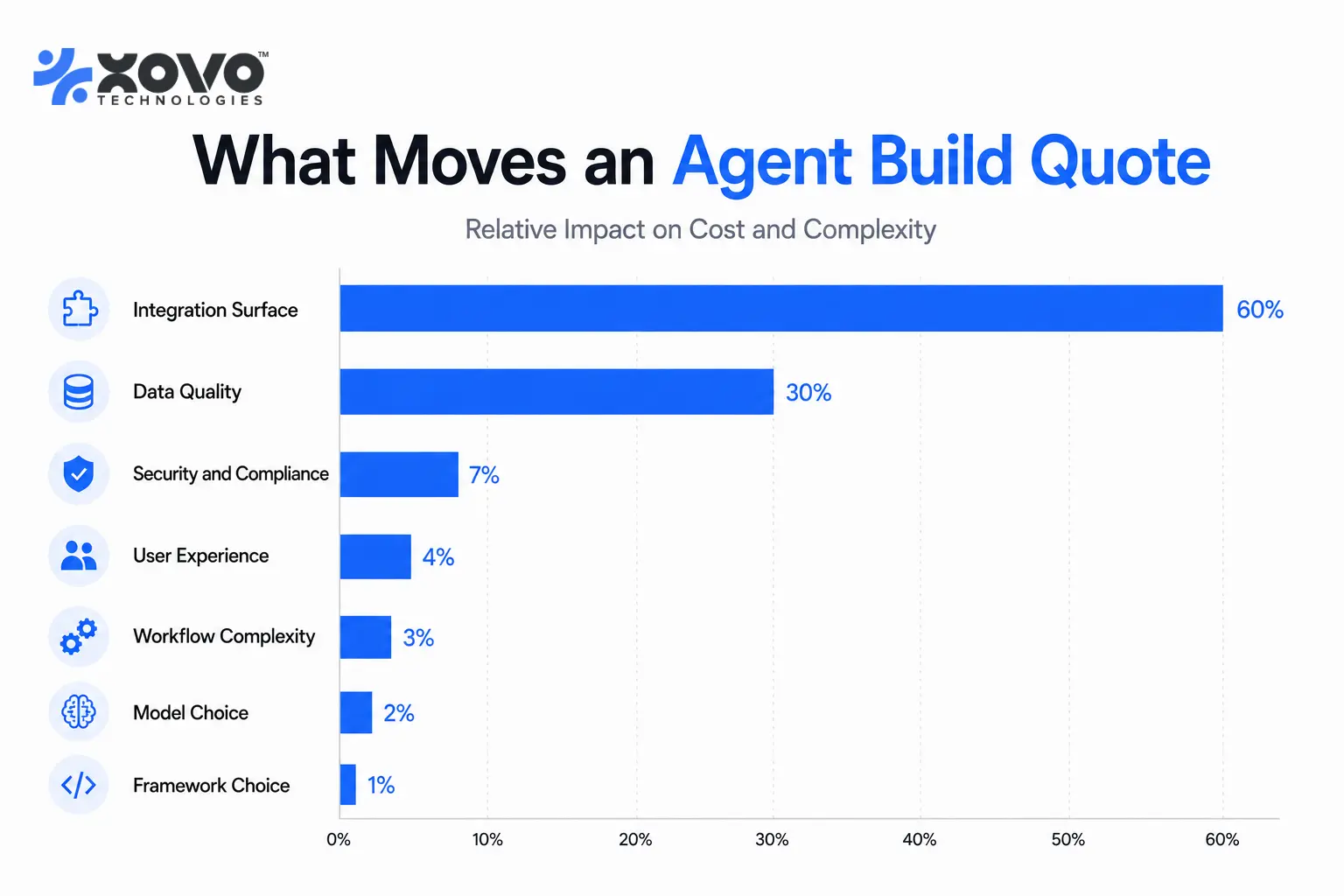
Integration surface. Not the model, not the framework, not the prompt.
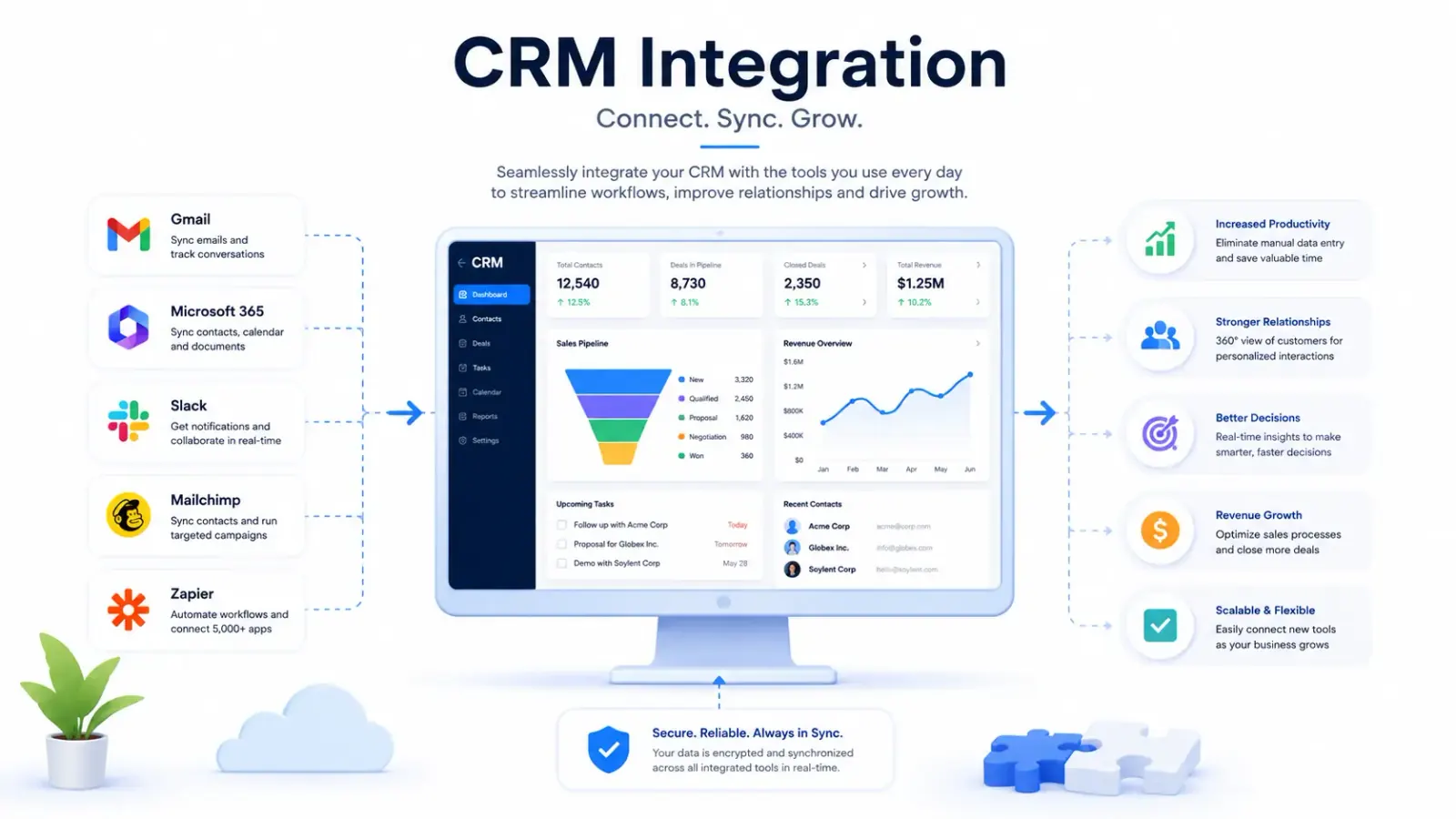
In our builds the cost is close to linear in the number of systems the agent reads from and writes to, and superlinear in how many of those lack a clean API. One documented SaaS API and one queue is a four to six week build. The same logic pointed at a 2013 on-premise ERP with a SOAP endpoint and a nightly batch window is a four month build, because AI agents integration is where the calendar actually goes. The integration inventory is the first thing we ask for and the last thing clients send.
Data quality is second, and it is what turns a fixed price into a change order. Agents fail on ambiguity, and ambiguity lives in your records. Agentic AI use cases with high data entropy cost more than their business logic suggests: ai agents for procurement reconciling three spellings of the same supplier, ai agents for HR spanning a legacy ATS and a modern HRIS, ai agents for marketing pulling attribution from four platforms that disagree. HR is the clearest example we see, because the source systems were never designed to be joined.
Third is the consequence of the action. An agent that drafts is cheap. An agent that sends is not. The moment an action is externally visible or financially material you are buying approval workflows, audit trails and reversal paths, which is why AI agents in finance cost more per workflow than almost any other category. Enterprise AI agents that move money carry a second cost most quotes miss: someone has to design the reversal, and reversal design takes longer than the happy path it undoes.
Everything else is smaller than buyers expect. Model choice is a tuning decision. Whether the team uses one AI agent framework or another matters for maintainability, not for price, and any vendor whose quote swings on which AI agent frameworks they picked is telling you they only know one of them.
What the 2026 market actually charges
Rates vary more by where a vendor sits than by what it can do. These are published 2026 benchmarks, not our rate card.
| Vendor type or region | 2026 rate | Source and date |
|---|---|---|
| US / Canada AI engineer | $150 to $250 per hour | Netclues, updated 24 Apr 2026 |
| Western Europe AI engineer | $100 to $180 per hour | Netclues, updated 24 Apr 2026 |
| Eastern Europe AI engineer | $60 to $100 per hour | Netclues, updated 24 Apr 2026 |
| South Asia (India, Pakistan) | $18 to $48 per hour | Ad Snipper, 30 Jun 2026 |
| Latin America | $35 to $100 per hour | Ad Snipper, 30 Jun 2026 |
| UK boutique senior consultant | £200 to £400 per hour | Winder.ai, 24 Jun 2026 |
| Big-4 or tier-1 blended | £500 to £1,500 per hour | Winder.ai, 24 Jun 2026 |
| LLM application engineering specialist | £250 to £450 per hour | Winder.ai, 24 Jun 2026 |
On total engagement size, Winder.ai's June 2026 figures are the most honest published set I have seen: a fixed-fee proof of concept at £15,000 to £40,000 over two to four weeks, a pilot at £40,000 to £120,000 over six to ten weeks, a mid-market production build at £120,000 to £400,000 over four to six months, and an enterprise build at £400,000 to £1.5m over six to twelve months. Year one operations run 15 to 25 percent of build cost, taking their worked mid-market first year to roughly £340,000.
Read that table carefully. A £60 offshore rate and a £300 boutique rate are not comparable units, because the first assumes you write the specification and the second assumes they do. A Big-4 blended rate is blended because a partner appears on the invoice while an offshore team does the work, which is legitimate as long as you know which of the two you will speak to on a Thursday. Among agentic AI companies selling enterprise AI agents, the spread between the cheapest and dearest credible bid on the same scope is routinely three to one. Ignore directory rankings of the best ai agents and ai agent marketplace placements while you build the shortlist; both are sold, not earned.
The run-cost line nobody quotes properly
Almost every proposal I have reviewed from another AI agent development company either omits inference cost or estimates it from a single-turn example. The second is worse, because it looks rigorous.
Published pricing as of August 2026 gives you the unit. Anthropic lists Claude Opus 5 at $5 per million input tokens and $25 per million output, Claude Sonnet 5 at $3 and $15 (introductory $2 and $10 through 31 August 2026), and Claude Haiku 4.5 at $1 and $5. Cache reads bill at roughly a tenth of the input rate, cache writes at 1.25x for the five minute window, and the batch API halves both sides for asynchronous work.
The unit is not the problem. The multiplier is. An agent turn is not one call: a tool-using loop calls, receives a result, and calls again, resending the accumulated context each time. A ten-step task on a growing transcript can cost twenty to fifty times a single-turn estimate. Retries multiply it again, and so do failed tool calls fed back as error results, which is exactly what happens while AI agents integration with a flaky legacy endpoint is still settling in month one.
Demand a token budget per completed task, measured on a real transcript rather than a prompt. Ask what the expected cache hit rate is on a stable system prompt, because that alone separates a $4,000 month from a $600 one. Ask which steps can drop to a smaller model. And ask what happens at ten times current volume, because ai agent platforms priced per seat and ai agent platforms priced per token behave very differently when you succeed. Several ai agent platforms also meter tool calls separately, which is where the surprise usually sits.
Pricing models compared
The pricing model is a risk allocation instrument. Put each risk with the party that can control it.
| Model | Carries scope risk | Carries efficiency risk | Use when | Fails when |
|---|---|---|---|---|
| Fixed price | Vendor | Vendor | Scope is frozen and the integration inventory is verified | Requirements move and every change turns adversarial |
| Time and materials | Client | Client | Discovery, R&D, unfamiliar legacy systems | Nobody watches burn and there is no incentive to finish |
| Capped T&M | Shared | Vendor above the cap | Most first agent builds | The cap is set before the integration inventory exists |
| Outcome-based | Vendor | Vendor | The metric is measurable and moved by the agent alone | The metric also depends on your team or your ad spend |
| Retainer | Shared | Client | Post-launch operations and model migrations | It is used to fund a build that needed a defined scope |
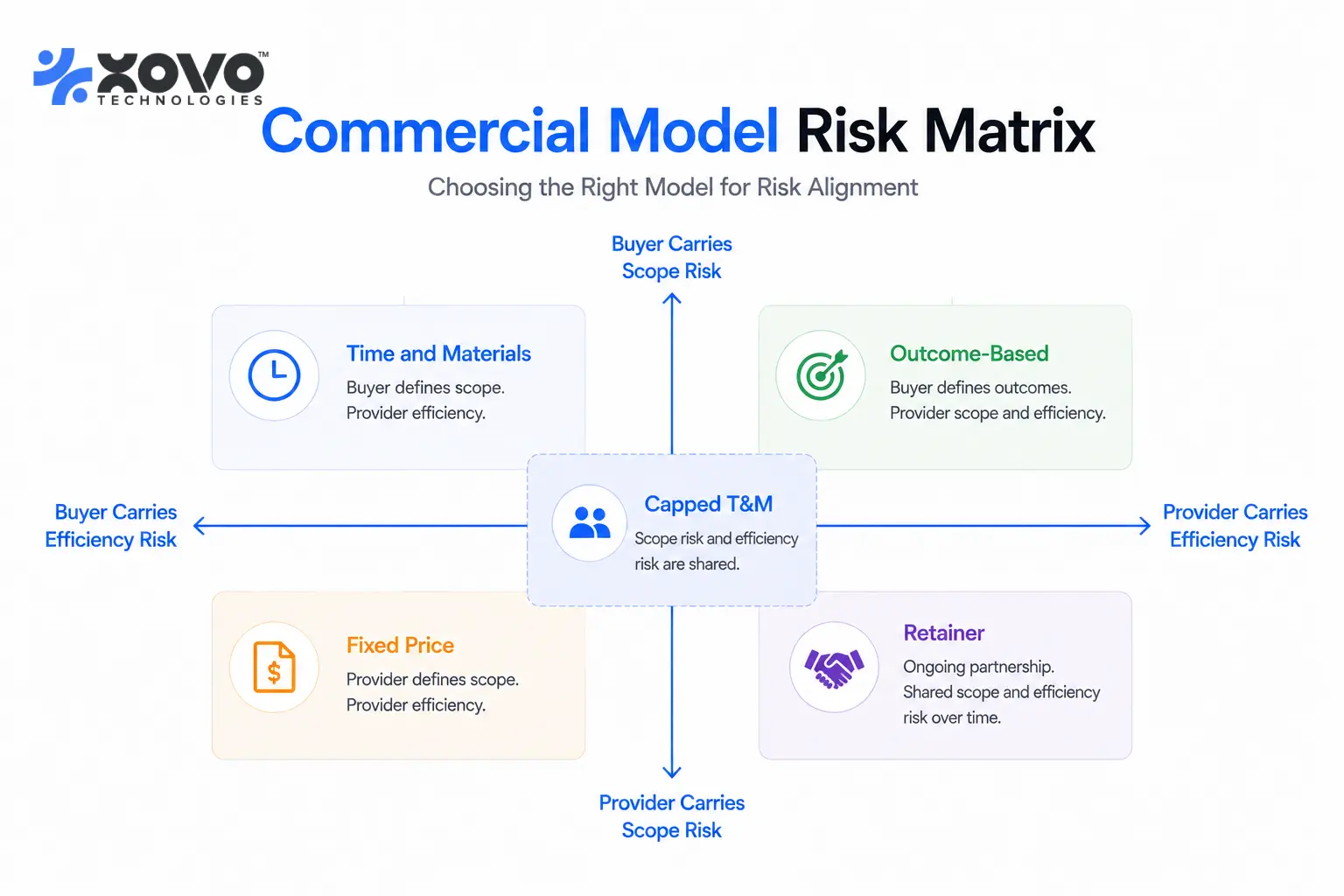
My honest answer on which protects you: capped time and materials, with a named cap, weekly burn reporting and written change control. Fixed price feels safest and is the most expensive way to buy a first agent, because a competent vendor prices scope risk into the number and a weak one absorbs it by cutting the eval suite. Outcome-based sounds like perfect alignment and rarely survives contact with attribution. We have signed one outcome-based agent contract and it worked only because the metric was invoice exceptions cleared per week, a number the agent alone moved. If your metric is revenue or churn, you are buying a dispute.
One warning on retainers. A retainer is the right structure for running a system and the wrong one for building it. An open-ended monthly retainer for an initial build is a request to fund an undefined project.
Should you run a paid discovery?
Usually yes, and the reason is arithmetic. Discovery costs £15,000 to £40,000 against a build of £120,000 to £400,000. If it changes the shape of the build even slightly it pays for itself, and if it concludes you should not build at all it has saved you the whole figure. Refuse a free discovery from anyone selling a build, because an unpaid discovery is a sales activity and its conclusion is known before it starts.
The output should be specific: a verified integration inventory with named endpoints and auth methods, a data quality assessment on real records rather than a schema, a prioritised shortlist of agentic AI use cases with an estimate against each, a proposed agentic AI architecture with the tradeoffs written down, an eval plan, and a build estimate with a stated confidence range. If you receive a deck of agentic AI use cases you could have listed yourself, you bought a workshop.
Insist that the shortlist is priced per candidate rather than in aggregate, because the categories behave differently. AI agents for procurement scope cleanly, since the workflow is rule-heavy and an approval path already exists. AI agents for HR carry more data-joining work than the business case suggests. AI agents for marketing look cheap until you count the platforms they have to read and reconcile. AI agents in finance sit at the top of the range because every write needs a reversal path.
What the vendor needs from you before quoting accurately is the mirror image, and withholding it does not protect you in negotiation, it just produces a padded quote. They need read access to the systems in scope, or at minimum API documentation plus a sample of real records with the messy ones included. They need to know who approves an action and who is accountable when the agent gets one wrong. And they need your security and residency constraints up front, because a requirement to run inside your VPC changes the architecture, as our private LLM hosting guide sets out.
What a credible proposal contains
Most proposals for AI agent development services are a capability deck with a number at the end. The good ones have these.
| What to look for | Why it matters | What a weak proposal says |
|---|---|---|
| Named integration inventory with auth method per system | AI agents integration is the actual scope | "Integration with your existing systems" |
| Acceptance criteria as eval pass rates on held-out real cases | Makes "done" objective | "Delivery of a working AI agent" |
| Token budget per completed task plus a caching plan | Prevents a month-two run-cost surprise | One line for "LLM API costs" |
| Named individuals with time allocation | You are buying people, not a logo | A blended day rate for "the team" |
| Explicit IP and model weight assignment clause | Decides what you own | "Client owns the deliverables" |
| Handover plan with runbook, eval suite and training days | Determines whether you are captive | "Knowledge transfer sessions" |
| Failure and rollback design for every write action | This is the part that goes wrong | A demo video |
Fight hardest for the eval line. Pass rates against a held-out set of real cases are the only definition of done that survives an argument; without them, "working" means whatever the demo showed, and the demo showed the happy path. Then ask for a reference build in the same integration environment rather than the same industry. Any AI agent development company can find a logo in your vertical. Far fewer have shipped against your specific ERP.
Who owns what at handover
This is the section buyers skip and then regret, because the default legal position is not what most people assume.
Under US copyright law, code written by an independent contractor belongs to the contractor unless there is an express written assignment. Software is not one of the nine categories of commissioned work that can be made a work made for hire by agreement, per the Copyright Office's Circular 30, so work-made-for-hire language alone does not transfer software. You need an assignment clause, and a surprising number of agency contracts contain the former without the latter.
Then go artefact by artefact, because "the deliverables" is not a definition. The repository should be assigned outright and live in your version control from the first commit. Prompts and tool schemas are the actual product logic in an agent and must be named explicitly, because a vendor who keeps the prompt library keeps the system. The evaluation suite and its test cases are what let a different vendor take over, which is precisely why some contracts quietly exclude them. Infrastructure as code belongs in the same clause, alongside the documented agentic AI architecture.
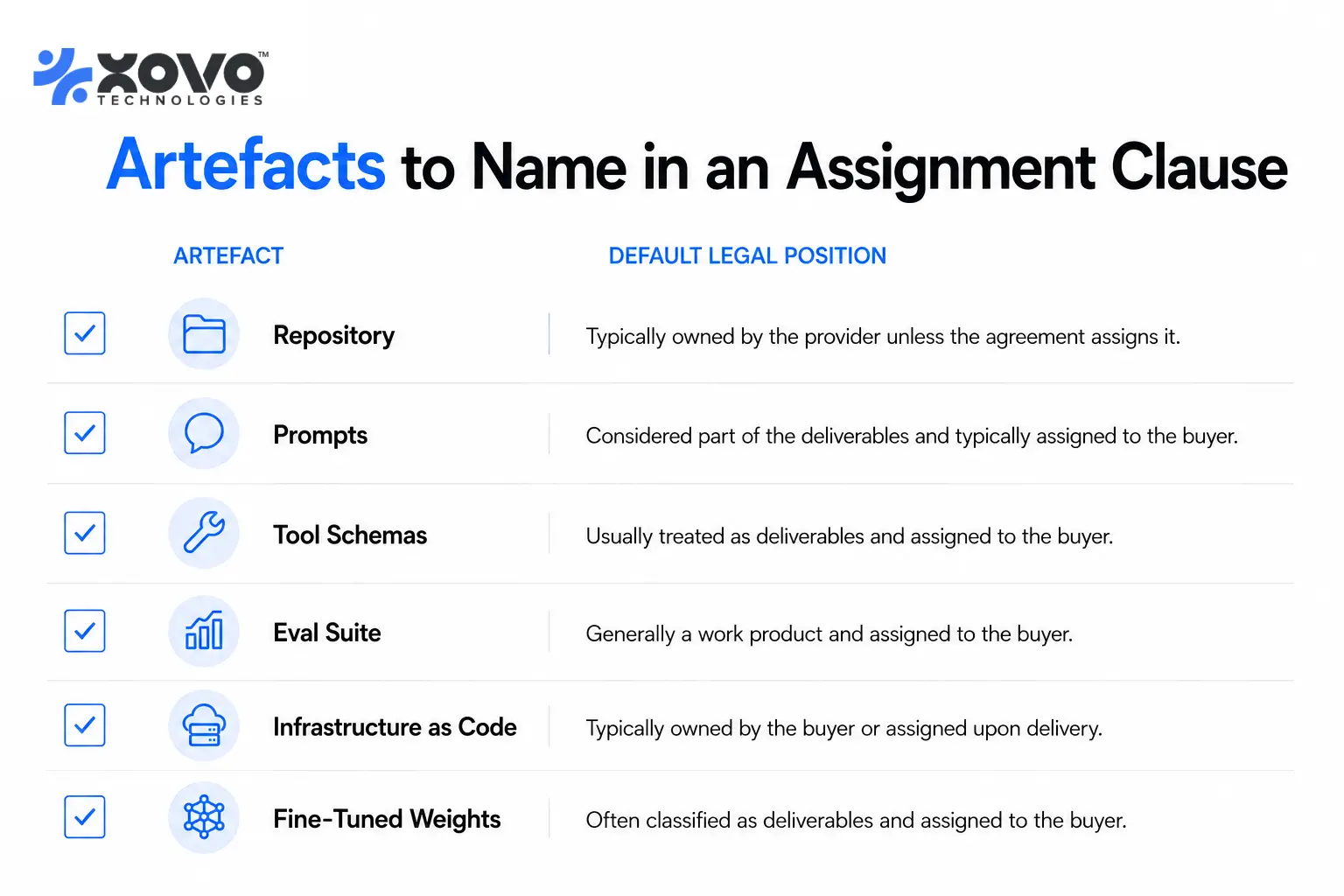
Fine-tuned weights are the messy one, and the answer sits in three layers. Your contract decides who owns the artefact the agency produced. The foundation model provider's terms decide what you may do with weights derived from their base model, and those terms differ by provider, so pull them from the contract rather than a marketing page. And if the fine-tune used your proprietary data, the contract should state whether you own the resulting model, hold a licence to it, or merely have a right to use it during the term. Those three outcomes are routinely collapsed into one ambiguous sentence. Where real custom AI agent model development is in scope, this clause is worth a lawyer's hour, and where it is not, ask why the proposal used the phrase custom AI agent model development at all.
Two clauses I would not sign without. A carve-out letting the vendor reuse generic components is reasonable, but limit it to non-client-specific libraries and exclude your prompts and evals. And source escrow or account access for anything the vendor hosts on your behalf, because the failure mode of an insolvent AI agent development company is that your production system lives in their cloud tenancy.
MCP, A2A and the clauses to add in 2026
Two standards moved in the last four months and both belong in your contract.
The Model Context Protocol shipped its 2026-07-28 specification on 28 July 2026, described by the project as the largest revision since launch. It moves the core to a stateless request and response model, drops the session handshake, adds header-based routing so gateways can authorise without parsing JSON bodies, adds cacheable list results with a TTL, and hardens authorisation with RFC 9207 issuer validation and a shift from Dynamic Client Registration toward Client ID Metadata Documents. TypeScript, Python, Go and C# are tier one SDKs, with Rust in beta. Practically, remote MCP servers that previously needed sticky sessions and a shared session store can now sit behind an ordinary round-robin load balancer. The project also committed to a twelve month minimum deprecation window, which is the kind of commitment to mirror in a vendor's maintenance terms.
On the other axis, the Agent2Agent protocol reached v1.0 and, per the Linux Foundation's 9 April 2026 announcement, is backed by more than 150 organisations with support in Azure AI Foundry and Copilot Studio, Amazon Bedrock AgentCore Runtime and Google Cloud. The Linux Foundation states plainly that A2A is complementary to the Model Context Protocol, not a competitor.
The A2A vs MCP question comes up in almost every vendor call and it is not a choice. MCP is vertical, connecting one agent to its tools and data. A2A is horizontal, letting agents delegate across organisational boundaries. Any vendor framing A2A vs MCP as a bet they have made on your behalf has misunderstood both. What you want in the contract is a commitment that tool access is exposed over the Model Context Protocol rather than a proprietary shim, that any remote MCP servers built for you target the 2026-07-28 spec or state a migration date, and that the vendor tracks the deprecation window at their cost. Get the A2A vs MCP answer right in writing and replacing the vendor later becomes an engineering task rather than a rebuild, because your remote MCP servers outlive the relationship.
Handover, and whether your team can maintain it
Can your own team maintain this afterwards? Sometimes no, and a vendor who says yes without asking about your team is not being straight with you.
The test is not whether your engineers can read the code. It is whether they can run the eval suite and interpret a regression, add a tool without breaking permission scoping, migrate to a new model version when the current one is deprecated, and diagnose a bad trace in production. With Python and API experience all four are learnable in weeks given a real runbook. If your only technical staff are a two-person IT function managing endpoints, you are buying a managed service whether the contract says so or not, and it should be priced that way from the start.
What makes handover work, from our own engagements: a runbook written for someone who was not in the room, the eval suite wired into your CI so regressions surface without anyone remembering to check, two of your engineers pairing through the final six weeks rather than receiving a demo, and a support taper from full cover to on-call to advisory instead of a cliff edge. We build the taper into the statement of work now because we got it wrong once and spent three unbilled weeks answering questions we should have written down.
Framework choice matters here. A build on mainstream AI agent frameworks with real documentation is maintainable by people who were not on the project. A build inside a vendor's private ai agent builder is maintainable by that vendor. Neither is automatically wrong, but the second is a commercial decision dressed as a technical one. The same goes for ai agent builder tools bundled into a licence: if the ai agents platform disappears, so does your system.
Name the AI agent frameworks and the ai agent builder tools in the proposal, so a successor vendor can price the takeover without reverse-engineering it. Then ask three questions: what happens to the agent if the ai agent builder vendor is acquired, what the ai agent builder tools export, and whether an ai agents platform migration would mean a rewrite. An ai agent marketplace listing answers none of them.
How long a first production agent really takes
Four to six months for a mid-market production build, per Winder.ai's June 2026 bands, which matches what we see. A proof of concept runs two to four weeks and a pilot six to ten. Anyone promising production in three weeks is describing a proof of concept and using the wrong noun.
Category changes the shape of it. AI agents for procurement usually ship fastest, because the source of truth is a single ERP. AI agents for HR run slowest, since consent and residency reviews stack up behind the build. AI agents for marketing land in between, and AI agents in finance are gated by the control environment rather than the code.
The distribution matters more than the average. In our builds the model work is typically two to three weeks of the total; the rest is integration, evaluation, security review and the approval workflow around consequential actions. Enterprise AI agents in regulated environments add a review cycle measured in weeks of calendar time and almost no engineering time, which is maddening but predictable and should be planned rather than discovered. The step nobody budgets is pilot to production: published 2026 guidance puts that jump at three to six times proof of concept cost, because the proof of concept proves the logic and production pays for everything it skipped.
Red flags in an agency pitch
| Red flag | What it usually means | What to ask |
|---|---|---|
| Demo with no failure cases shown | Failure handling does not exist yet | "Show me what happens when the API returns a 500" |
| No eval suite in the proposal | They can assert improvement, not prove it | "How will you measure version four against version one?" |
| Fixed price quoted before integration review | The risk premium is buried, or a change order is planned | "Which systems did you inspect to price this?" |
| Model choice presented as the differentiator | They are selling a wrapper | "What share of the build is model work?" |
| Reluctance to name the individuals doing the work | Delivery is going somewhere you were not told about | "Who writes the first commit, and where do they sit?" |
| "We own the framework, you own the output" | You are renting the system you paid for | "Can another vendor take this over? Show me how" |
| An ai agent marketplace listing as the main proof point | A listing is distribution, not delivery | "Which of these did you build end to end?" |
| A ranked list of the best ai agents as the pitch | The pitch is content marketing | "What did you ship against a system like ours?" |
The sixth one should end a meeting. The rest are negotiable.
Where agencies overcharge, including ours
Three places, and you should hear them from someone who sells this.
Discovery is the first. Four weeks of discovery for a single-workflow agent is padding. If the integration surface is two systems and the data is clean, two weeks is enough, and we have quoted four when two would have done. Push back with the integration count.
Strategy layers are the second. A separate AI strategy engagement, priced independently and delivered before the build, is often a way to bill for the sales process. It is warranted when you genuinely do not know which workflows to attack across a large organisation, and not when you already know the workflow. Ask for it to be folded into a paid discovery.
Ongoing retainers are the third and the largest. A run-rate retainer at 25 percent of build cost is defensible in year one, when models change and evals need maintaining. The same figure in year three on a stable system is rent. Negotiate the step-down at signature, not at renewal when you have no leverage.
The market's own numbers explain why this persists. McKinsey's State of AI research found 23 percent of organisations scaling an agentic system somewhere in the enterprise and 39 percent experimenting, with no more than 10 percent scaling agents in any single function. MIT's Project NANDA report found that despite $30bn to $40bn of enterprise generative AI spend, 95 percent of organisations saw no measurable P&L return. Most buyers have never done this before, and pricing reflects that asymmetry rather than the difficulty of the work. For what it is worth, the best ai agents we have shipped were the narrowest ones, and they were not the most expensive.
For the technical criteria to sit alongside these commercial ones, the enterprise architecture and guardrails guide has the evaluation and observability detail, our AI chatbot development services guide covers the simpler end of the same decision, and where agents replace the rules engine covers the workflow side. Our agentic AI development service page sets out how we scope this, the AI automation practice covers the surrounding process work, and the three-way matching case study shows what one engagement actually produced.
Run the shortlist properly. Pay two agentic AI companies for a short discovery, compare the integration inventories rather than the decks, and give the build to whichever one told you something inconvenient. If you want a second opinion on a proposal already sitting in your inbox, book a free AI audit and bring the document.