A custom website development company builds your site's front end, back end, and data layer from scratch around how your business actually runs, instead of configuring a theme or drag-and-drop builder to approximate it. That distinction matters the moment your site has to do something a template was never built for: pull live data from an internal system, run a workflow specific to your industry, or meet a security review that a page builder cannot pass. XOVO Technologies builds these systems for scaling B2B companies in the US, UAE, and Saudi Arabia, and this guide covers what a custom build actually involves in 2026: when it beats a template, what the process and cost look like, how to pick custom website developers, and how to make sure the finished site gets found by both Google and the AI assistants now answering questions directly.
Most companies looking at custom websites development options are really trying to answer one question: is this worth the extra cost and time over a template? The honest answer depends entirely on what the site has to do, which is where we'll start.
When Does a Business Actually Need a Custom Website Development Company?
A business needs a custom website development company once a template, page builder, or off-the-shelf CMS can no longer support what the site actually has to do: connect to internal systems in real time, run a checkout or intake flow unique to the business, or hold up under a security review. Below is where that line shows up in practice, not in theory.
- You are stacking plugins on top of plugins to force a workflow the CMS was never designed to run, and each new plugin makes the site slower and harder to maintain.
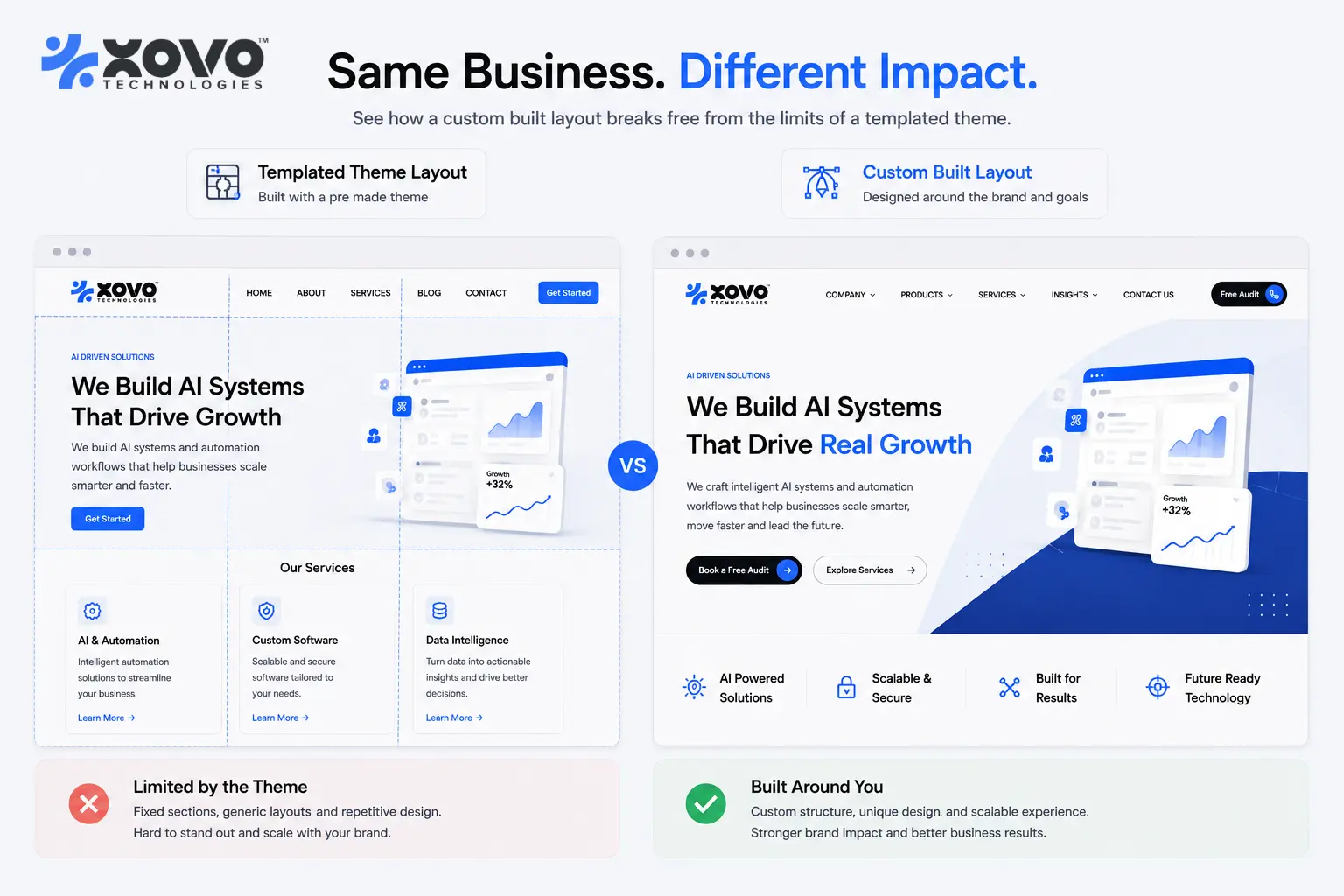
- Design is capped by what the theme allows, so the site ends up looking like every other business running the same theme.
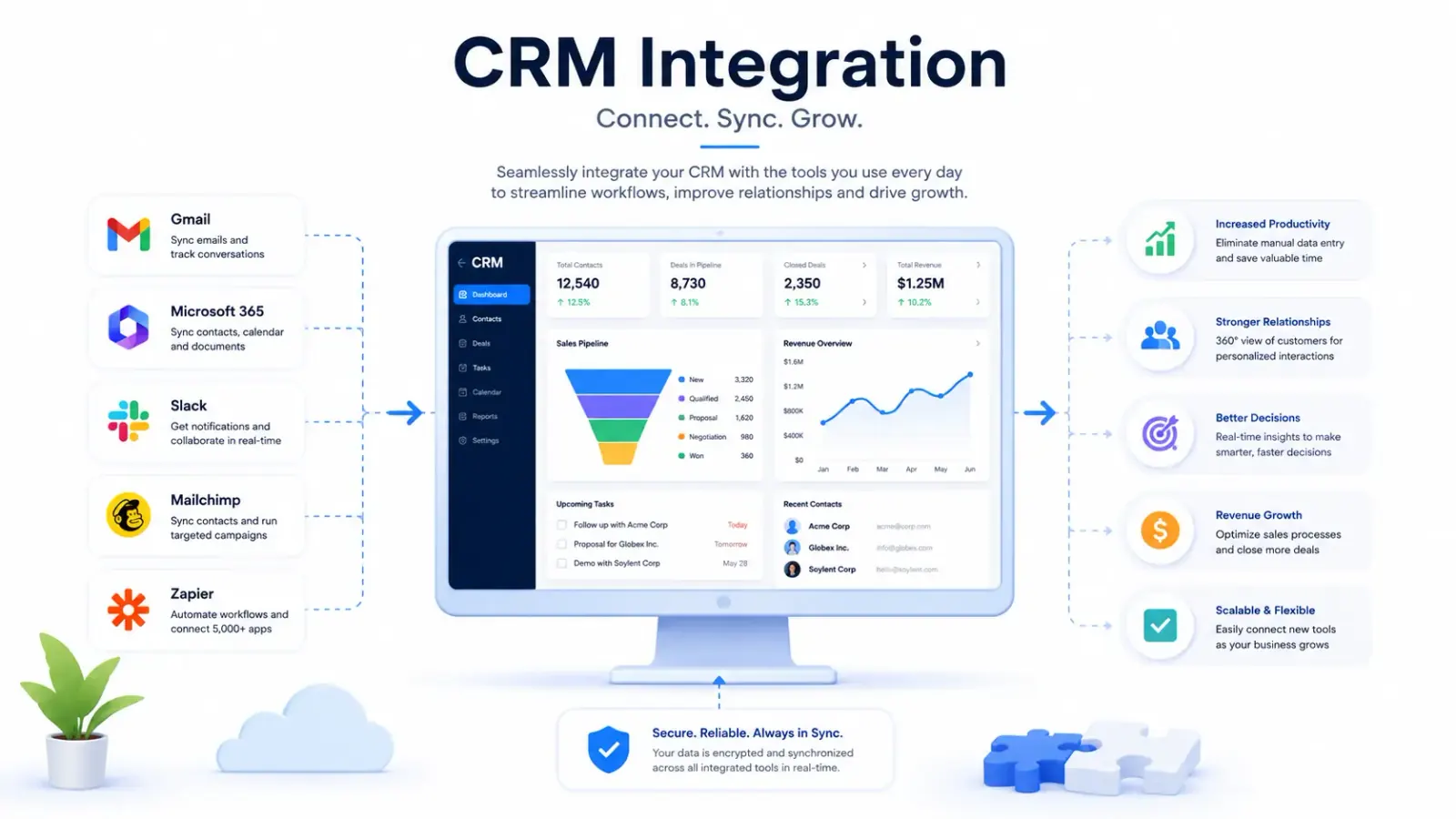
- The site needs to talk directly to a CRM, ERP, inventory system, or proprietary database, and the available plugin connectors are read-only or unreliable under real traffic.
- You are entering a regulated industry, such as healthcare, finance, or government contracting, where a security or compliance review will look at the actual codebase, not a plugin's marketing page.
- You are scaling into new markets and need multi-currency, multi-language, or region-specific logic that a generic template cannot express.
If none of these apply yet, a well-built template is the more sensible choice and a custom build would be spending money to solve a problem you don't have.
How Is Custom Website Development Different From a Template or Website Builder?
The difference is where the code comes from. A website builder or CMS theme hands you someone else's code and lets you fill in the content. Custom website development means every part of the front end, back end, and database is written for your specific requirements, so nothing you need has to be worked around later.
| Approach | Typical launch time | Design flexibility | Integration depth | Best fit |
|---|---|---|---|---|
| Website builder (Wix, Squarespace) | Days to 2 weeks | Limited to the builder's blocks | App marketplace only, often shallow | Small business brochure sites |
| CMS with a theme (WordPress, Webflow) | 2 to 6 weeks | Moderate, constrained by the theme | Plugin-dependent, can break on updates | Content sites, blogs, simple marketing sites |
| Fully custom build | 8 to 20+ weeks | Full | Direct API connections to any internal system | B2B platforms, SaaS marketing sites, regulated industries |
That third row is what our full-stack development service is built around. One team owns the front end, the back end, and the database design, so the integration and performance work does not depend on whether a plugin author still maintains their code next year.
What Are the Stages of a Custom Website Development Project?
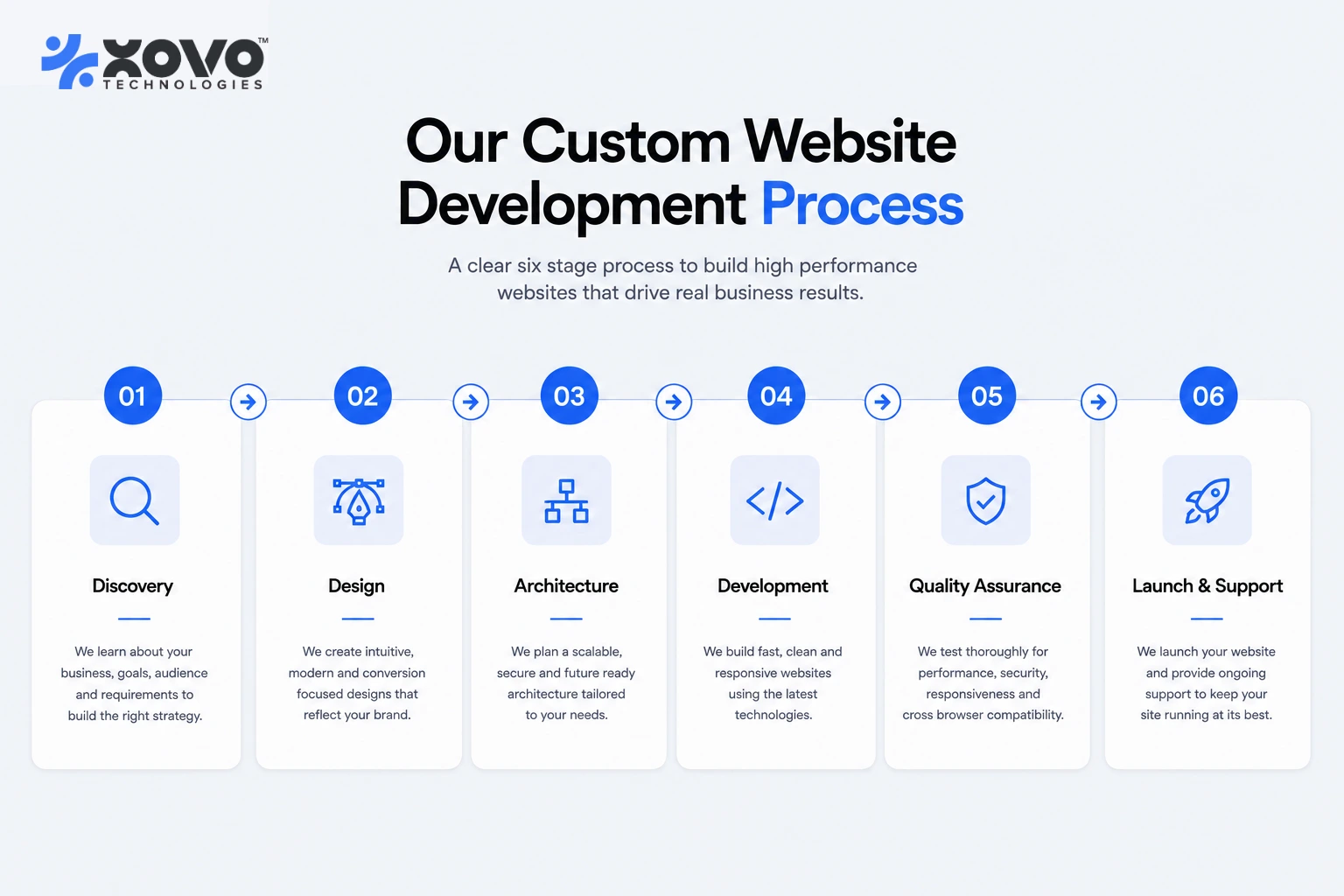
A custom website development project runs through six stages: discovery, design, architecture, development, quality assurance, and launch, followed by ongoing support. Skipping or compressing any of the first three is the most common reason a build runs over budget, because a problem caught during architecture costs a fraction of what the same problem costs once code has already been written around it.
- Discovery: mapping the workflows, integrations, and business rules the site has to support, not just the pages it needs.
- Design: UX and UI design built around how your specific users actually make decisions, not a generic layout borrowed from a competitor.
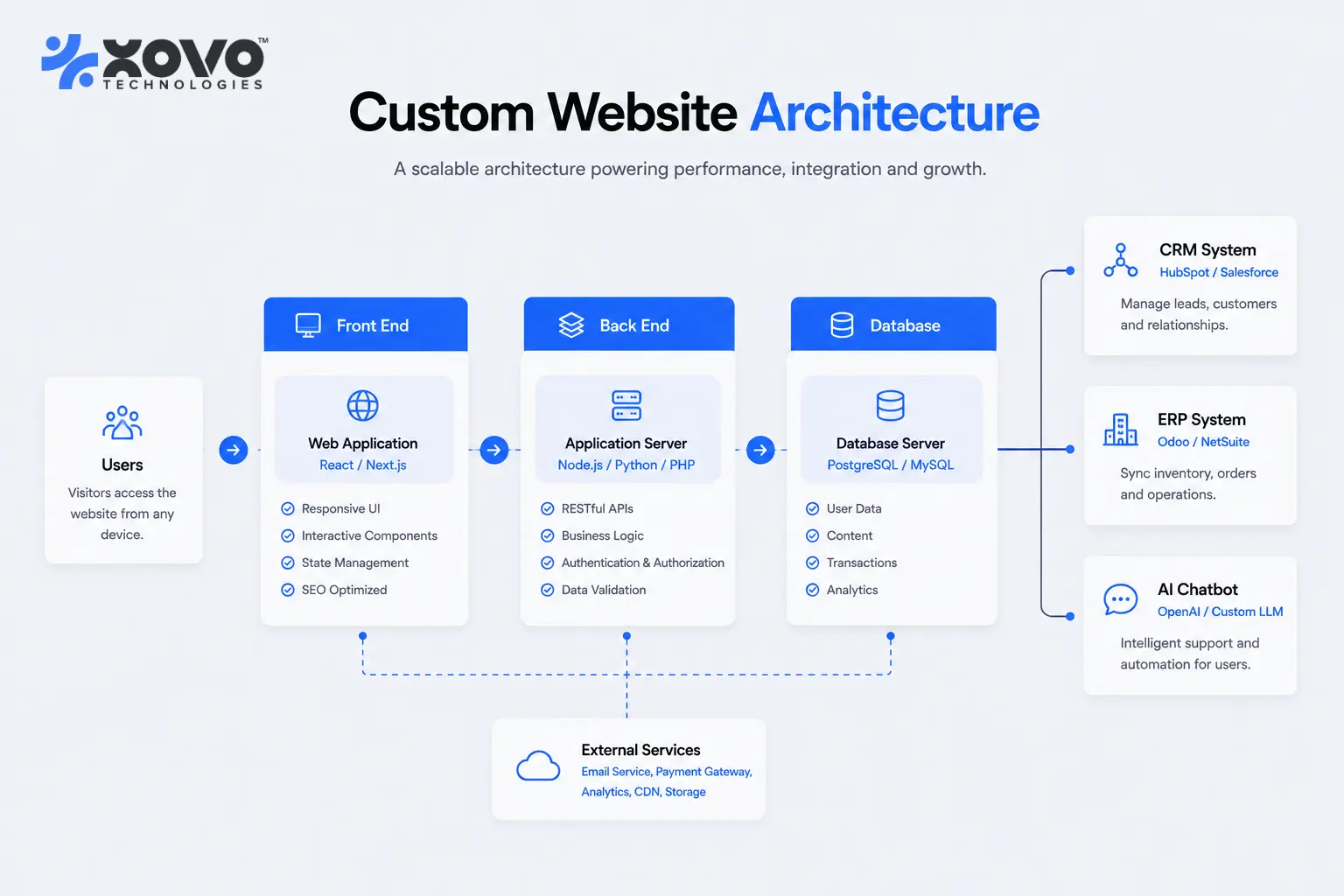
- Architecture: deciding the tech stack, data model, and integration points before a line of production code is written.
- Development: building the front end and back end in parallel sprints, with a staging environment the client can review as work progresses.
- Quality assurance: functional testing, security testing, and performance testing against real traffic patterns, not just a checklist.
- Launch and support: migration, monitoring, and a maintenance plan, since a custom site needs an owner after it ships the same way any piece of software does.
How Much Does Custom Website Development Cost in the US in 2026?
Custom website development in the US typically runs from $15,000 for a focused marketing site to $250,000 or more for a full platform with deep integrations, and the number is driven almost entirely by scope, not by which state or country the development team sits in. In our engagements, the two biggest cost drivers are how many systems the site has to talk to and how much of the design is genuinely original versus adapted from an existing pattern.
| Project type | Typical range (USD) | What drives the cost |
|---|---|---|
| Marketing or brochure site, custom design | $15,000 to $40,000 | Design complexity, number of unique page templates |
| Web application or client portal | $40,000 to $120,000 | Custom logins, dashboards, and business logic |
| Enterprise platform with multiple integrations | $120,000 to $250,000+ | Number of systems integrated, compliance requirements, data migration |
If you're pricing out website custom development for a US-based B2B company specifically, expect the higher end of these ranges once real integrations enter the picture. For anyone comparing custom website development USA pricing against other regions, scope is the real variable, not geography. XOVO Technologies runs its primary engineering base out of Lahore, Pakistan, with a second office in Al Jubail, Saudi Arabia, which keeps senior engineering cost lower than a comparable US-based team without changing what the client in the US, UAE, or Saudi Arabia actually receives.
Custom CMS, Headless Architecture, or a Full-Stack Framework: Which Should You Pick?
Custom CMS, headless, and full-stack frameworks are really three different custom website development solutions for three different shapes of business. Pick a custom CMS if editors need to publish frequently without touching code. Pick headless architecture if the same content has to power a website, a mobile app, and another channel from one source. Pick a full-stack framework built without a CMS at all if the site is closer to a web application than a content property.
- Custom CMS: a tailored admin panel wired to your own database, which works well when marketing needs to update pages constantly and the underlying logic is otherwise simple.
- Headless architecture: separates content from presentation, so the same content feeds a website, an app, and a partner portal through one API, which matters once you publish to more than one surface.
- Full-stack framework: a stack such as Next.js paired with a Node or Python backend, built for sites that behave like software, with logged-in dashboards, live data, and custom business rules rather than mostly static pages.
Most B2B companies we work with end up on a headless or full-stack setup once the site needs to do more than publish pages. This is the category our full-stack development team builds most often, because a growing product roadmap rarely stays inside what a CMS was designed for.
Should Your Custom Website Include AI Features Like a Chatbot?
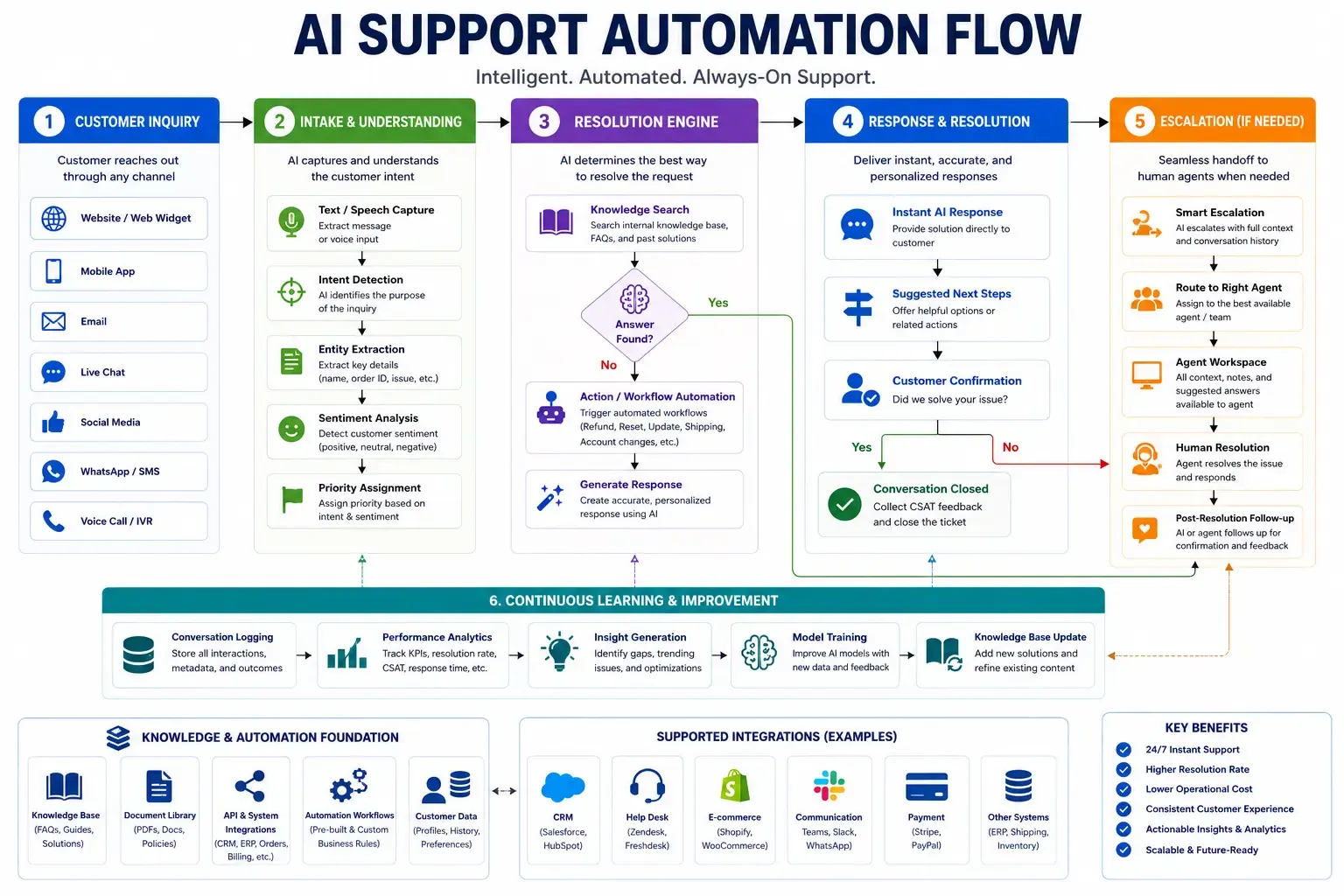
Add an AI chatbot or a recommendation engine to a custom website once a real share of your traffic asks repeat questions or browses a large catalog, since that is where automation actually cuts cost instead of just adding a feature for its own sake. XOVO's AI Chatbot is built to resolve up to 80% of customer queries without a human agent, and that number only holds up when the chatbot reads live data from the site's own systems instead of running as a bolted-on widget.
The same logic applies to product recommendations. For a storefront with a large catalog, a recommendation system built into the same codebase as the site itself can use the actual browsing and purchase data your custom build already collects, rather than guessing from generic behavioral signals.
How Do You Choose Custom Website Developers or a Development Partner?
Choosing custom website developers comes down to three checks: can they show a live site they built with a similar level of complexity, do you own the source code and infrastructure once the project ends, and who maintains the site after launch. A studio that will not hand over full ownership of the code, and of any AI model weights behind a feature it built, is a studio you will eventually have to leave and rebuild from scratch somewhere else.
Questions worth asking any development partner before you sign:
- Do we own the source code, the design files, and any AI model weights outright, or are we licensing access to your platform?
- Can you show a live site you built with integrations similar to ours, not just a design portfolio?
- Who is on the team day to day, and is that the same team still here in a year for maintenance?
- What happens to hosting, security patches, and monitoring after launch?
- How do you handle a security or compliance review if our industry requires one?
At XOVO Technologies, the client keeps the source code and any model weights from the outset, so switching providers later never means starting over. If your site specifically serves a B2B buying committee rather than a single decision-maker, our B2B website development playbook goes deeper on structuring the site itself around that reality.
How Long Does Customized Website Development Take From Kickoff to Launch?
A focused marketing site typically takes 6 to 10 weeks from kickoff to launch. A web application or client portal takes 10 to 20 weeks. An enterprise platform with several system integrations takes 20 to 40 weeks, mostly because of how long real integration testing runs once your other systems are involved, not because the design work itself takes longer.
The single biggest thing that stretches a timeline in our experience isn't design or code. It's how ready the client's own systems and data are when development starts. A CRM with clean records and documented API access saves real weeks compared with one that needs to be untangled first.
How Do You Make a Custom Website Rank on Google and Get Cited by AI Search?
A custom website ranks on Google and gets cited by AI search when its content is server-rendered into raw HTML, structured with clear headings and schema markup, and fast enough to pass Core Web Vitals. That matters because crawlers such as GPTBot, ClaudeBot, and PerplexityBot read the HTML a server sends and do not execute JavaScript the way a browser does. Google's Gemini is the exception, since it rides on Googlebot's own renderer, but building for server-rendered HTML covers every crawler at once, Gemini included.
This is an architecture decision made at the start of a build, not something an SEO team can fix after launch with meta tags. A site built as a pure client-side JavaScript application looks fine in a browser and is largely invisible to most AI crawlers reading its raw response. XOVO Technologies' own SEO service treats this architecture layer as the starting point of a project, not an afterthought bolted onto a finished site.
Where XOVO Technologies Fits
XOVO Technologies builds custom websites as part of a wider practice that also covers SaaS products, mobile apps, and AI agents, which matters because a marketing site today is often a client portal or a product demo environment within a year. The same full-stack team that ships your site can extend it into a logged-in application, add an AI chatbot grounded in your own data, or connect it to the CRM and ERP systems your sales and operations teams already use, without a second team relearning the codebase from scratch.
Every engagement includes managed hosting, monitoring, and 24/7 support, and the client owns the source code and any model weights from day one. Full-stack engineering is led by co-founder and CTO Sufi Inam Ul Hassan, and projects run out of our primary engineering base in Lahore, Pakistan, with a second office in Al Jubail, Saudi Arabia, serving B2B companies across the US, UAE, and Saudi Arabia directly.
If you're weighing whether to rebuild on a custom stack, extend an existing site with AI features, or fix a build that's already underway, book a free AI audit and XOVO Technologies will look at your current site, your systems, and your growth plan, then tell you plainly what a custom build would actually take and cost.