Customer service automation in 2026 works, but not at the rates the decks claim. Independent cross-program data puts median tier-1 deflection near 41 percent, with a top quartile around 59 percent, while vendor headlines sit between 67 and 90 percent. The gap is definitional. Automation rate and containment rate count conversations that never reached a person; resolution rate counts problems that were actually solved. Platform cost for an automated resolution runs roughly $0.50 to $2.40, against $2.70 to $60 for a human contact depending on complexity. The economics only survive contact with reality if escalation is designed deliberately rather than bolted on afterwards.
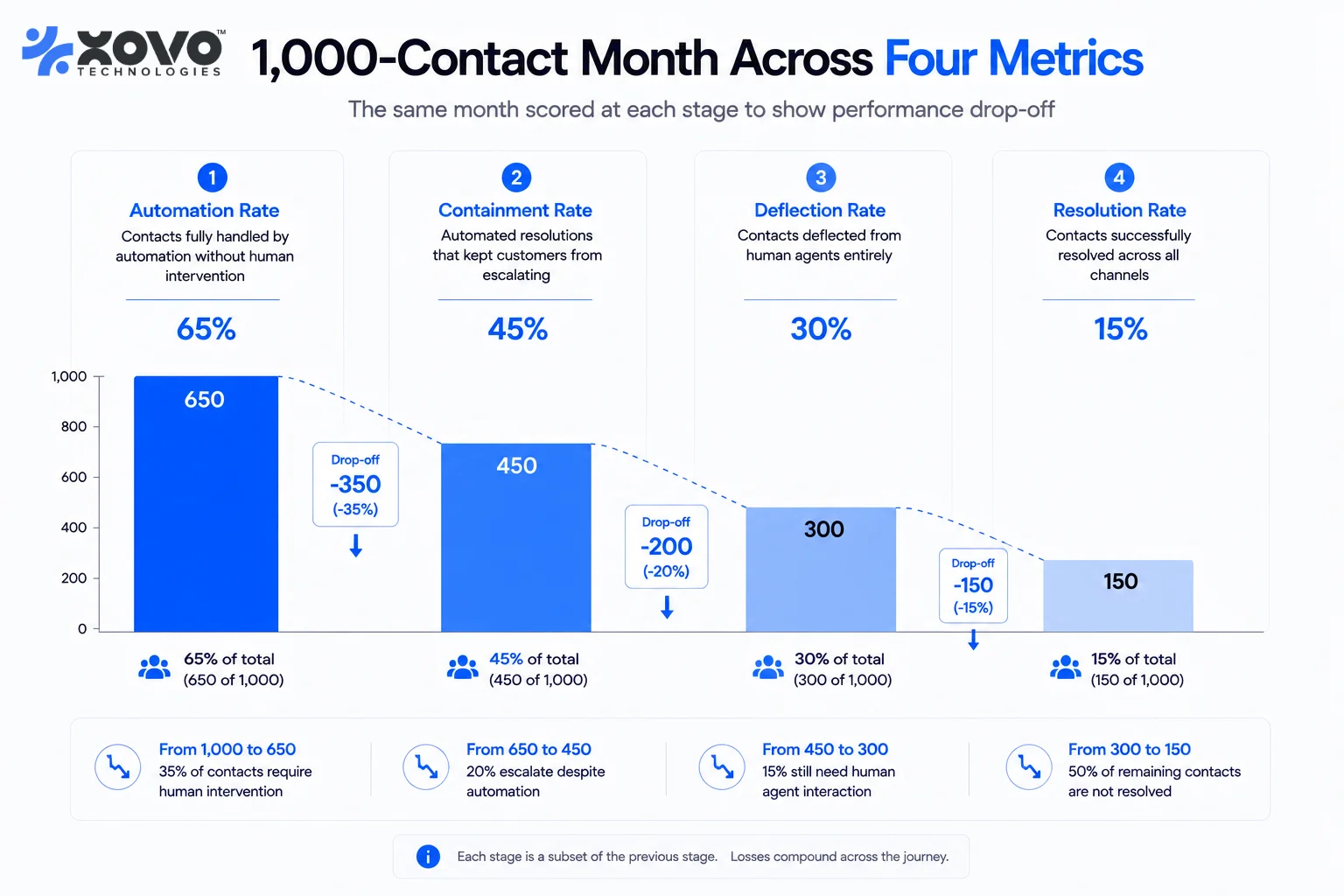
Four metrics, one word, and a 53-point spread
A support director sent me a vendor deck in June claiming 87 percent automation. We pulled six months of her ticket export, matched conversations against re-contacts, and got 34 percent genuine resolution. Neither figure was a lie. They counted different things, and the vocabulary of customer service automation lets four incompatible metrics wear the same name.
That is the most expensive misunderstanding in the category, and the first thing we check when a client forwards a proposal from one of the larger ai customer service companies.
| Metric | What it counts | Who reports it | How it inflates |
|---|---|---|---|
| Automation rate | Conversations an ai customer support agent touched and closed inside its own channel | Vendor marketing, headline slides | Counts abandons, counts "was that helpful?" silence as success |
| Containment rate | Contacts that reached the customer service ai agent and did not hand off | Platform analytics, measured per channel | Counts customers who gave up and phoned instead |
| Deflection rate | Contacts that never reached a person, measured across the whole contact universe | CX operations | Counts self-service exits where nothing got solved |
| Resolution rate | Issues solved, with no re-contact inside a defined window | Post-hoc audit against ticket data | Hard to inflate, which is why it is rarely quoted |
| Outcome | Any configured action the agent completes, including a handoff to a person | Intercom billing since 12 March 2026 | Bills you for handoffs, so it decouples spend from resolution |
That last row matters more than it looks. On 12 March 2026 Intercom explained why Fin's billing metric moved from resolutions to outcomes: as the agent took on subscription changes and billing disputes, "success no longer meant full automation". Reasonable engineering argument. It also means the number on your invoice is no longer the number your CFO thinks it is.
eesel's June 2026 benchmark analysis frames the same gap from the buyer side. AI deflects more than 45 percent of queries, while only around 14 percent reach genuine self-service resolution. Roughly 31 points of that is false deflection, which is not a saving. It is a deferred, more expensive contact.
Take the measurement discipline if you take nothing else. Define resolution as no re-contact on the same intent within 48 hours, instrument it before go-live, and refuse to sign a contract whose commercial terms rest on a metric you cannot recompute from your own helpdesk export. Any serious comparison of customer service ai tools starts there, not with a feature grid.
What deflection actually reached in 2026
Enterprise median tier-1 deflection sits at 41.2 percent, top quartile at 58.7 percent, bottom quartile at 22.4 percent. Aissist's benchmark of 9 July 2026, which synthesised more than 40 vendor disclosures and contact-centre studies, lands in the same place: an independent cross-program median of about 41 percent against vendor headlines of 67 to 90 percent.
Intercom publishes an average Fin resolution rate of 76 percent across its customer base. Independent production accounts of the same product cluster lower, in the 38 to 53 percent band depending on ticket mix and knowledge quality. Both can be true if the vendor average is weighted toward high-volume ecommerce tenants with narrow intent sets while the independent tests run on messier B2B queues.
So what is realistic in year one? In our builds, the first 90 days with a new ai customer support agent land between 18 and 28 percent genuine resolution, because the first quarter goes on discovering that your knowledge base disagrees with your policy engine. By month nine, with integrations wired and the top 25 intents instrumented, 40 to 55 percent is achievable for most mid-market SaaS and ecommerce queues. Anyone promising 70 percent in quarter one is selling you a favourable intent mix or measuring containment.
Architecture moves the ceiling more than model choice does. The Aissist benchmark quantifies it: agentic systems beat pure retrieval by 10 to 20 points, multi-agent orchestration adds another 10 to 15, and letting the agent execute refunds, address changes and rescheduling adds 20 to 30. That is the practical answer to the rag vs agentic ai question that keeps surfacing in procurement calls. The rag vs agentic ai difference is whether the system can close the loop, and it is worth roughly half your deflection ceiling. Teams shortlisting enterprise conversational ai platforms should score exactly this: not retrieval quality in isolation, but how many write actions the platform can safely perform against your systems of record. Most enterprise conversational ai platforms demo retrieval brilliantly and integrate badly, which is the rag vs agentic ai gap showing up as a delivery date. The platform-level view sits in our 2026 enterprise conversational AI guide; this post assumes you have read it.
Ticket type sets your ceiling, not your vendor
Before evaluating a single ai agent for customer service, bucket last quarter's tickets by intent and apply realistic rates to each bucket. No ai agent for customer service beats its ticket mix.
| Ticket type | Realistic automated resolution | Why the ceiling sits there |
|---|---|---|
| Password reset, account access | 70 to 85% | Deterministic, one system of record, outcome verifiable in-session |
| Order and delivery status | 65 to 80% | Read-only lookup against one integration, low ambiguity |
| Refund status and in-policy refunds | 55 to 75% | Write action; needs a spend cap and a policy boundary before it is safe |
| Subscription change, upgrade, downgrade | 45 to 60% | Multi-step with billing side effects; proration questions generate follow-ups |
| Standard product Q&A | 50 to 70% | Entirely dependent on knowledge freshness, which decays |
| Billing disputes | 25 to 40% | Sentiment-heavy; the customer wants a decision, not an explanation |
| Complex technical troubleshooting | 15 to 30% | Branching diagnosis in an environment the agent cannot inspect |
| Complaints and escalations | 19 to 34% | Automate the intake and the summary, never the outcome |
| Bereavement, debt hardship, safeguarding, vulnerability | 0% by policy | Keep these out of automation in customer service at any deflection cost |
| Chargebacks, medical, immigration, legal exposure | 0 to 10%, intake only | One wrong answer costs more than a year of savings on the intent |
Those bottom two rows are the position I will defend hardest. Every year someone asks us to pull hardship and bereavement queues into scope because they are high volume and the scripts look simple. We decline. The scripts are simple because the humans handling them do the difficult part off-script, and no amount of generative ai customer service tuning replicates that. Automation in customer service should be judged on the worst case it produces, not the median, and no version of autonomous ai customer service changes that.
Cost per resolved contact, with the assumptions on the table
Most cost comparisons here are dishonest by omission. They set a fully loaded human cost against a bare platform fee and ignore integration engineering, knowledge upkeep and the re-contact tax.
| Path | Cost per resolved contact | Where the number comes from |
|---|---|---|
| Human, retail ecommerce chat | $2.70 to $5.60 | LiveChatAI cross-industry analysis, cited in Lorikeet's 31 July 2026 benchmark |
| Human, SaaS support | $18 to $35 | Same source; labour is 70 to 80% of it |
| Human, complex B2B | $30 to $60 | Same source; single-threaded, high handle time |
| AI, platform fee only | $0.50 to $2.37 | Aissist benchmark, 9 July 2026 |
| AI, all-in B2B (platform, connectors, engineering, knowledge upkeep) | around $5 | Aissist benchmark, 9 July 2026 |
| AI voice resolution | $1.20 to $1.50 | Lorikeet, 31 July 2026 |
| Blended at 41% deflection | $17.39 | (0.41 x $5) + (0.59 x $26), using the SaaS human midpoint |
| Blended at 55% deflection | $14.45 | (0.55 x $5) + (0.45 x $26) |
| Blended at 41% with 15% false deflection | $18.99 | Re-contacts pay the AI cost and then the human cost |
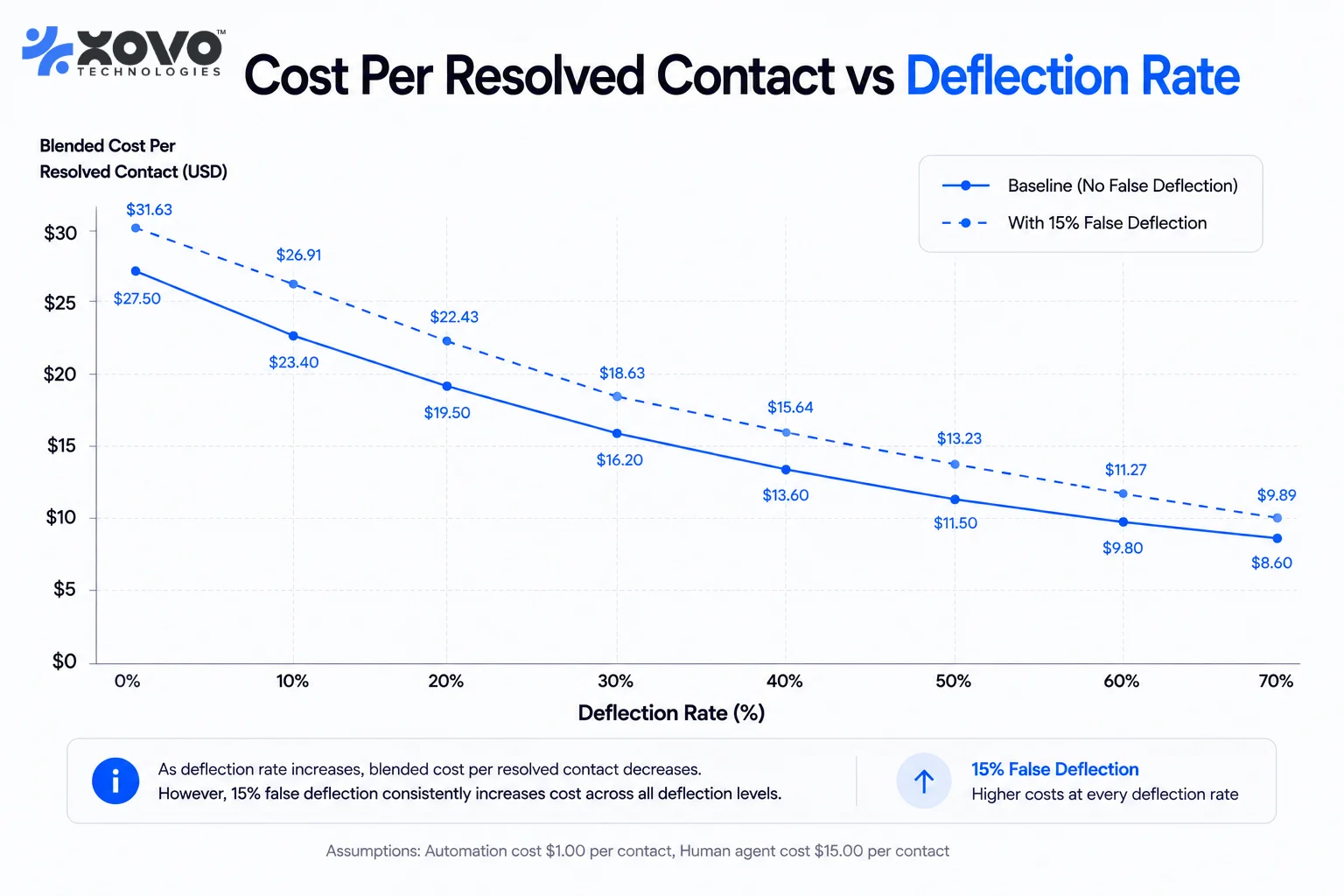
Against a $26 human-only baseline the picture is sober. Clean 41 percent deflection saves about 33 percent. The same 41 percent carrying a 15 percent false-deflection rate saves 27 percent. That sits close to Gartner's projection of a 30 percent reduction in operational costs from agentic service, and nothing like the 60 to 80 percent in vendor ROI calculators.
Two costs those calculators omit. Integration engineering comes first: wiring an ai agent for customer support into your order system, billing system and identity provider is where the real spend sits, and it does not amortise until volume is high. Ongoing evaluation comes second, because someone has to read failed conversations every week. We budget one part-time analyst per 40,000 monthly contacts, indefinitely.
When clients ask how much does it cost to make a chatbot, the platform fee is the smallest line. For a production deployment across two channels with three write-capable integrations, the build runs 8 to 14 weeks of engineering plus per-resolution fees on top, which we break down in our guide to AI chatbot development services, scope and timeline. Firms selling custom ai chatbot development services have every incentive to answer how much does it cost to make a chatbot with the licence fee alone.
If you are building a chatbot cost calculator internally, model three lines and not one: build, per-resolution fees, and the standing cost of knowledge and evaluation. A chatbot cost calculator that omits the third line will always overstate the saving. Our own chatbot cost calculator assumes knowledge and evaluation runs at 15 to 25 percent of annual platform spend, which is what we see across custom ai chatbot development services engagements.
What the 2026 pricing models actually charge
Pricing shifted hard toward outcomes across 2025 and 2026, and the definitions now differ enough that two vendors quoting the same headline rate can differ by 3x on your invoice.
Intercom's Fin lists $0.99 per outcome, where an outcome is a resolution, a procedure handoff or a disqualification, with qualifications at $9.99 and a 50-outcome monthly minimum for non-Intercom helpdesks. One outcome per conversation, regardless of how many actions the agent took. Because procedure handoffs bill, a low-resolution deployment still generates invoice volume.
Zendesk moved to outcome-based pricing and does not publish a self-serve rate. Deals in 2026 are reported at $1.50 to $2.00 per automated resolution, committed volume at the lower end, stacked on Suite seats plus an Advanced AI add-on.
Salesforce runs three models in parallel. Flex Credits at roughly $500 per 100,000 credits works out near $0.10 per agent action, against a $2 per conversation SKU. The crossover sits around 20 actions per conversation, so a three-action ticket costs $0.30 on credits and $2.00 on conversations. Model your actual action counts before choosing; that decision is worth more than any discount you will negotiate.
Decagon prices from about $1.25 per resolution plus a fixed monthly platform fee. Sierra negotiates privately, and at least one publicly discussed contract used $0.50 per resolution on top of a platform fee, with year-one enterprise deployments reported at $200,000 to $350,000 once implementation is included.
The mapping rule is simple. Take the quoted rate, divide by your genuine resolution rate, and that is your true cost per resolved contact. At $0.99 per outcome with 50 percent genuine resolution and outcomes billing on handoffs, you are nearer $2 per solved problem than $1. Buyers comparing ai customer service companies should run that division before comparing anything else, because it reorders the shortlist more often than not. It also exposes which enterprise conversational ai platforms are quoting on effort rather than on results.
Escalation is the product
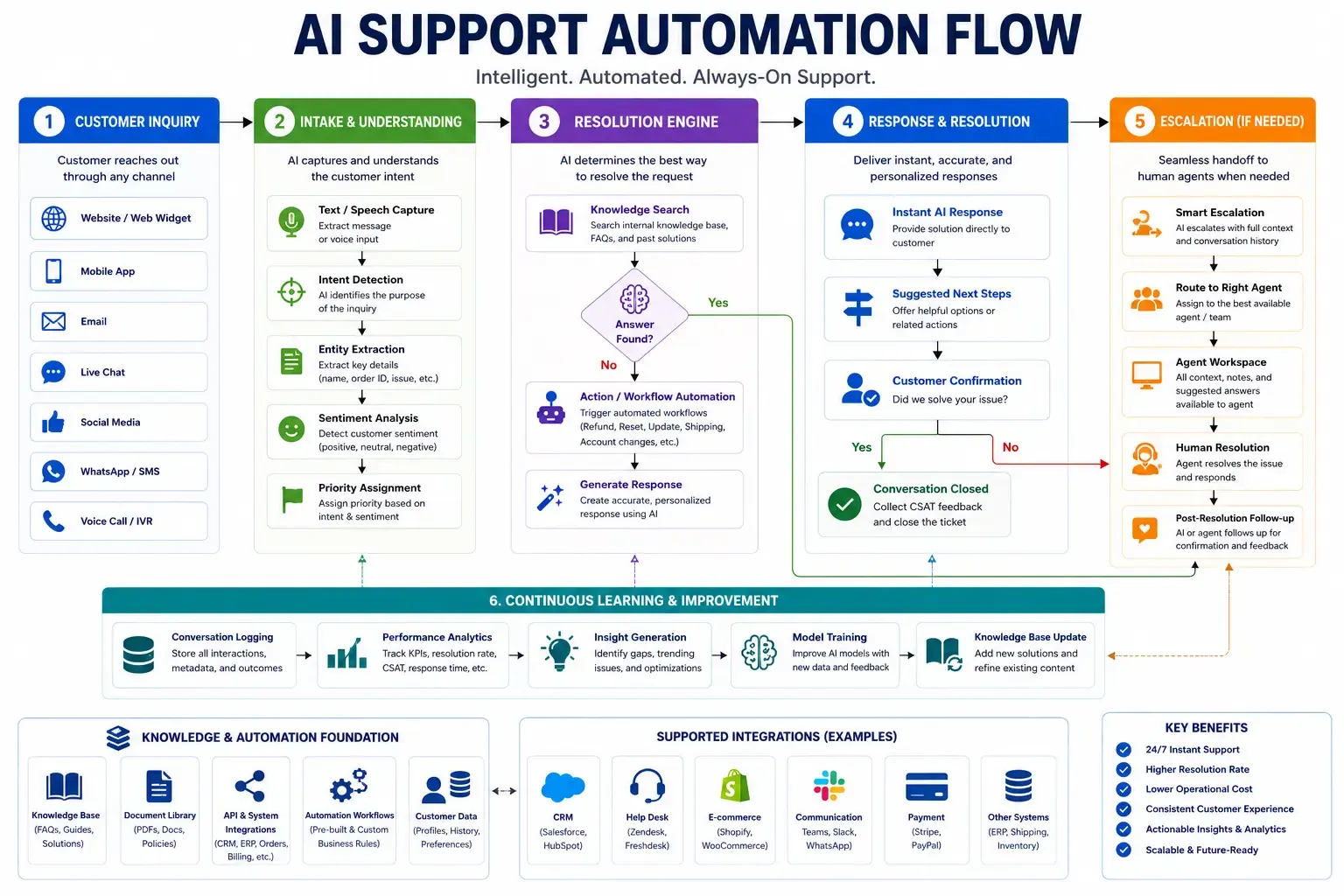
The escalation layer decides whether the whole thing works, and it gets the least design attention in the build. Over-escalate and you pay twice for every contact. Under-escalate and you manufacture the experience that made 2025 a bad year for AI support reputations. This is where an ai agent for customer support earns or destroys its business case, and it is the cleanest way to tell the best ai customer support chatbot from an average one.
| Trigger | Signal | Action | Why it sits there |
|---|---|---|---|
| Explicit request for a person | "agent", "human", "representative" in any supported language | Immediate transfer, no confirmation loop, no "are you sure?" | Confirmation loops are the single biggest CSAT killer we measure, and California AB 1609 would turn them into legal exposure |
| Low retrieval confidence | No source passage above the similarity floor | Say plainly that it is not documented, then transfer | A fabricated policy costs more than a transfer ever will |
| Sentiment slope | Negative sentiment across two consecutive turns | Transfer with full transcript plus a written summary | Anger compounds; the summary is what saves the handoff |
| Action outside cap | Refund above the configured limit, or a plan change with proration above threshold | Draft the action, route for human approval | Keeps the blast radius bounded and auditable |
| Re-contact within 48 hours | Prior conversation on the same intent closed as resolved | Bypass the ai customer support agent entirely, route to a named queue | Re-contacts are where CSAT dies and where the deflection metric lies |
| Regulated or vulnerable intent | Bereavement, hardship, safeguarding, chargeback | Never enters the automated flow | Policy, not model behaviour |
| Silence after a failed answer | Customer stops replying mid-flow | Log as unresolved, not contained | Stops your own dashboard from flattering you |
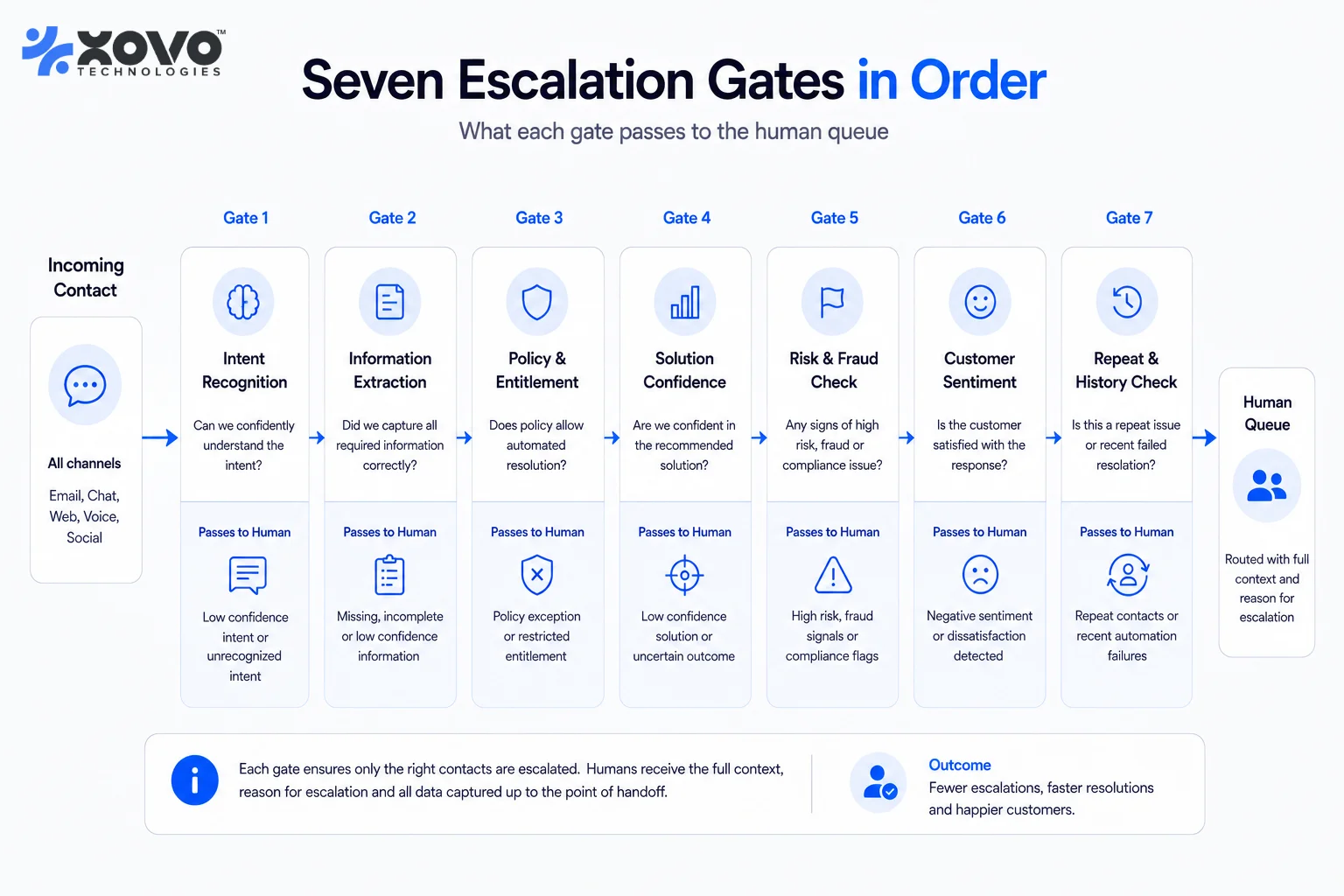
Two failure modes recur. The first is tuning escalation thresholds against aggregate deflection, which pushes the bot to hold conversations it should release. The second is escalating without context, so the customer repeats themselves; Zendesk's CX Trends 2026 research found 74 percent of consumers find repeating their story to a different agent frustrating, and that frustration is self-inflicted. Pass the transcript, a one-paragraph summary, and the actions already attempted. Every time.
For the "not documented anywhere" case, the correct behaviour is not a graceful non-answer. It is a transfer plus a logged documentation gap. We route those into a weekly queue a content owner works through, and in most deployments that queue is the highest-return artefact the system produces, because it tells you which questions your customers have that your company has never written down. Most customer service ai tools will not build that queue for you.
What automation does to CSAT
Whether conversational ai for customer service raises or lowers satisfaction depends almost entirely on whether escalation works.
Aissist's July 2026 cross-industry benchmark puts average CSAT at 78 on a 100-point scale, with AI-handled contacts scoring 5 to 10 points below human-handled contacts for the same team. That is the honest baseline: a satisfaction cost on the automated path, offset by speed and availability.
The counterweight comes from Salesforce's State of Service: AI Agents Edition, a double-anonymous survey of 3,075 service professionals fielded 9 March to 4 April 2026. Adoption of ai customer service agents rose from 39 percent to 66 percent year on year, 70 percent of adopters reported measurable value inside 60 days, and the most improved KPI after deployment was customer satisfaction, ahead of productivity and handle time.
Both hold at once. Contacts handled by ai customer service agents score lower than human-handled contacts on the same intent, while overall CSAT rises because customers who used to wait 40 minutes now get a password reset in 30 seconds. The damage sits in the middle band: contacts that should have escalated and did not. Forrester's 2026 predictions, published 10 November 2025, warned of a service quality dip during deployment years, with one in four brands managing a 10 percent improvement in simple self-service success and the rest absorbing the disruption.
Our rule: measure CSAT separately for fully automated, escalated and human-only paths. A single blended number hides the one segment that is hurting you.
Your knowledge base decays faster than your roadmap
Knowledge freshness has the largest effect on resolution rate and the smallest budget attached to it.
Pageloop published an audit on 31 July 2026 of ten consumer-facing help centres, measuring articles untouched for six months or more. Staleness ranged from 7 percent to 71 percent. One crowdfunding platform had 210 of 295 articles past the six-month mark. These are public help centres belonging to companies that care about support.
Consider what that does to retrieval. A generative ai customer service agent grounded on that corpus will answer confidently from a document describing a flow that shipped two releases ago, in the same tone it uses for correct answers. Retrieval does not know it is wrong.
What works, from our engagements:
- A monthly light pass over the top 50 articles by retrieval frequency, not by page views. The two lists differ more than people expect.
- A quarterly deep pass covering consolidation, orphan removal and contradiction hunting.
- Article-level ownership with an expiry date, so unreviewed content is flagged unverified at 90 days rather than quietly serving traffic.
- A release-triggered review: any product change that alters a documented flow opens a doc ticket in the same sprint.
- The documentation gap queue from the escalation section, worked weekly.
The knowledge layer is where most customer service ai tools quietly succeed or fail. It is a standing operating cost, not a project, which is why we quote it as one.
One system for chat, email and voice, or three?
One platform for text channels, and a separate decision for voice. That is the position I hold in 2026, and ai voice agents for customer service are the one case where a second vendor earns its keep.
Chat, email, messaging apps and in-product help share a knowledge layer, an intent taxonomy and an escalation policy. Splitting them means maintaining three versions of your refund rule, and those versions will diverge inside a quarter. Fin runs across tickets, email, live chat, WhatsApp, SMS, Messenger and Slack from a single configuration, and most serious platforms now do the same.
Voice is a different engineering problem: latency budgets, barge-in handling, turn-taking, telephony integration, and a completely different failure mode when the model is uncertain. An ai voice agent for customer service fails loudly, because silence reads as a dropped call rather than as thinking. Plenty of vendors sell ai voice agents for customer service on the same platform, and the knowledge layer genuinely should be shared. The runtime rarely should be. We have seen more voice deployments die on 800ms of added latency than on answer quality, so treat the ai voice agent for customer service decision as its own build with its own evaluation harness, and read our breakdown of AI voice agent architecture and cost before signing a bundled contract. The cost profile differs too: an ai voice agent for customer service resolves at roughly $1.20 to $1.50 against $0.50 to $2.37 for text, and the ceiling for ai voice agents for customer service is generally lower on the same intent mix.
What happens to the support team
Klarna is the reference case in both directions. Its OpenAI-built assistant handled 2.3 million chats in its first month in 2024, equivalent to roughly 700 full-time agents, covering about two-thirds of conversations, with around $40 million in annualised cost avoidance claimed. In May 2025 the company began rehiring, with CEO Sebastian Siemiatkowski saying they had focused too much on efficiency and cost and that "the result was lower quality, and that's not sustainable". The 2026 position is a dual-track model: automation for volume, humans for complexity.
The macro data says the same thing in slower motion. The US Bureau of Labor Statistics projects employment of customer service representatives to decline 5 percent from 2024 to 2034, from about 2.8 million jobs in 2024, while still generating roughly 341,700 openings a year through the decade. Forrester's 16 July 2026 analysis found postings around 10 percent below pre-pandemic levels and salary growth flat since May 2025, while cautioning that "estimates for job shrinkage are all over the place" because regulatory, liability and integration constraints stop many contact centres from hitting projected automation rates.
So, will ai replace customer service? No, and the question is the wrong shape. What changes is composition. Forrester's November 2025 prediction set expects 30 percent of enterprises to create parallel AI functions mirroring human service roles: people who onboard and coach agents, teams who tune performance, specialists who unblock the system when it fails. Gartner's February 2026 survey of 321 service leaders found 91 percent under executive pressure to implement AI, and Gartner separately predicts that by 2027 half the companies attributing headcount reduction to AI will rehire for similar functions under different titles. Anyone answering will ai replace customer service with a headcount-zero roadmap is selling the 2024 version of this story.
In our engagements the pattern holds. Tier-1 headcount shrinks by attrition rather than layoff. Two or three of your strongest customer service agents become knowledge owners and conversation reviewers, worth more in those seats than on the queue. Quality assurance shifts from sampling human transcripts to auditing automated ones. The future of ai in customer service, at least the part visible from inside builds, is a smaller team doing harder work with a supervision layer that did not exist three years ago. Fully autonomous ai customer service exists today only for narrow, deterministic intent sets, and that is where it should stay; every vendor pitching autonomous ai customer service across a whole contact centre is describing something we have not once seen ship.
The future of ai in customer service is mostly a staffing question, so budget for retraining and not just tooling. Teams that got value from ai customer service training in year one taught agents to write and audit knowledge; teams that treated ai customer service training as a two-hour tool demo got nothing.
The right to a human is becoming law
Two dates changed escalation from a UX choice into a compliance requirement.
Article 50 of the EU AI Act becomes applicable on 2 August 2026. Providers of AI systems that interact directly with people must inform those people that they are dealing with an AI system, unless that is obvious to a reasonably well-informed observer, and the disclosure must be clear and delivered at the latest at the point of first interaction. If you run a customer service ai agent in the EU, that disclosure is an obligation with a date attached, not a design preference.
In California, AB 1609 was introduced on 20 January 2026 and amended in the Senate on 25 June 2026. As amended it would require large private businesses (more than $500 million in gross annual national revenue) to make a good faith effort to connect a customer to a human customer service agent within 15 minutes of a request, or offer an appointment within one business day, with human access available across at least a normal 10-hour period per day. It also bars representing a chatbot as a person. It is not law yet, and the response window widened from the five minutes in the original draft, so track it rather than build to it.
The design implication is identical in both jurisdictions: an unambiguous, always-available path to a human customer service agent, a disclosed identity for the customer service ai agent, and a log that proves both. Retrofitting disclosure into a live conversation flow costs more than including it in sprint one.
How we scope this, and how to score a shortlist
We start with the ticket export, not the demo. Six months of tickets, bucketed by intent and mapped against the ceilings above, gives a defensible deflection forecast before anyone signs anything. If that forecast does not clear 30 percent on your actual mix, automation in customer service is not your highest-return project and we will say so.
The build sequence after that: knowledge audit, top-10 intent coverage, read-only integrations, escalation layer, then write actions behind spend caps. Write actions last, always, because that is where an unbounded agent costs you real money. Our AI chatbot platform is built around that sequence, which is also how we think the best ai agents for customer support should be assembled, and the AI Support Architect handles the routing, escalation and supervision layer above it. Teams wanting the underlying build rather than a packaged product use our chatbot building and integration service for custom ai chatbot development services end to end, including the evaluation harness most vendors leave to you.
On selection, ignore the demo and ask four questions: how do you define a resolution, can I recompute it from my own data, what happens on low confidence, and what does a handoff carry with it. The best ai agents for customer support answer all four without hesitation; most ai customer service companies answer two. That test works whether you are picking the best ai customer support chatbot for a 200-ticket-a-day queue or ranking the best chatbots for customer service across a multi-brand contact centre.
Then ask three more. What is your published re-contact window, and can I change it? Which reference customer will let me see their raw resolution export? What happens to my knowledge base if I leave? The best ai tools for customer service answer in writing. Ranking the best chatbots for customer service on deflection headlines compares marketing departments, not products, and the best ai tools for customer service will not rescue a bad ticket mix anyway.
I am not neutral about whether you should automate, and I would rather say so plainly. What we are neutral about is the number. The best ai customer support chatbot on the market cannot raise a ceiling your ticket mix has already set, so if your mix caps you at 25 percent, publish 25 percent internally and plan against it. The organisations getting real value from conversational ai for customer service in 2026 set an honest ceiling early, instrumented resolution properly, and spent budget on escalation quality instead of chasing a deflection figure that only ever existed on a slide. Generative ai customer service pays back on the boring parts, and conversational ai for customer service fails on the parts nobody scoped. If you want that ticket-mix analysis run against your own export, book a free AI audit, or read how we structure the AI chatbot build itself before you brief anyone.