A cold email agency is worth hiring only if it runs sending infrastructure, not just copy. Ask how many sending domains and mailboxes it will run for you, what its bounce threshold is, how it isolates your sending reputation from other clients, and who owns the domains when you leave. Vague answers to those four are the tell.
Copy is the least important variable
Most cold email agencies are copywriting shops with a sending tool subscription. They will show you subject lines, frameworks, a personalisation angle and a sample sequence. None of that decides whether the message arrives.
We sell in this category. Our own AI cold email product writes sequences, and we still think copy is the wrong argument to have first. A well-written message in the spam folder performs identically to a badly written message in the spam folder. Inbox placement is binary before it is anything else, and it is decided by authentication, sending reputation, list quality and volume discipline. Copy only starts to matter after those four are handled, and by then it is a second-order variable. It moves reply rate within a delivered population, which is a smaller lever than moving the size of the delivered population.
There is a harder version of this point that a cold email agency will rarely put in front of you. Spamhaus, which maintains the blocklists most receiving infrastructure consults, published a position on 19 June 2025 that reads: "By definition, there is no difference between cold email and spam - no consent, no commercial relationship, and often some form of bulk (automated) delivery." The same piece states that "Permission is not transferrable", and names the tactics it treats as aggravating: buying addresses in bulk, scraping contacts from social media, using warmup tools to spread traffic across platforms, and "using platforms which enable bulk creation of domains for the sole purpose of soliciting prospects (and evading filters)". Spamhaus says it will assess cold outreach sent in bulk and hitting its spamtraps as a candidate for listing.
Read that last item again, because it describes the standard architecture of the cold email marketing agency you are about to hire. Dozens of lookalike domains, a few mailboxes each, rotation across the pool. That design exists for two reasons. One is capacity. The other is that it keeps every individual domain below the thresholds where the large mailbox providers apply their bulk sender rules, and below the volume at which a single domain's reputation collapses visibly.
An agency that understands this will tell you so. It will explain the trade-off, say where its line is, and say what it refuses to do. An agency that does not understand it will talk about copy, because copy is the part it can control.
The ten questions, side by side
Take this table into the meeting. The middle two columns are the point: for each question there is a shape of answer that indicates an operator, and a shape that indicates a reseller.
| Question | A good answer | An answer that means walk away | Why it matters |
|---|---|---|---|
| How many sending domains and mailboxes will you run for us, and why that number? | A number derived from your target volume and a stated per-mailbox daily ceiling, with the arithmetic shown | "As many as we need", or a number with no ceiling behind it | The ratio is the whole capacity model. Without a ceiling there is no plan, only a dial |
| What does week one of domain warming look like? | A named schedule: starting daily volume, ramp rate, what proportion is conversational, when cold volume begins | "We warm for two weeks" with no schedule, or warming left to the sending tool's defaults | Warming is where sending reputation is built or forfeited. Defaults are not a strategy |
| How is our sending reputation isolated from your other clients? | Separate domains, separate authentication, separate sending path, and a straight statement of what is genuinely shared | "We use a shared pool, it is fine", or visible confusion about what is shared | One bad client on a shared path takes your delivery down with theirs |
| What is your bounce threshold and what happens when it is crossed? | A hard number, an automatic pause, and a named person who decides to resume | "We monitor it", with no number and no pause | A threshold you cannot state is a threshold you do not enforce |
| What verification do you run before the first send? | Named verification vendor, the result categories it returns, what gets suppressed, and a re-verification interval | "The data provider verifies it" | Verification age matters more than verification existence. B2B addresses decay continuously |
| What is your policy on catch-all domains? | A stated position with a reason, plus separate reporting so catch-alls do not flatter the bounce rate | Catch-alls folded silently into the main list and the main numbers | Catch-alls accept everything, so they hide list rot inside a healthy-looking bounce rate |
| What is your positive reply rate, measured how, over what period? | A definition of "positive", the denominator, the period, and the variance across accounts | A single headline percentage with no denominator | A reply rate without a denominator is not a number, it is a decoration |
| Who owns the domains, the mailboxes and the data when we stop? | Registered to your organisation from day one, with a written transfer process | Domains in the agency's registrar account, "we will sort it out at the end" | Domain reputation is an asset you paid to build. It should not leave with the vendor |
| What happens when we get listed on a blocklist? | Named lists monitored, who submits the delisting, what stops immediately, and the root-cause step | "That does not happen to our clients" | It does happen. The answer reveals whether an incident process exists |
| What do you do differently for UK and EU recipients? | A named distinction between corporate and individual subscribers, a lawful basis, and a suppression process | "Cold email is legal B2B everywhere" | The UK and EU rules are not CAN-SPAM, and the penalty ceilings are not comparable |
The pattern across the rows is consistency. Every good answer contains a number, a name or a document. Every bad answer contains a reassurance.
Infrastructure: domains, mailboxes and warming
Sending infrastructure is the part of cold email outreach a buyer cannot see, and therefore cannot evaluate without asking. Three questions expose most of it.
How many sending domains and mailboxes per client, and why that number?
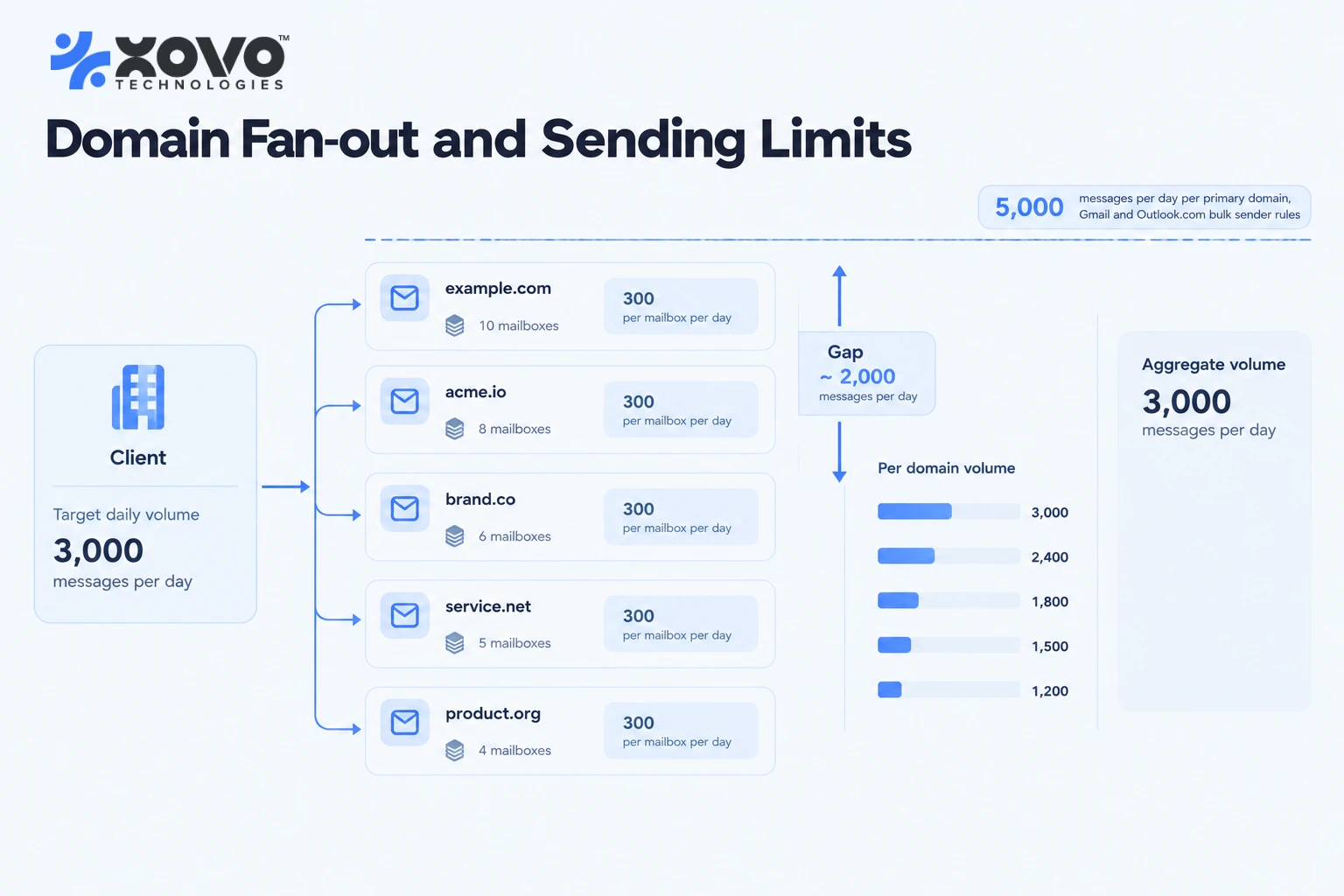
The answer you want is arithmetic. A cold email agency should be able to say: your target is this many emails per working day, we cap each mailbox at this many sends per day, we run this many mailboxes per domain, therefore we need this many domains. Every figure in that chain should be a decision the agency can defend, and the per-mailbox ceiling should be conservative rather than the maximum the provider tolerates.
What that ceiling should be is genuinely contested, and anyone telling you there is one correct number is selling. What is not contested is that a ceiling has to exist and has to be stated. An agency that answers "as many as we need" has no capacity model. It has a dial.
The reason this architecture exists at all is worth understanding before you agree to it. Google's sender guidelines, which we checked on 12 September 2026, apply an additional set of requirements to anyone sending more than 5,000 messages a day to Gmail accounts, a threshold in force since 1 February 2024. Google's accompanying FAQ states that messages from the same primary domain count toward that limit, subdomains included, and that "Senders who meet the above criteria at least once are permanently considered bulk senders." Microsoft's Defender for Office 365 blog announced the same 5,000 per day threshold for outlook.com, hotmail.com and live.com on 2 April 2025, updated on 29 April 2025, with enforcement from 5 May 2025.
Spread across forty domains, a programme sending 4,000 emails a day never touches either threshold on any one domain. That is not an accident of the design. It is a property of it, and Spamhaus named it directly in the June 2025 piece quoted above. An agency that can explain the trade-off honestly is a different vendor from one presenting a forty-domain estate as a neutral technical detail.
What is your domain warming schedule and what happens in week one?
Domain warming is the process of establishing sending reputation on a new domain by starting at low volume and increasing gradually while engagement signals accumulate. IP warming is the same idea applied to a sending IP address, and it only applies to you if you are on a dedicated IP. On a shared IP, which is what most cold email programmes run on, the IP reputation is not yours to warm and not yours to protect.
A good answer here is a schedule with numbers in it. How many messages on day one. What the daily increase is. What proportion of early volume is conversational traffic between seeded mailboxes rather than cold sends. When the first message to a real prospect goes out. Whether the ramp pauses if engagement signals drop, and on what trigger.
A bad answer is "we warm for two weeks", which describes a duration rather than a schedule, or "the tool handles it", which means the agency has accepted the defaults of software it did not write and cannot explain. Most cold email tools ship a warming module with a default ramp that is tuned for the vendor's average customer, not for your domain age, your list or your volume.
Ask one follow-up: what happens in week one if a domain shows early trouble. The answer should be that the ramp stops rather than continuing on the calendar. Agencies that run the warming calendar regardless of signal are optimising for your start date instead of your sending reputation.
While you are there, ask which DNS records are set before the first send. SPF, DKIM and DMARC are the floor of email authentication, and they are the floor everywhere. Google requires all three for bulk senders and at least SPF or DKIM for everyone. Microsoft's April 2025 post requires SPF to pass, DKIM to pass, and DMARC "at least p=none and align with either SPF or DKIM (preferably both)". The DMARC specification itself was reissued as RFC 9989 in May 2026, a Standards Track document that obsoletes RFC 7489 and RFC 9091, removes the old pct tag and adds an np tag covering policy for non-existent subdomains. An agency still describing DMARC by reference to pct is working from a document that has been superseded.
BIMI is the optional layer above that, and it is worth asking about mainly to see whether the answer is honest. BIMI requires an enforcing DMARC policy and, for most participating providers, a verified mark certificate. It is a brand display feature for recipients who already recognise you. It does nothing for a cold recipient who has never seen your logo, and an agency selling BIMI as a cold email deliverability lever is selling.
Unsubscribe handling belongs in the same technical conversation, and cold email agencies treat it as a legal box rather than a deliverability control. It is both. Google's sender guidelines require marketing and subscribed messages from bulk senders to support one-click unsubscribe and to carry a clearly visible unsubscribe link in the body, and Google's FAQ says unsubscribe requests must be processed within 48 hours. The one-click mechanism is specified in RFC 8058, published in January 2017, which defines a List-Unsubscribe header carrying an HTTPS URI alongside a List-Unsubscribe-Post header whose only permitted value is List-Unsubscribe=One-Click. Ask whether the agency sets those headers, whether the opt-out is honoured across the whole domain estate rather than only on the mailbox that received it, and how fast. An opt-out that only suppresses one of forty domains is not an opt-out, and a recipient who has to press unsubscribe twice presses the spam button instead. That is the quiet mechanism by which sloppy opt-out handling teaches the spam filter what to do with you.
How do you isolate my sending reputation from your other clients?
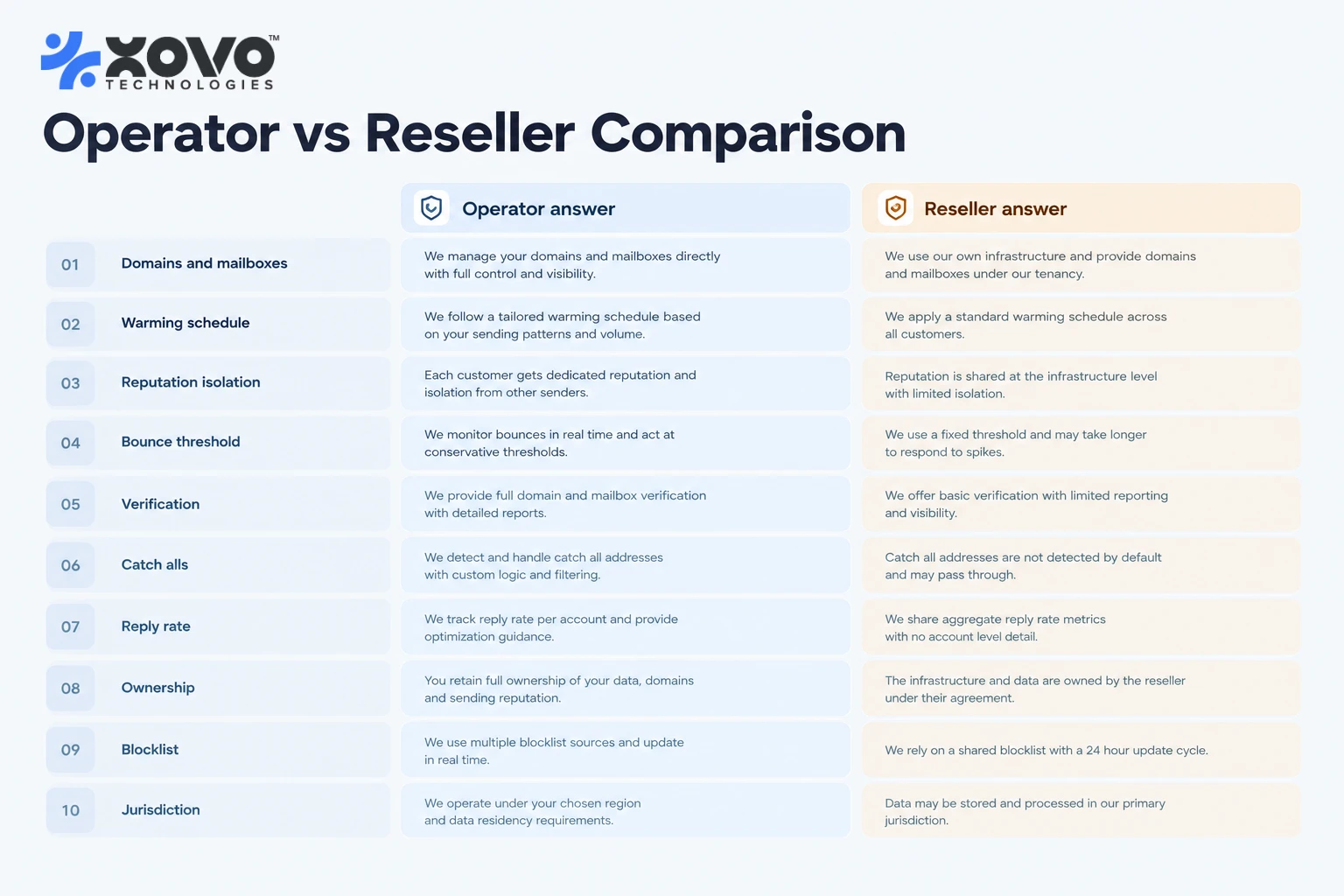
This is the question that separates an infrastructure operator from a reseller, because the honest answer is partly uncomfortable.
Separate sending domains are the easy part, and every competent cold email marketing agency does that. The harder questions are about what sits underneath. Are you on a shared IP pool with the agency's other clients, or a dedicated IP? Does the agency's sending platform apply reputation signals across its whole customer base? If another of its clients gets a domain blocklisted this month, which part of your setup is affected?
A good answer names what is shared and does not pretend the answer is "nothing". On most cold email stacks something is shared, usually the outbound IP space of the sending provider. An agency that says "your reputation is completely isolated" either does not know what its own stack does, or is telling you what you want to hear.
A dedicated IP is not automatically better. A dedicated IP at low volume warms slowly and carries no reputation buffer while it does, which is why consistent high-volume senders benefit from one and low-volume cold programmes usually do not. If an agency offers a dedicated IP as an upsell without first asking your sending volume, it is selling a line item rather than making a recommendation.
The subdomain strategy question belongs here too. Sending from a subdomain of your primary domain keeps the corporate domain insulated from cold sending reputation at the cost of some brand recognition. Sending from lookalike domains insulates the primary domain completely and gives up the brand entirely. Both are defensible. An agency should have a position and a reason, and the reason should name what it is protecting.
If you are evaluating vendors right now and want a second read on the answers you are getting, our team runs email marketing automation engagements and will go through a prospective agency's technical proposal with you. Bring the proposal, not the pitch deck.
List quality: verification, bounces and catch-alls
List quality decides more outcomes than copy does, and it is the area where agencies are most likely to have outsourced the decision to a data vendor and stopped thinking about it.
What verification do you run on a list before the first send, and what is your bounce threshold?
Two separate questions hide here, and you should ask them separately.
On verification: which vendor, what result categories it returns, which categories get suppressed, and how old a verification result is allowed to be before the address is re-verified. B2B email addresses decay continuously because people change jobs. A list verified four months ago is not a verified list. Email verification is a perishable good, and an agency treating it as a one-off onboarding step will be sending to dead addresses by month three.
On bounce rate: the answer should contain a number, a consequence and an owner. Something shaped like "we pause the campaign at X per cent hard bounces in a rolling window, the pause is automatic, and it does not resume until someone has re-verified the affected segment." What matters is not which number they choose. It is whether they can state one, whether the pause is automatic rather than discretionary, and whether a named person owns the decision to resume.
Hard bounces and soft bounces need handling differently, and an agency reporting a single blended bounce rate is hiding the signal that matters. Hard bounces mean the address does not exist, which is a list problem. Soft bounces are often a reputation or volume problem, which is an infrastructure problem, and the two fixes have nothing in common.
Spam complaint rate belongs in the same conversation. Google's sender guidelines tell bulk senders to keep the spam rate reported in Postmaster Tools below 0.10% and to avoid ever reaching 0.30% or higher, and Google's FAQ states that spam rate is calculated daily. Those thresholds are written for bulk senders, but they are a reasonable standard to hold any programme to, and an agency that cannot tell you its spam complaint rate is not measuring one.
What is your policy on catch-all domains?
A catch-all domain is one configured to accept mail addressed to any local part, whether or not that mailbox exists. Verification tools cannot confirm an address on a catch-all domain, because the receiving server says yes to everything.
This matters for a reason that is easy to miss. Catch-alls make your bounce rate look better than your list is. Mail to a non-existent person at a catch-all domain is accepted, so it never bounces, and it may land in an unmonitored quarantine or on a spam trap. Your reported bounce rate stays healthy while the list rots underneath it, and the engagement signals mailbox providers use to judge you get quietly worse.
A defensible policy can go either way. Some agencies exclude catch-alls entirely and accept the reduction in addressable list. Some include them, segment them separately, send at lower volume and report them as their own cohort. Both are reasonable. What is not reasonable is folding them silently into the main list and the main numbers, because that makes the bounce rate you are shown meaningless.
Ask the follow-up: what proportion of the list we are buying is catch-all. If the agency does not know, it has not looked.
What is in the lead list, and where did it come from?
The ICP definition, the source of the lead list and whether intent data is in the mix are commercial questions, but they carry a deliverability consequence. Scraped lists carry spamtrap addresses. Bought lists carry spamtrap addresses and stale addresses. Spamhaus's June 2025 position names bulk purchase and social scraping as tactics it treats as aggravating when assessing a sender for listing.
A good agency will tell you where the data came from, will not claim a source it cannot name, and will run a suppression process before every send: existing customers, open opportunities, current unsubscribes, previous bounces, and anyone who has asked not to be contacted. A suppression list living in one spreadsheet and one person's head will fail the first week that person is on leave.
Measurement: what a reply rate actually means
An agency's numbers are the easiest part of its pitch to inflate, because almost none of the terms have agreed definitions.
What is your positive reply rate, measured how, over what period?
Every part of that question does work.
"Positive" needs a definition. Is an out-of-office a reply? Is "not right now, ask me in Q2"? Is a referral to a colleague? Agencies counting every inbound message as a reply produce numbers that look good and mean nothing. Ask for the classification rule in writing.
"Measured how" means the denominator. Replies over emails sent, replies over prospects contacted across a whole sequence, and replies over delivered messages are three different fractions, and the third is the flattering one because it silently removes bounces from the bottom. A five-step sequence measured per prospect will report roughly a fifth of the rate the same campaign reports per email. Neither is wrong. Only one is comparable to the number the last agency quoted you.
"Over what period" catches the survivorship problem. An agency quoting its best quarter across its best accounts is quoting a selection, not a benchmark. Ask for the range and the median across all accounts over the last two quarters, and ask how many accounts sit in that set. An agency with four clients quoting a median is quoting an anecdote.
We are not going to hand you a benchmark reply rate here, because we do not have one we can source to a named study within a defensible period, and an invented benchmark is worse than none at all. What you can do instead is insist that whatever number an agency quotes arrives with its definition, its denominator and its period attached. A cold email agency that can produce those three things is measuring. One that cannot is reporting.
Meeting booked rate is the metric that actually pays, and it carries the same problem in a worse form, because a booked meeting that never happens is still counted by most agencies. Ask whether the figure is meetings booked or meetings held, and hold the commercial conversation on meetings held.
What do you A/B test, and what do you do with the result?
A/B test discipline is a decent proxy for whether an agency thinks statistically. Two questions do the work: what is the minimum sample before you call a test, and do you test one variable at a time.
Most cold email campaigns never reach the volume where a subject line test on a single account is conclusive. An agency reporting a winning variant after 200 sends is reporting noise. A good answer acknowledges that, and usually involves pooling results across accounts in the same segment rather than pretending a small campaign settled anything.
There is a narrower version worth asking about if you sell software. Effective cold email CTAs in the software industry tend to be lower-commitment than the meeting request most templates open with, because the recipient is being asked to spend calendar time on a product they have not evaluated. Ask what CTAs the agency uses for software buyers specifically, and whether it has tested the low-commitment version against the meeting ask. If the answer is a framework name rather than a result, it has not tested it. The same discipline runs through our B2B SaaS SEO playbook: the channel changes, the rigour about what you are actually measuring does not.
Cold email personalisation is the other place where testing claims outrun evidence. Agencies sell what the tooling market calls "cold email personalization" as a reply-rate multiplier, and the honest position is that personalisation quality is hard to isolate from list quality, because a better-researched prospect is usually also a better-fitting prospect. Ask how they separated the two. Most cannot, and saying so out loud is a point in their favour.
Ownership: who holds the assets when you leave
Who owns the domains, the mailboxes and the data when we stop working together?
Ask this in the first commercial conversation. It is a contract question rather than a technical one, and it does not resolve itself at the end of an engagement.
Four assets are in play and each can sit on either side. The sending domains, which carry the reputation you have spent months building. The mailboxes and their history. The lead list and any enrichment applied to it. And the reply data, which is the record of who said what, and the most commercially useful thing the programme produces.
The position to hold is that the domains are registered to your organisation from day one, with the agency added as a user rather than the other way round. This is the same argument we make about repository and infrastructure ownership when hiring an AI agent development partner, and it fails in the same way: the asset is cheap to assign at the start and expensive to extract at the end.
A cold email agency will sometimes argue it needs the domains in its own registrar account to manage the estate, and there is an operational grain of truth in that. The answer is delegated access, not transferred ownership. If the agency will not agree to that, you now know what its offboarding looks like.
Three more clauses to read before signing. What happens to the mailboxes at termination, including whether you receive the mailbox contents. Whether the data processing agreement lets you get the reply data back as a usable export rather than a screenshot of a dashboard. And what notice period applies, because a programme wound down abruptly leaves sequences mid-flight and prospects receiving step four from a company that has stopped watching the inbox.
Failure: what happens on a blocklist day
How do you handle a blocklist event?
Assume it will happen. Blocklist listings are a normal operating event for anyone doing volume outbound, and an agency claiming otherwise is either new or not telling you.
The answer you want has four parts. Which lists they monitor and how they find out. Who submits the delisting request, through which channel. What stops immediately while the listing is live. And what the root-cause step is, because delisting without fixing the cause produces a second listing.
Spamhaus's own FAQ on the Spamhaus Blocklist, read on 12 September 2026, is explicit that "There is never any charge or fee associated with removing any Spamhaus listing", and that any offer to remove a listing for a fee is a scam. If an agency has ever told you it paid to get a client delisted, that is a fact worth sitting with. The same FAQ describes the SBL zone as updating every five minutes, which means a correctly resolved listing propagates quickly and an unresolved one does not improve with time.
The listing type changes the process. Spamhaus's combined spam sources listings are generated automatically and have a self-service removal path. Listings made by a person at Spamhaus need human review to remove. An agency that knows the difference has been through it.
The part most agencies skip is what stops. The correct answer is that sending from the affected path stops immediately, not that it continues at reduced volume while the delisting is pending. Continuing to send from a listed asset is how a one-domain problem becomes an estate problem.
Ask one last thing: how many blocklist events have you had across your client base in the last twelve months. An agency that says zero is either very small or not being straight with you.
Jurisdiction: the UK and EU rules are not CAN-SPAM
What do you do differently for UK and EU recipients?
This is where most US-based cold email agencies are quietly wrong, and where the cost of being wrong changed this year.
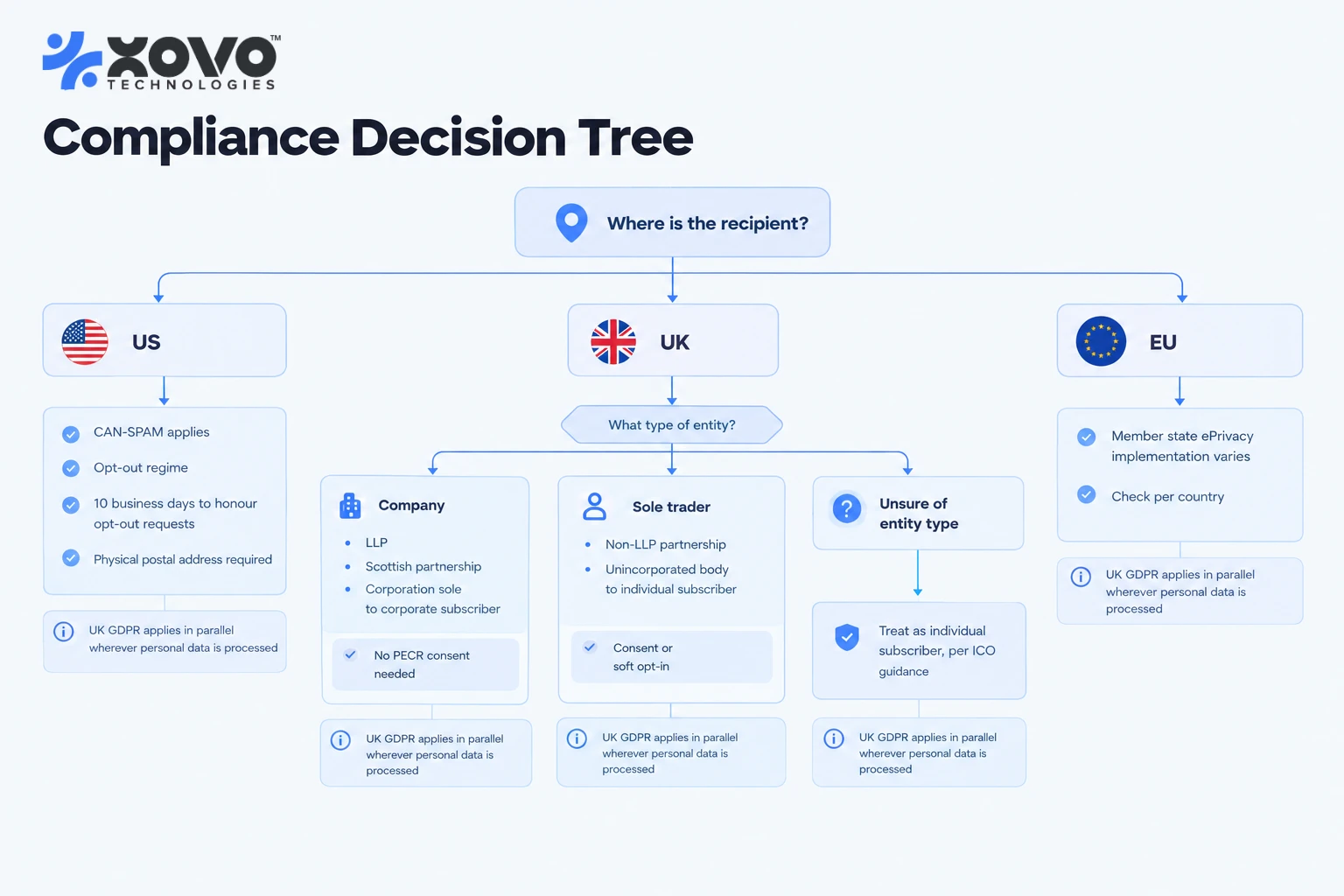
CAN-SPAM, which governs commercial email to US recipients, is an opt-out regime. The FTC's compliance guide, checked on 12 September 2026, requires accurate header information, a subject line reflecting the content, identification of the message as an advertisement, a valid physical postal address, a clear opt-out mechanism, and that you "honor a recipient's opt-out request within 10 business days". It also states you remain responsible when another company handles email on your behalf, which is the sentence that matters when you are hiring an agency. The FTC's guide as published when we read it prices each violating email at up to $53,088, a figure the page notes was last inflation-adjusted in January 2024.
The UK is a different regime, and the difference is structural rather than cosmetic. Under the Privacy and Electronic Communications Regulations, the electronic mail marketing rule turns on what kind of subscriber you are contacting. The ICO's business-to-business marketing guidance, which we read on 12 September 2026, states that the PECR rule on direct marketing by electronic mail does not apply to corporate subscribers, so you may email a corporate body without PECR consent, provided you do not disguise your identity and you give a valid address to opt out.
The trap is the definition. The ICO classes companies, limited liability partnerships, Scottish partnerships, corporations sole and some government bodies as corporate subscribers. It classes sole traders, non-limited-liability partnerships and other unincorporated bodies of individuals as individual subscribers, which means they get the full protection: consent, or the soft opt-in, and the soft opt-in only applies where you obtained the details during a sale or negotiation of a sale of your own similar products and gave an opt-out at collection and in every message since. The ICO's guidance adds the instruction most cold email agencies ignore: "If you are unsure whether the contact details belong to an individual subscriber or a corporate subscriber this puts you at risk of breaching PECR. To mitigate that risk you should treat the details as belonging to an individual subscriber."
A UK lead list full of consultancies, trades, small agencies and partnerships is full of individual subscribers. An agency that has never asked you about entity type has not thought about this.
UK GDPR runs underneath all of it. The ICO is clear that if you hold the name of the person, or the email address itself identifies an individual, you are processing personal data and UK GDPR applies. That means a lawful basis, which for B2B cold outreach is usually legitimate interests and requires the documented three-part test: identify the interest, show the processing is necessary to achieve it, balance it against the individual's rights and freedoms. It also means privacy information has to reach the person, and where the data came from a third party rather than from them, the ICO says within a reasonable period and no later than one month from collection. Almost no cold email programme does this. Ask the agency how it does.
One more item in the ICO guidance catches nearly everyone: the PECR rules on cookies and similar technologies apply to tracking pixels in marketing emails, for all subscriber types, where the pixel stores or accesses information on the device used to read the message. Open tracking is not exempt because the recipient happens to be a company.
The penalty position changed in 2026. Schedule 13 of the Data (Use and Access) Act 2025 brings PECR enforcement under the Data Protection Act 2018 framework, including its section 157 maximum penalty provisions, for breaches of a list of PECR regulations that includes regulation 22, the electronic mail marketing rule. Section 157 of the Data Protection Act 2018 sets a standard maximum of £8,700,000 or 2% of total annual worldwide turnover, whichever is higher, and a higher maximum of £17,500,000 or 4%. That is a different order of exposure from the old PECR ceiling, and it is reason enough to ask the question rather than assume the agency has.
For EU recipients, the consent position and the legitimate interest analysis vary by member state implementation of the ePrivacy Directive, and an agency operating in Germany or France should be able to say how its approach differs there. If the answer treats the EU as one jurisdiction, the work has not been done.
The sentence that should end the conversation is "cold email is legal B2B everywhere". That is not a legal position. It is a shrug.
How we would answer these about ourselves
Publishing this is awkward, because a buyer can point it at us. That is the intent. Here is where we stand on the two questions that cost us most.
On isolation: our AI cold email product runs sending rotation across multiple sending paths, and any honest description of a rotation architecture has to concede that the infrastructure underneath is not infinitely partitioned. We would tell you what is shared, and if one client's volume or list quality created risk for others, we would slow that client down rather than absorb it quietly.
On measurement: the reply-rate multiple on our own product page is a first-party product claim, not a sourced benchmark, and we do not think you should buy on it. Buy on the definition of the metric, the denominator and the period, the same way we have told you to interrogate everyone else in this post.
On copy: we write sequences, and we think sequence copy and cadence are worth paying for once the infrastructure is right. Before that, paying an agency for copy is paying for paint on a house with no foundations. If your current programme has a delivery problem, the content strategy and brand messaging work can wait a month. The domain estate cannot.
There is one more question worth asking any agency, us included. Ask what they would tell you not to do. An agency that cannot name a tactic it refuses to run, or a client it turned down, has no standard you can hold it to. Ours: we will not run a programme on a list we cannot trace to a source, and we will not send to a UK list where entity type has not been checked.
If you are shortlisting a cold email agency, take the ten questions above into every meeting and write the answers down. When you have them, book a session with our team and we will go through what you heard. If the right answer is that you need better list quality rather than a new agency, or that the channel is wrong for your ICP and paid acquisition fits the motion better, we will say so. Our AI growth strategist exists for that channel-mix question, and the economics of automating the reply side are covered in our analysis of customer service automation costs.