Generative engine optimization services are the work of making a page eligible to be retrieved, quoted and attributed by AI answer engines: Google AI Overviews and AI Mode, ChatGPT search, Perplexity, Microsoft Copilot and Gemini. The job splits three ways. Crawler access decides whether an engine can read you at all. Page structure decides whether a passage is liftable once you have been retrieved. Measurement decides whether you can prove any of it worked, because AI answers have no ranking positions to track. Classic ranking still helps. It stopped being sufficient in 2025.
I run this work for clients, and the honest version is less exciting than most vendor decks. There is no secret token, no file you upload, no schema type that flips a switch. What there is: a retrieval layer that can be blocked by accident, a set of page shapes that get lifted more often than others, and a measurement problem that most teams have not solved yet.
What generative engine optimization services actually buy you
The category name is doing a lot of work. Strip it back and generative engine optimization services cover four deliverables, and a serious generative engine optimization agency will price them separately because they run on different clocks.
The first is crawler access and policy. This is an infrastructure job: robots.txt, CDN bot rules, and a decision about which AI companies you want reading your site. It takes a day and it can silently undo everything else.
The second is passage engineering. Rewriting pages so a retrieval system can pull a self-contained 40 to 80 word answer out of them without needing the surrounding context. This is the part most people mean when they say "how to optimize content for ai search engines", and it is the part that overlaps least with what an ai seo content generator produces, because a generator optimises for coverage and retrieval optimises for distinctiveness.
The third is off-site presence, because a meaningful share of the answer is now assembled from sources you do not own.
The fourth is measurement. This is where most engagements fall apart, and it is the reason we insist on a baseline before any content ships.
Those four run on different clocks, which is why we scope them separately inside our SEO and GEO service rather than selling one retainer and hoping the mix works out.
If you already run classic search work, the B2B SaaS SEO agency playbook we published in July covers the ranking side: keyword architecture, technical debt, link acquisition. This piece deliberately does not repeat it. What follows is citation mechanics.
GEO vs SEO: the mechanism that changed
The geo vs seo question gets answered badly because people treat it as a branding argument. It is not. It is a difference in how the system decides what to show you.
Classic search ranks documents. Ten blue links, ordered. Your job was to be the best document for a query, and the reward was proportional to position.
An answer engine does something else. It runs retrieval against an index, pulls a set of candidate passages, synthesises a response, then attaches citations to the parts of that response it can attribute. The unit of competition moved from the document to the passage. You can rank first and contribute nothing to the answer, and you can rank nowhere and supply the sentence the model quotes.
That is the whole of geo vs seo in one paragraph. Everything else is implementation.
The user behaviour shifted too, and the best public evidence is still the Pew Research Center browsing study published 22 July 2025. Pew instrumented the browsers of about 900 US adults for March 2025 and logged 68,879 Google queries, 12,593 of which produced an AI summary. Users clicked a result link on 8% of visits where an AI summary appeared, against 15% where it did not. Clicks on the sources cited inside the summary itself: 1%. Sessions ended entirely on 26% of AI-summary pages versus 16% of standard result pages.
That 1% is the number that should reset your expectations. Being cited is mostly a brand and consideration event, not a traffic event. If your growth model requires clicks per citation, the arithmetic will not work, and any ai seo agency promising otherwise is selling you a story.
How AI answer engines pick citations
The evidence base is now large enough to argue with, which is progress. It is also inconsistent, which matters more than the individual numbers.
| Study | Date | Sample | Finding |
|---|---|---|---|
| Ahrefs, search rankings vs AI citations | 21 Jul 2025 | 1.9M citations from 1M AI Overviews | 76.1% of cited pages ranked in the top 10; 14.4% ranked below position 100 |
| BrightEdge rank overlap analysis | 18 Sep 2025 | 16 months of AI Overview tracking | Citation overlap with organic rankings rose from 32.3% (May 2024) to 54.5%; only 16.7% of citations came from top 10 results |
| Ahrefs rerun, reported by Search Engine Journal | 2 Mar 2026 | 863,000 keywords, 4M AI Overview URLs | 38% of cited pages appeared in the top 10; 31% fell beyond position 100 |
| Semrush AI Visibility Index | 2026, data Jan to Apr 2026 | 126M US AI search prompts | ChatGPT cites ~15 sources per response, Gemini ~3; on Gemini the overlap between mentioned brands and cited domains can be as low as 30% |
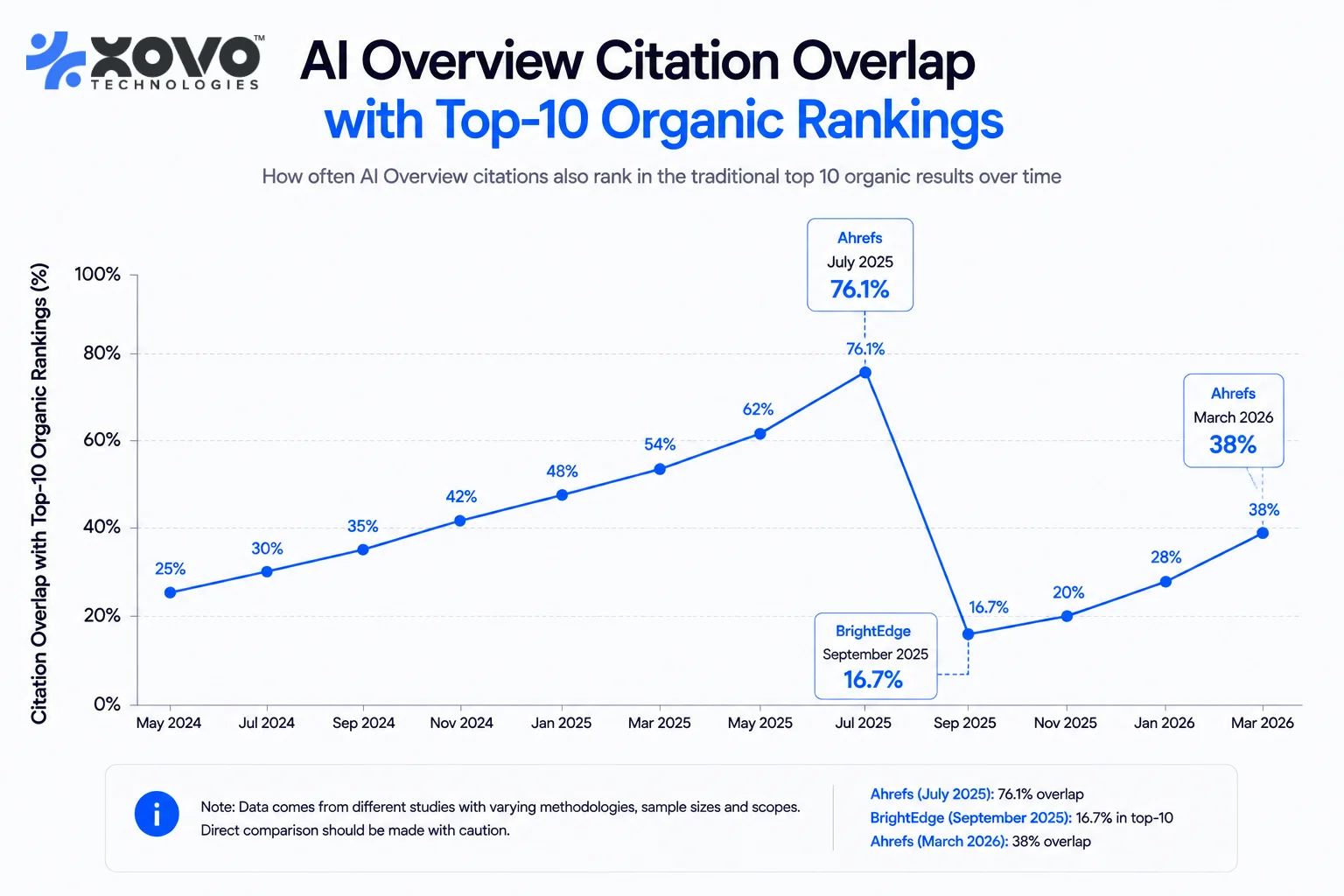
Read those four rows together and the picture is not "rankings stopped mattering". It is that the correlation between ranking and citation is unstable, differs by measurement method, and has weakened sharply over eighteen months. Ahrefs and BrightEdge disagree by more than 20 points on the same question in the same year because they count different things (all SERP features versus organic listings only, different keyword sets, different sampling windows). Anyone quoting one of these figures as settled fact has not read the other three.
Ranking first still helps, it just stopped being sufficient
So: does ranking first still matter once an AI Overview answers the query? Yes, on two counts. A top-10 position remains the single strongest predictor of being in the candidate pool, and for branded and navigational queries the classic result still absorbs most of the click. But the Ahrefs March 2026 figure of 31% of citations coming from pages outside the top 100 tells you the retrieval layer is reaching well past the ranked set. Treat your ranking work as the floor and the citation work as the thing you are actually being paid for. That is the honest framing of ai overviews seo, and it is what separates a real ai seo strategy from a rebadged content calendar.
Platform behaviour differs enough that a single ai seo strategy will not cover all of them. Semrush's index, built on 126 million US prompts between January and April 2026, found ChatGPT averaging around 15 sources per response and leaning on community and reference platforms, while Gemini averaged about 3 sources from a much narrower pool. A page that gets picked up by ChatGPT can be entirely invisible in Gemini for the same query, and that is a sourcing difference, not a quality difference.
Third-party sources now carry a large share of the answer
Do third-party listicles matter more than your own site? For commercial and comparison queries, often yes, and pretending otherwise wastes budget. Semrush's index makes the point plainly: a company's AI narrative is no longer shaped only by owned websites and brand-controlled content, but by reviews, community discussion, independent publishers and retailers.
In our own client work the pattern is consistent. For a query like "best X for Y", the engine assembles most of its answer from roundups, review sites and forum threads, and cites the vendor's own page only for a specification or a price. So we split the budget. Roughly two-thirds of off-site effort goes to getting accurately represented in the roundups that already get cited for the target prompts, and the rest goes to review platforms and to the communities where the category actually gets discussed. This is unglamorous digital PR, and it is the highest-leverage thing most generative engine optimization companies could be doing for their clients instead of publishing another 2,000-word guide.
The counter-case: if you sell something with a narrow buyer set and no review ecosystem, there are no listicles to be in, and this entire line of work returns nothing. We have told clients to skip it.
The page formats most often lifted into AI answers
Which page formats get lifted into AI answers most often? The question behind how to rank in ai overviews is really a question about shape, not length. These are the formats that survive retrieval in our tracking and in the platform documentation, ordered by how reliably they get quoted.
| Page format | Why it gets lifted | Where it fails |
|---|---|---|
| Direct-answer opener under a question-shaped H2 | Self-contained, needs no surrounding context, matches the prompt phrasing | Answer buried after two paragraphs of preamble |
| Comparison table with named entities and units | Machine-readable, resolves several sub-questions at once | Images of tables, or tables with merged cells and unlabelled columns |
| Numbered process or spec list with concrete values | Clean extraction boundaries, each item stands alone | Vague steps ("optimise your content") with no values |
| Definition paragraph with the term, category and distinguishing property | Answers "what is X" without the model having to synthesise | Definitions that start with "In the world of..." |
| Original data or a stated first-party measurement | Nothing else on the web says it, so it survives deduplication | Restating someone else's statistic without adding anything |
| Q&A block written as real questions people ask | Maps directly onto prompt phrasing | FAQ blocks stuffed with keyword variants nobody says out loud |
Two things are absent from that list on purpose. Long narrative introductions, which never get quoted. And the JavaScript-rendered content pattern: if a passage only exists after client-side hydration, several retrieval crawlers will not see it. We have watched pages lose citations for no reason other than a framework migration that moved copy into a client component, which is the same class of problem covered in our B2B website development playbook.
What to change on a page that already ranks but never gets cited
This is the most common brief we get, and the fix is usually structural rather than editorial. It is also the cheapest work in the whole discipline, which is why we run it before anything else: the page already has authority, it just does not have a liftable passage.
Start by finding where the answer lives. If a reader has to get past 180 words of setup before the page says the thing, no retrieval system will lift it. Move a 40 to 80 word answer directly under the heading, in plain prose, with no internal links inside it. Links in the answer paragraph make it messier to extract and give the model a reason to prefer a cleaner source.
Then make the headings match the question. Not "Our Approach to Pricing" but "How much does X cost in 2026". This is the single change with the highest hit rate in our work, and it costs an afternoon.
Third, add something only you can say. A price band, a measured timeline, a failure rate from your own delivery data. Deduplication is real: if your page says what forty other pages say, the engine has no reason to pick yours.
Fourth, date it and keep it dated. Perplexity in particular skews toward recent content, and a visible last-updated date with a genuinely changed body is worth more than a rewritten intro.
On schema, I will be straight with you because a lot of ai seo services oversell this. The evidence that structured data drives AI citation is contested. A Search Atlas analysis across OpenAI, Gemini and Perplexity found no correlation between schema coverage and citation rate, while vendor-side research claims large lifts, and as of the reviews published in May 2026 there is no peer-reviewed study settling it. Our position: implement Article, Organization and FAQPage because they are cheap, they are correct, and they earn classic rich results. Do not build a business case on them for AI citation. If someone tells you schema is how to rank in ai overviews, ask them for the study.
Run those five changes in order on your twenty highest-value URLs before you commission anything new. Most teams asking how to optimize content for ai search engines are imagining a new content programme, and the return is usually higher on pages that already exist and already have links.
The crawler decision: allow, block, or price it
Should you block AI crawlers or let them through? You cannot answer that until you separate the bots by job, because blocking the wrong one costs you visibility you wanted and blocking the right one costs you nothing you were being paid for.
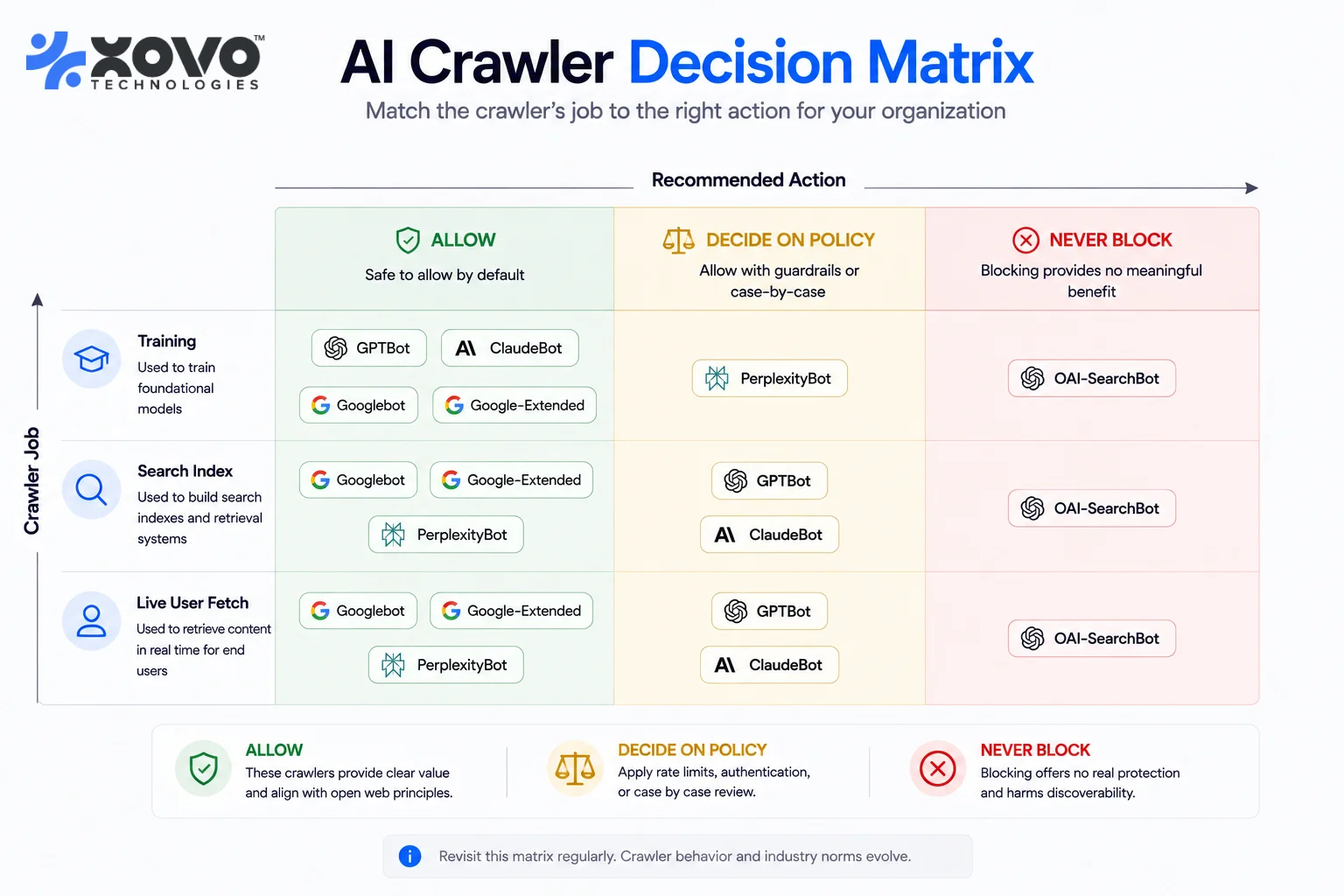
| Bot / token | User agent or robots.txt token | What it feeds | Blocking it costs you |
|---|---|---|---|
| GPTBot | GPTBot/1.4 | OpenAI foundation model training | Nothing in ChatGPT search visibility; gptbot is a training crawler only |
| OAI-SearchBot | OAI-SearchBot/1.4 | ChatGPT's search index | Your eligibility to appear in ChatGPT search results |
| ChatGPT-User | ChatGPT-User/1.0 | Live fetch when a user asks ChatGPT about a page | The ability for a user to pull your page into a conversation |
| PerplexityBot | PerplexityBot/1.0 | Perplexity's search index | Perplexity citations; the PerplexityBot user agent robots.txt entry is the one that governs this |
| Perplexity-User | Perplexity-User/1.0 | User-initiated fetch; Perplexity's docs say it generally ignores robots.txt | Little, since it is not fully robots-governed |
| ClaudeBot | ClaudeBot | Anthropic model training | Nothing in Claude's search answers |
| Claude-SearchBot | Claude-SearchBot | Anthropic's search index | Claude search citations |
| Claude-User | Claude-User | User-initiated fetch, honours robots.txt opt-outs | Users pulling your page into a Claude session |
| Googlebot | Googlebot | Google Search index, and therefore AI Overviews and AI Mode | Everything. Google Search, AI Overviews, AI Mode, all of it |
| Google-Extended | Google-Extended (token, no user agent) | Gemini model training and grounding | Gemini training use only. Search and AI Overviews are unaffected |
| Bingbot | bingbot | Bing index, which feeds Microsoft Copilot | Bing organic and Copilot citations together |
| Applebot-Extended | Applebot-Extended (token) | Apple generative model training | Apple AI training use only; Applebot search is separate |
The general rule we apply: allow every search and retrieval bot, decide training bots on principle and licensing posture, and never block a bot whose only job is a live user-initiated fetch.
Two rows deserve a closer look. The PerplexityBot user agent robots.txt entry is what decides whether Perplexity can cite you at all, because PerplexityBot builds the search index while Perplexity-User handles live fetches and, per Perplexity's own documentation, generally ignores robots.txt. Every time a client has told us their Perplexity citations disappeared, the cause was a blanket disallow rather than a targeted one, and the fix was a corrected PerplexityBot user agent robots.txt line rather than anything editorial. The other row is gptbot, which people block for licensing reasons and then quietly panic about. Blocking gptbot has no effect on ChatGPT search visibility whatsoever.
Are you accidentally blocking Googlebot by blocking training bots?
No, provided you use the correct tokens, and this is worth stating precisely because the wrong answer is expensive.
Google's crawler documentation is explicit: Google-Extended is a standalone product token with no HTTP user agent of its own. It controls whether content Google has already crawled may be used to train Gemini models and to ground responses in Gemini Apps and Vertex AI. Google's own wording is that Google-Extended "does not impact a site's inclusion in Google Search nor is it used as a ranking signal in Google Search."
The consequence trips people up in both directions. Blocking Google-Extended does not remove you from AI Overviews, because AI Overviews are built from the Googlebot index, not from Google-Extended. And there is no separate token that removes you from AI Overviews while keeping you in Google Search. Google's AI features guidance says the controls are ordinary Googlebot robots.txt directives plus nosnippet, data-nosnippet, max-snippet and noindex. If you want out of AI Overviews, you are trading away snippet display in classic search too. We have never recommended that trade to a client.
Where teams genuinely do break Googlebot is with blanket CDN bot rules or a User-agent: * disallow written to stop scrapers. Check the live file, not the one in your repo.
Cloudflare's 15 September 2026 defaults
This one has a deadline, so deal with it before mid-September.
Cloudflare has split AI traffic into three categories in its own words: Search is behaviour that collects or indexes content to answer questions about it later, Agent is automated behaviour acting in real time on a person's behalf, and Training is a crawler taking content to train or fine-tune models. On 15 September 2026, new defaults take effect for new domains onboarding to Cloudflare: Training and Agent bots blocked by default on pages that display ads, with Search still allowed. The options are available on all plans including free.
The detail that will catch people out is the multi-purpose crawler rule. Cloudflare evaluates crawlers against all of their behaviours, so a bot that does both Search and Training gets caught by a Training block. Googlebot, Bingbot and Applebot are all named in that category. If you run ads and you switch Training off without thinking it through, you can take out crawlers you very much wanted.
Cloudflare has also extended the robots.txt Content Signals standard with a use preference: use=immediate (interact, store nothing), use=reference (index, excerpt and link back, which is the default), and use=full (summarise and reproduce). Managed robots.txt customers now get use=reference added automatically.
Running alongside this, the IETF's AI Preferences working group is building the standard version. Draft draft-ietf-aipref-vocab-06, dated 28 April 2026 and on the Standards Track, defines usage categories including train-ai and search. It is not consensus yet and the draft says so on its face, but it is the thing to build toward rather than any vendor-specific syntax. This is the most useful piece of generative engine optimization news for anyone with an infrastructure team: the expression layer is being standardised, and hand-rolled robots.txt hacks will age badly.
Does an llms.txt file do anything yet?
No, and the data on this is now unambiguous enough that I would treat any vendor still selling llms.txt as a signal about the vendor.
Ahrefs checked 137,210 domains with traffic in May 2026. About 28% published a valid llms.txt. Of those files, 97% received zero requests that month. Nothing fetched them at all. Among the roughly 3% that did get traffic, AI retrieval bots accounted for just 1.1% of AI bot requests, and no AI bot ever requested an llms.txt file at a domain that did not have one, which tells you the crawlers are not looking.
Google's position matches. Its AI features documentation states that "You don't need to create new machine readable files, AI text files, or markup to appear in these features."
Write one if it costs you nothing. Do not let it displace work that does something.
Do AI crawlers like GPTBot support content negotiation for markdown?
Not in any documented way. We get asked "do ai crawlers like gptbot support content negotiation for markdown" roughly once a month now, usually by an engineering lead who has read that serving Markdown to bots improves extraction. OpenAI's published bot documentation describes GPTBot, OAI-SearchBot, ChatGPT-User and OAI-AdsBot by purpose and user agent string, and says nothing about Accept: text/markdown or any content negotiation behaviour. Neither do Perplexity's or Anthropic's crawler docs. So the honest answer to "do ai crawlers like gptbot support content negotiation for markdown" is that there is no vendor commitment to it, and building a parallel Markdown representation of your site on that assumption is speculative work.
Serve clean, server-rendered HTML with real headings and real tables. That is the format every crawler is documented to handle, and it is the same answer we gave in our custom website development guide.
Which generative engine optimization news is worth acting on
Most of it is not. The feed moves weekly and almost none of it changes a plan. The filter we use has two tests: does it change what a crawler can reach, or does it change what a measurement tool can see? Cloudflare's September defaults pass the first test. The IETF vocabulary will pass it eventually. A new AI Mode language rollout or a model version bump does not, however loudly it gets announced.
Apply that filter and the volume of generative engine optimization news you actually need to read drops to roughly one item a month.
How to monitor SEO performance in AI search when there are no rankings
How is any of this measured when there are no rankings to track? This is where good and bad generative engine optimization services separate, and where most of the tooling budget goes. The uncomfortable part is that to monitor SEO performance in AI search you need an instrument your team has never used, running against inputs your team has never had to write.
Rank tracking for AI Overviews is one question with six names
A large share of the enquiries we get arrive as tool searches: ai overview rank tracking, ai overviews rank tracking tool, best ai overviews rank tracker, rank tracker for ai overviews, rank tracking tool ai overviews, ai overviews seo rank tracking. Six phrasings, one question, and the answer is awkward. There is no rank to track.
An AI Overview does not assign positions to its citations the way a SERP does, and every link inside the panel shares a single position. So what an ai overviews rank tracking tool actually measures is prompt-level presence: it runs a fixed set of prompts on a schedule, records whether your domain is cited and in what context, and trends the result. That is share of voice. Calling it ai overview rank tracking is a naming convention inherited from the old world rather than a description of the mechanism.
Which does not make it useless, because prompt-level presence is the only leading indicator available. When you evaluate the rank tracking tool ai overviews vendors are selling you, ask which engines it queries, how many prompts you get, how often it re-runs them, and whether it records competing citations rather than only yours. Prompt volume and refresh rate drive price far more than any feature list, which is why a rank tracker for ai overviews at $29 a month and one at several thousand can look identical in a demo.
Our practical answer to the best ai overviews rank tracker question: buy the cheapest product that covers every engine your buyers actually use, then spend the difference on prompt volume. Coverage beats interface. We have never regretted more prompts, and we have regularly regretted a prettier dashboard. If you want ai overviews seo rank tracking that survives a board question, the report has to place competitor citations next to yours, and a surprising number of products still do not.
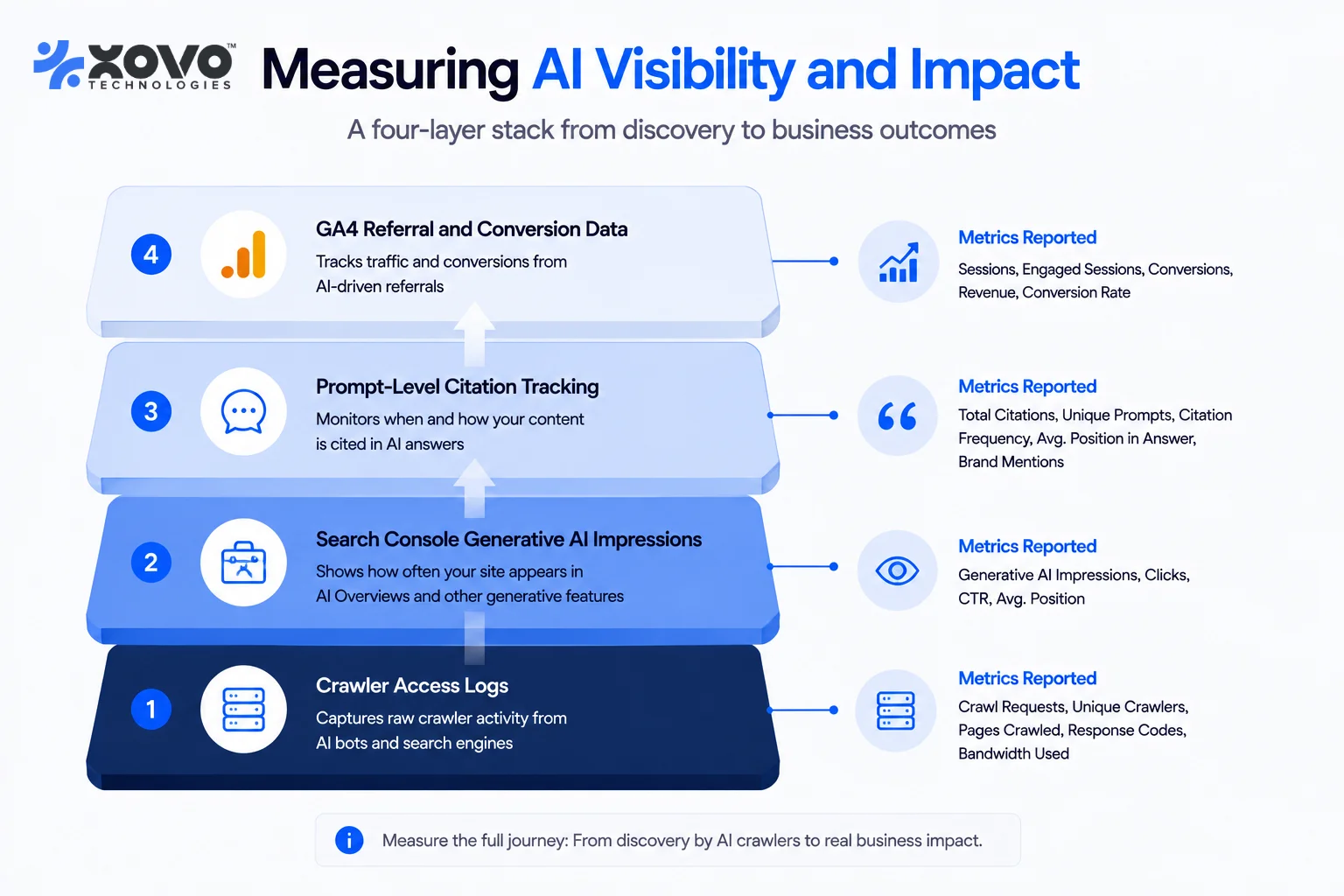
| Layer | What it answers | Tools | Notes |
|---|---|---|---|
| Prompt-level citation tracking | Are we cited, for which prompts, next to whom | Profound, Peec AI, Otterly, Semrush AI Toolkit, Ahrefs Brand Radar, SE Ranking AI visibility, Conductor | Sold as a rank tracking tool ai overviews buyers can plug in, or as a rank tracker for ai overviews; entry products start near $29 to $95/mo and enterprise platforms run into the thousands. Insist on ai overviews seo rank tracking that shows competitor citations |
| Google's own impression data | How often our URLs appeared in AI Overviews and AI Mode | Google Search Console generative AI reports | Impressions only at launch, no clicks, no CTR, no query data |
| Referral analytics | Did AI-sourced visitors arrive and convert | GA4, server logs | Segment by source hostname; treat volume as small and high-intent |
| Crawler access logs | Are the retrieval bots reaching us at all | Server logs, CDN analytics | The first place to look when citations disappear |
What are AI search optimization tools, really?
So: what are ai search optimization tools? They are prompt monitors, not rank trackers, and the distinction is not pedantry. A rank tracker tells you where you sit in a fixed, ordered list. A prompt monitor tells you whether a generated answer happened to include you this time, for this phrasing, on this engine. Ask a vendor "what are ai search optimization tools actually measuring underneath?" and you will find out quickly whether they built the product or resold someone else's index.
The strategic value is narrow and real. A monitoring platform tells you which prompts you lose, which competitor gets cited instead, and which third-party page is supplying the answer on your behalf. That last one is a content brief you could not have written from keyword data alone, and it is why we run this alongside classic reporting rather than in place of it.
What Search Console gives you and what it withholds
Google announced generative AI performance reports in Search Console on 3 June 2026, covering AI Overviews, AI Mode and generative AI features in Discover, with an initial rollout to UK site owners ahead of wider availability.
Understand the limits before you build reporting on it. At launch the reports are impressions only, broken down by page, country, device and time. No clicks. No CTR. No query data. All links inside an AI Overview share a single position. And those impressions were already inside your overall performance totals, so this is a visibility split, not new traffic.
We still pull it, because per-URL impression trend is the cheapest signal that a page has entered or fallen out of the candidate pool. We just do not present it as performance.
Reading AI referrals in GA4
Treat AI referrals as their own channel. In GA4, build a segment on session source containing chatgpt.com, perplexity.ai, copilot.microsoft.com, gemini.google.com and claude.ai, and watch conversion rate rather than volume, because the volume will be small and the intent will not be.
Similarweb's July 2026 analysis is a useful check on your expectations: monthly visits across generative AI platforms grew about 70% year over year to 9.5 billion between June 2025 and May 2026, while ChatGPT's share of that traffic fell from roughly 76% to about 53% as Gemini climbed from under 9% to the high twenties. If your dashboard only tracks ChatGPT referrals, you are now missing close to half the market. That shift alone is a reason to revisit your tracking every quarter, and it is the kind of ai seo news that changes a measurement plan rather than a headline.
How to find out whether ChatGPT and Perplexity already cite you
Before buying anything, spend two hours. Write out the 25 to 40 prompts a real buyer would type, run them manually in ChatGPT, Perplexity, Gemini, Copilot and Google AI Mode, and record who gets cited and which URL supplies the answer. Then check your server logs for OAI-SearchBot, PerplexityBot, Claude-SearchBot and Googlebot hits on those pages.
That manual pass gives you a baseline and, more importantly, it tells you whether your problem is access, structure or presence. Buying an ai overviews rank tracking tool before you know which of the three you have is how budgets get wasted.
How long before GEO work shows up in traffic
Set expectations at 90 days for signal and two quarters for anything you would put in a board deck.
Here is the sequencing we see. Crawler and access fixes register within days, because the bots come back and the logs show it. Page restructuring on URLs that already rank tends to produce citation movement in four to eight weeks, and that is the fastest lever available. Off-site work, which is where the commercial queries are won, runs on the publication schedules of other people and realistically takes three to six months. Referral traffic lags all of it, and given Pew's 1% source-click figure it will always be the smallest number on the page.
The trap is measuring the wrong thing early. Citation share moves before traffic does, so if you only report sessions you will conclude the programme failed while it is working. Baseline first, monitor SEO performance in AI search monthly on citation share, and report revenue quarterly.
What to look for when buying generative engine optimization services
The market filled up fast and the quality spread is wide. Whether you are comparing an ai seo agency, an ai seo company, a specialist generative engine optimization agency, or a white label ai seo supplier sitting quietly behind the provider you already pay, four questions sort them inside one call, and they work as well on an ai seo agency deck as on an in-house plan.
Ask what they measure and how. If the proposal has no baseline prompt set and no named tracking platform, they will report on rankings and hope you do not notice. Ask how they handle crawler policy, because a generative engine optimization agency that has not read the Cloudflare category definitions or the Google-Extended documentation will get the infrastructure decision wrong and you will pay for that in September. Ask what share of the budget goes off-site, and be suspicious of any answer under a quarter for commercial categories. Then ask what they will not do, because the ones worth hiring have firm opinions about it.
One note on the white label ai seo layer, since it is now a large part of the market. Plenty of ai seo services sold under one brand are fulfilled by two or three suppliers underneath, which is fine when the reporting is honest and a problem when nobody in the chain owns the crawler decision. Ask who touches robots.txt. A vague answer is the answer.
Tools, agents and generators
The useful ai seo tools comparison is not a feature grid. Compare on engine coverage, prompt volume and refresh rate, then check whether the platform surfaces competing citations. Better still, run the ai seo tools comparison yourself against your own prompt set during the trial, because vendor benchmarks are chosen to flatter the vendor. The best ai seo tools 2026 has produced are unremarkable in interface and specific in data, and most teams need one ai seo tool plus Search Console plus their server logs. Anyone selling you five is selling you dashboards, and any best ai seo tools 2026 roundup that does not disclose its affiliate arrangements should be read as advertising.
The ai seo agent category splits cleanly. An ai seo agent that runs your prompt set on a schedule, diffs the results and files the changes is useful, and we run one. An ai seo agent pointed at content production is a different proposition, and so is an ai seo content generator. Both optimise for volume while retrieval rewards distinctiveness. We have yet to see an ai seo content generator produce a passage that got cited ahead of a human-written one on the same page, and the mechanism explains why: generators converge on the consensus phrasing, which is precisely the text an answer engine already holds forty copies of.
A last word on the ai seo tools comparison question, because it keeps getting conflated with strategy. No product answers how to rank in ai overviews. It tells you whether you currently do. The best ai seo tools 2026 has on offer are diagnostic instruments, nothing more, and if a white label ai seo supplier is presenting a tool dashboard as the deliverable, you are paying agency rates for a subscription that costs $95.
Where an ai seo company earns its fee
Not in publishing. An ai seo company earns it in three places: getting the crawler and CDN decision right the first time, restructuring pages that already rank so they become quotable, and getting the client accurately represented in the third-party pages that already win their commercial prompts. Everything else is content marketing with a new label on it, and a lot of ai seo services are exactly that.
Our own view, having run this alongside classic search work: generative engine optimization companies that treat GEO as a separate discipline produce worse results than teams running one programme with two measurement surfaces. The retrieval index is the search index. A serious ai seo strategy is a search strategy with a citation layer on top, not a parallel department, and generative engine optimization companies charging you twice for the same crawl are relying on you not noticing.
If you want the ranking foundation and the citation work handled together, that is how our SEO and GEO programme is built, and it pairs with content strategy and branding for the off-site half, where most commercial-query citations are actually won. For teams who would rather automate the monitoring loop than staff it, our AI growth strategist product runs the prompt set on a schedule and reports the deltas.
If you want a read on where you currently stand across the five major answer engines, book a free AI visibility audit and we will run your prompt set and send back the citation map, including the pages currently supplying answers on your behalf.